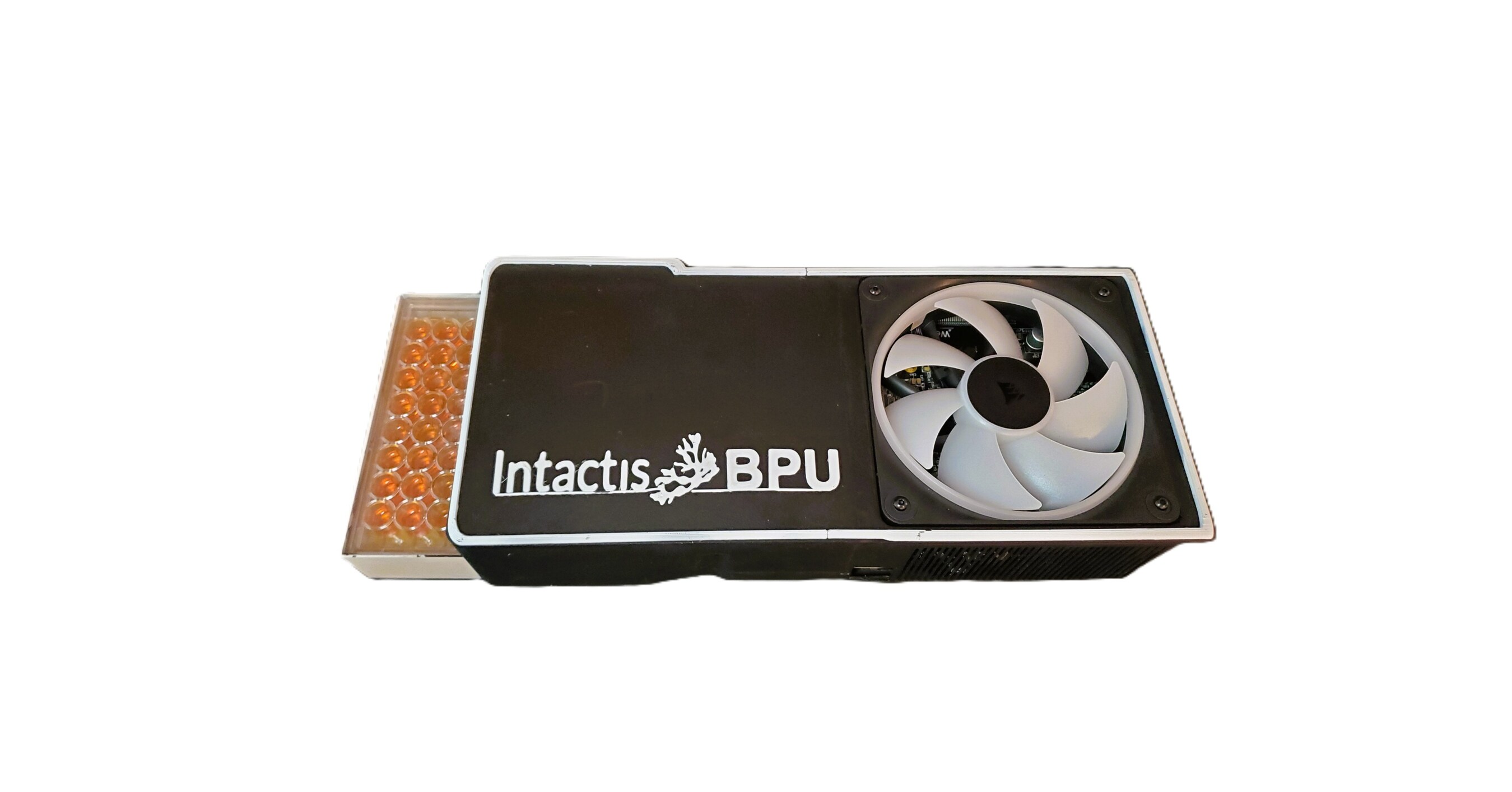
Intactis Bio launched Biostack Alpha, a public biocomputation demo running on its rack-mountable Biohybrid Processing Unit (BPU), aimed at cutting AI energy use. The company claims ~95% energy-cost reductions, ~90% total-cost reductions, and ~88% data-center footprint reductions versus exaflop-scale silicon, supported by mapping 150+ stimulus-response relationships. Intactis has raised $1M+ in early and non-dilutive support and is seeking a $5M seed round for data center partner deployments.
This reads more like a signal about AI power scarcity than a near-term substitute for GPUs. The investable takeaway is that even fringe compute modalities are now being marketed around watts-per-inference, which reinforces the market’s willingness to pay up for any infrastructure that lowers power density or improves cooling efficiency. That is modestly supportive for names like VRT, ETN, CEG, EQIX, and DLR over a 6-18 month horizon if AI load growth keeps stressing grids and data-center capacity.
The immediate loser is the “AI electricity demand only goes one way” narrative, but the commercial threat to NVDA/AMD is remote: this is pre-scale, pre-unit economics, and pre-distribution. For the next 1-3 months, the stock-market impact should be mostly sentiment-driven unless a named hyperscaler or lab pilot appears. The real diligence items are repeatability, neuron lifespan, failure rates, and whether the cost of the wet lab envelope overwhelms the claimed watt savings.
Contrarian view: consensus may be over-penalizing the idea as sci-fi while missing the second-order benefit to the broader AI hardware stack. If biologic compute ever becomes credible, it likely expands total addressable compute by making some previously uneconomic workloads viable, rather than simply replacing silicon. The thesis is falsified if no third-party benchmark or commercial pilot lands within 6-12 months, or if the seed round prices it as a platform business without clear manufacturing economics.
AI-powered research, real-time alerts, and portfolio analytics for institutional investors.
Overall Sentiment
mildly positive
Sentiment Score
0.35
