
Inflation, Competing Priorities, and Uncertainty Erode Retirement Security
Source: PR Newswire
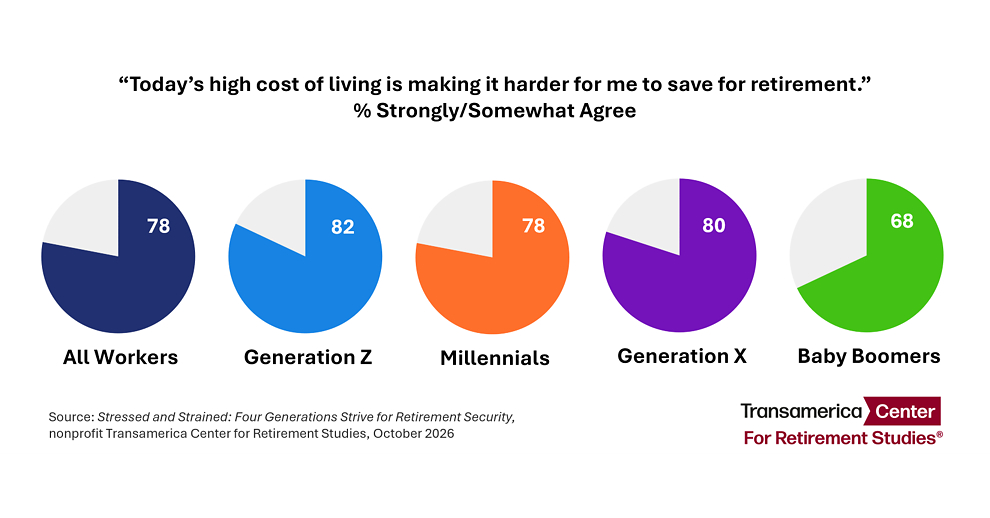
A survey of 6,153 U.S. workers found 78% say the high cost of living makes it harder to save for retirement, while 65% worry they could work until retirement and still fall short of their needs. Seventy-three percent are concerned Social Security will not be available when they retire, and estimated median household retirement-account savings range from $37,000 for Gen Z workers to $263,000 for Baby Boomers. The findings highlight financial strain across generations; the survey was conducted September 16–October 17, 2025.
Analysis
The signal is more useful as a demand and labor-market watch item than as a standalone market catalyst. The survey is self-reported and was fielded in 2025; it does not establish that retirement contributions or household spending are now falling. Near term, therefore, expect little direct earnings impact. Over 1–3 months, a deterioration in real discretionary spending or rising household delinquencies would make the retirement-security stress more consequential for consumer-facing companies. Over 6–18 months, pressure to work longer could support labor supply, but health constraints and caregiving create downside risk to that offset. Retirement-plan providers may see durable demand for workplace access and financial guidance, while withdrawals and limited contribution capacity could constrain asset gathering; this is not enough to infer company-level revenue changes. The contrarian point: broad retirement pessimism is not automatically bearish for financial markets or bullish for annuities—actual flows, employer-plan participation, and product adoption matter more than stated concern. Treat the report as a low-conviction indicator, especially given its lagged survey period.
AllMind Terminal
AI-powered research, real-time alerts, and portfolio analytics for institutional investors.
Request TrialMarket Sentiment
Overall Sentiment
moderately negative
Sentiment Score
-0.35
Key Decisions for Investors
- No trade on the report alone. Do not convert survey sentiment into a forecast of current consumer spending or retirement-account flows without corroborating data.
- Watch real retail sales, revolving-credit delinquencies, and household contribution/withdrawal data over the next 1–3 months. If these deteriorate together, consider a small XLY-underweight versus XLP; invalidate the relative-value thesis if discretionary sales and credit quality stabilize.
- For retirement-services exposure, monitor employer-plan participation, net flows, and hardship withdrawals before favoring providers or annuity businesses. Rising participation with positive net flows would support the thesis; rising withdrawals or flat participation would falsify it.
- Policy headlines on Social Security and Medicare are a 6–18 month volatility catalyst, not a near-term earnings signal from this survey. Reassess only if proposals become actionable or materially change employer or household behavior.
More News
- What investors need to know about Alphabet's stock-busting earnings report
- Our next steps for Alphabet stock after earnings disappoint at nearly every turn
- Budget 2026 speech
- Wendy's shares jump 15% as Nelson Peltz's Trian offers $1.4 billion to buy burger chain
- Federal Reserve issues FOMC statement
- GE Vernova shares slip despite a beat-and-raise. What the sellers are getting wrong