
End of an Era: The Oracle of Omaha Steps Down
Source: zacks.com
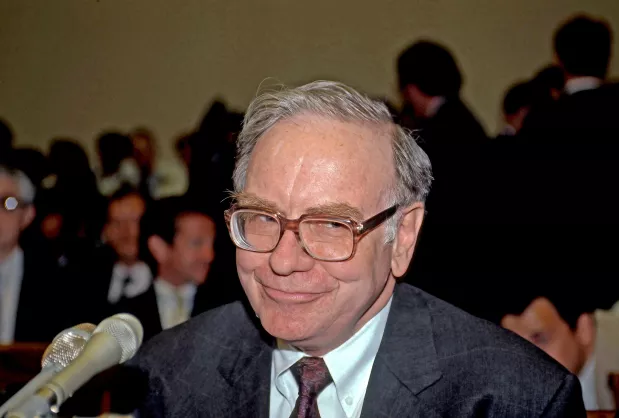
Warren Buffett, 96, has stepped down as Berkshire Hathaway chairman emeritus, with director Howard Buffett taking the role while CEO Greg Abel retains operational control. Berkshire's Class B shares hold a Zacks Rank #3 and a D Value-Growth-Momentum grade. Separately, U.S. industrial production was flat versus expectations for a 0.3% increase, while capacity utilization held at 76.3%, 10bps below forecasts; Brent crude retreated as Saudi pipeline-repair expectations and potential U.S.-Iran diplomacy eased supply-risk concerns.
Analysis
The governance assertion is not independently investable without Berkshire filings, board documentation, and a confirmed capital-allocation framework. BRK.B's valuation premium is partly a governance/liquidity premium: uncertainty around insurance float deployment, repurchase discipline, and the timing of Berkshire's eventual equity-portfolio monetization could widen its discount to the S&P 500 over the next 1-3 months. The key transmission is not operating disruption—Abel's decentralized model limits that—but whether the market applies a lower conglomerate multiple absent confidence in capital allocation.
The more actionable second-order issue is that a lower crude-price regime would be a modest net positive for GEICO underwriting severity and Burlington fuel costs, while reducing earnings power at Berkshire's energy and rail-adjacent exposures; the offsetting effects make a broad BRK.B call on oil direction low-conviction. GNRC is more directly exposed to commodity-price normalization through weaker backup-power urgency, whereas OKLO's valuation is dominated by financing, licensing, and power-contract milestones rather than near-term fuel prices. Industrial-production softness raises the probability that cyclical holdings such as ADM face weaker volume/mix before any benefit from lower energy inputs reaches margins.
Consensus may overstate a symbolic leadership event while understating that Berkshire's succession discount has been discussed for years. A material rerating requires evidence of changed capital allocation—especially repurchase pace, acquisition size, insurance combined ratio, and cash deployment—not commentary. Falsification of a cautious BRK view would be a board-confirmed succession plan paired with a large accretive acquisition or accelerated buybacks; conversely, a sustained rise in the cash balance without deployment would support multiple compression over 6-18 months.
AllMind Terminal
AI-powered research, real-time alerts, and portfolio analytics for institutional investors.
Request TrialMarket Sentiment
Overall Sentiment
mixed
Sentiment Score
-0.05
Ticker Sentiment
Key Decisions for Investors
- Do not initiate a directional BRK.B position on this report alone; require SEC/board confirmation and management commentary. If confirmation is followed by a 5%+ relative underperformance versus SPY without a change in operating guidance, consider a 3-6 month long BRK.B / short SPY mean-reversion pair, with exit if the relative drawdown reaches 10% or Berkshire reduces repurchases while cash rises.
- Maintain a 1-3 month underweight in GNRC versus XLU if crude remains below its recent spike range and no weather-driven outage catalyst develops. The trade is invalidated by a major U.S. grid-outage event, hurricane activity, or order/backlog guidance that demonstrates resilient residential-generator demand.
- Avoid treating OKLO as an energy-price hedge. Establish an event watch—not a position—around NRC licensing milestones, binding power-purchase agreements, and financing terms; absent those, its equity remains primarily duration/financing beta and vulnerable if real yields rise.
- For ADM, monitor the next earnings release for processing-margin and volume guidance before adding exposure. A long ADM thesis needs independently verified margin expansion from lower energy inputs; weaker crush volumes or a downward earnings revision would favor staying neutral despite lower fuel costs.
More News
- Warren Buffett stepping down as chairman of Berkshire Hathaway: 'Father Time always wins'
- Buffett Steps Down at Berkshire
- Warren Buffett steps down as Berkshire Hathaway chairman
- Meet Warren Buffett’s son Howard, a former sheriff, war photographer, and now, Berkshire’s new chairman
- Warren Buffett abruptly steps down as Berkshire chair as ‘Father Time’ wins, handing role to son Howard who will ‘guard its culture and values’
- Buffett Steps Down as Berkshire Chair, Ending Six-Decade Run
From AllMind Research
- Anthropic IPO Preview: Valuation, Timing, and What to Watch
- Shein After the IPO: Venue, Valuation, and What Must Be Proved
- What AI Research Tools Should a Small Hedge Fund Buy First?
- AllMind Discusses Ontario's AI Economy with Minister Stephen Crawford and Supply Ontario CEO James Wallace
- AI Research Tools for SEDAR+, UK and ASX Filings