
New Report Reveals the Keys to Winning Over Today's Borrowers: Innovation and Education
Source: PR Newswire
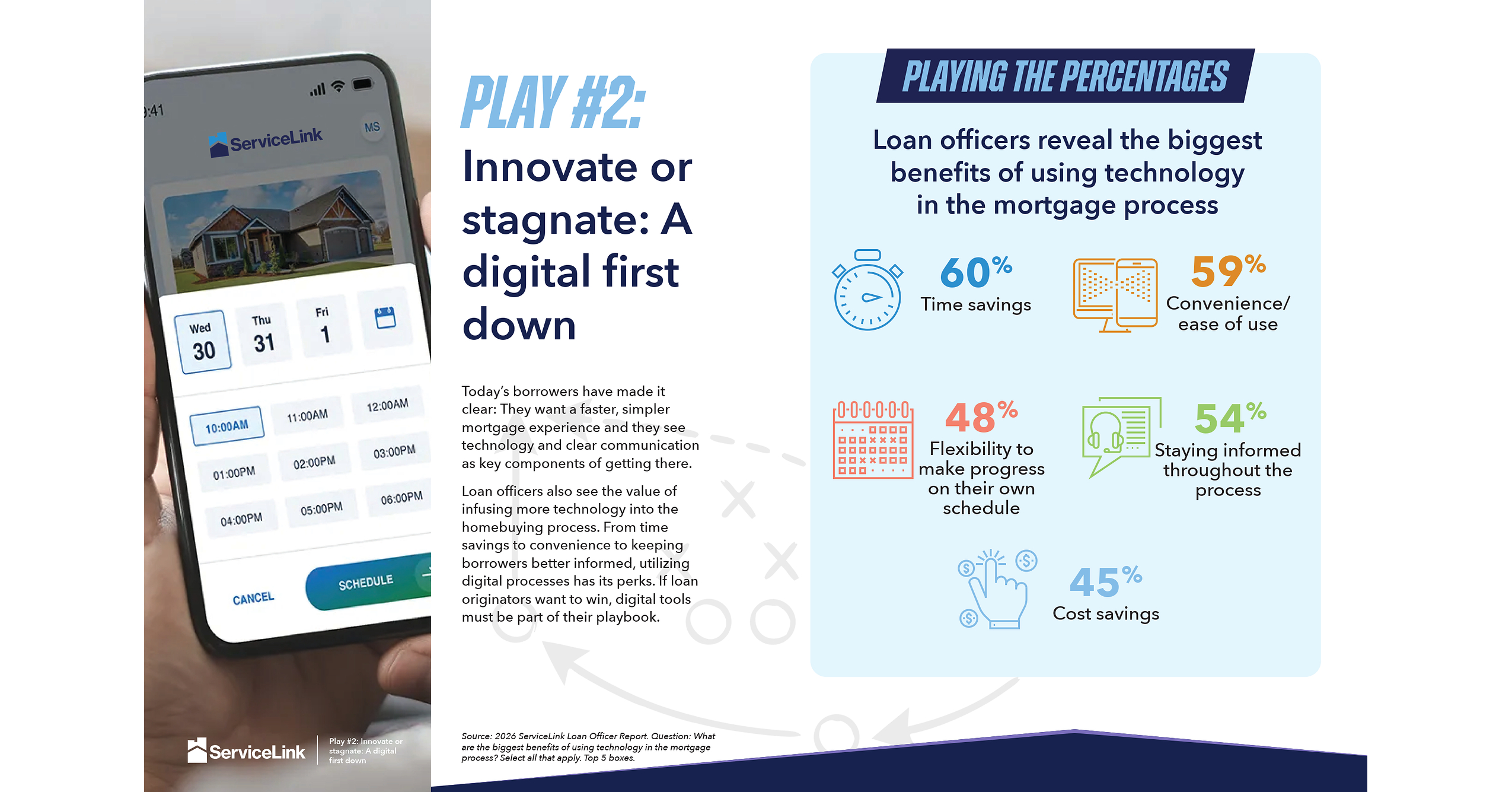
ServiceLink's survey of more than 500 experienced loan officers and 1,500 recent homebuyers found strong demand for mortgage digitization: 82% of buyers would favor a lender offering virtual closings, while 87% would switch for self-scheduled appraisal or closing appointments. Although 84% of loan officers report increased eClosing adoption over the past two years, 45% cite perceived borrower discomfort as the main barrier. Borrowers also want faster processing and greater transparency (39% each), while gaps in understanding mortgage fees highlight a need for improved lender education.
Analysis
This is a weak standalone signal because the survey is sponsor-produced and measures stated preference rather than funded-loan conversion or unit-cost savings. The investable implication is nevertheless that digital workflow is becoming a competitive retention tool in a low-volume origination market: lenders that can reduce borrower touchpoints and closing-cycle friction can defend pull-through and gain share without matching competitors point-for-point on rate. That favors scaled, direct-to-consumer platforms such as RKT and digital-enablement vendors such as ICE more than correspondent-heavy originators whose economics remain tied to manual processing.
The more important second-order effect is margin pressure on fragmented title, appraisal and closing providers. If scheduling, document collection and disclosure explanations migrate into lender-controlled digital workflows, title/settlement firms risk becoming lower-priced fulfillment vendors unless they own proprietary data, compliance infrastructure or a bundled network. FNF is comparatively insulated through scale and its broad title ecosystem, while ICE has exposure to software attach rates across the mortgage stack; however, neither benefits materially until purchase/origination volumes recover, so this is a share-of-wallet thesis rather than a near-term earnings catalyst.
Over the next 1-3 months, watch mortgage application mix, lender-funded-loan growth, and any evidence that RKT or UWMC are lowering cost per loan while maintaining gain-on-sale margins. A sustained decline in mortgage rates would accelerate the value of a faster digital funnel, but it also invites price competition that can erase the benefit. The contrarian view is that consumer demand for digital closing may be overstated: regulatory and county-level notarization/title requirements, plus borrower preference for human guidance on the largest transaction of their lives, can keep fully remote completion rates below marketing claims for years.
AllMind Terminal
AI-powered research, real-time alerts, and portfolio analytics for institutional investors.
Request TrialMarket Sentiment
Overall Sentiment
mildly positive
Sentiment Score
0.20
Key Decisions for Investors
- No immediate event trade: treat this as a watch item until a public lender reports measurable digital-closure adoption, lower cost per funded loan, or improved purchase-market pull-through; survey data alone is insufficient to underwrite earnings revisions.
- Build a 6-12 month relative-value watchlist: long ICE versus short a broad mortgage-originator basket (use MORT) if mortgage rates decline and ICE demonstrates mortgage-software revenue acceleration. Thesis is recurring workflow/software monetization versus cyclical gain-on-sale exposure; invalidate if ICE mortgage segment growth fails to improve despite higher applications.
- Prefer RKT over UWMC on a 3-6 month tactical basis only if RKT reports sequential improvement in conversion or cost per closed loan while preserving gain-on-sale margin. Target a 10-15% relative move; exit on a material margin-guidance cut or if UWMC's purchase share gains accelerate despite comparable pricing.
- Monitor FNF for evidence that digital closing is disintermediating settlement economics rather than expanding transaction throughput. A decline in title revenue per order or adverse commentary on closing-service pricing would support reducing exposure; stable revenue per order alongside volume recovery would falsify the disruption concern.
More News
- Chinese authorities reportedly in possession of F-35 components in Hong Kong
- Meta announces new lightweight virtual reality glasses to one-up Apple’s Vision Pro
- How Meta took the lead in the race for the post-smartphone world
- Here's what happens to the economy when Treasury yields soar like they are now
- Oil industry warns a diesel export ban will raise fuel prices as Trump weighs restrictions
- Mark Zuckerberg debuts $1,299 Meta VR Glasses and Muse Charm pendant amid AI agent push