
Creality lance la SPARKX i8 sur Indiegogo au prix de 289 dollars pour l'impression la plus rapide et sans déchets de purge
Source: PR Newswire
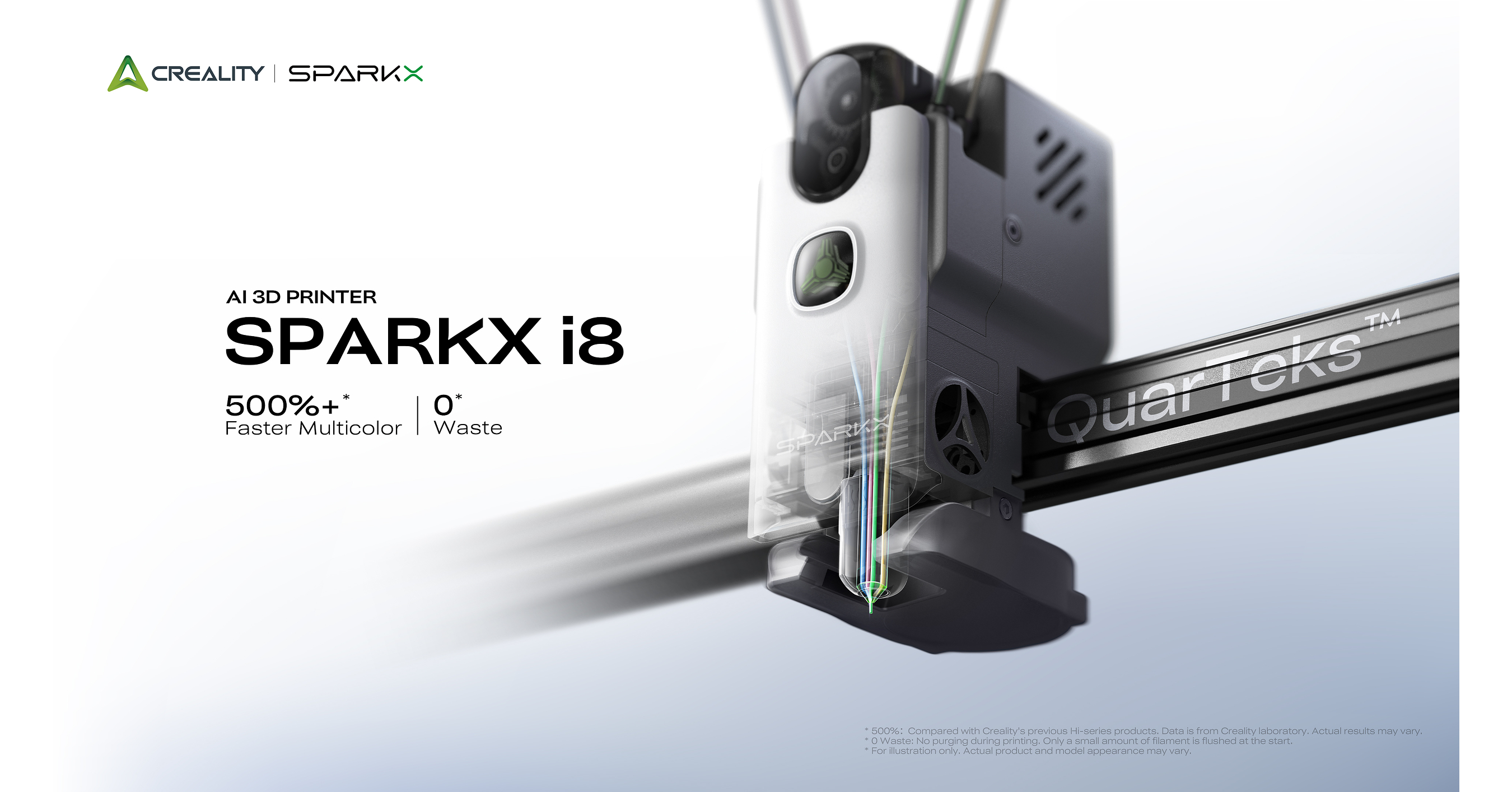
Creality launched its SPARKX i8 multicolor 3D printer on Indiegogo at a limited promotional price of $289, versus a $399 recommended retail price, with shipments planned for October and deliveries expected in November. The company says its four-channel QuarTeks system can switch colors in under one second and completed a 3,000-change laboratory test in about 18 hours, or 500% faster than externally fed systems. The printer also uses 13 printhead sensors and an AI vision camera to monitor filament and printing issues, while claiming zero external purge waste under optimized settings.
Analysis
This is primarily a private-company execution signal rather than a direct public-equity catalyst. The aggressive sub-$300 entry price positions multicolor capability as a consumer/prosumer feature rather than a premium add-on, potentially pressuring the installed-base economics of listed 3D-printing incumbents such as SSYS and DDD, whose valuation cases increasingly depend on higher-value industrial applications rather than desktop hardware. The more relevant spillover is to desktop-focused peers and resellers: lower hardware ASPs can expand unit demand but compress distributor margins and shift the profit pool toward proprietary filament, software, and post-sale services.
The claimed productivity and waste advantages need independent validation after November deliveries. If real-world users confirm reliable high-frequency color changes without material loss, multicolor print economics improve most for Etsy-style creators, education, small-batch merchandising, and figurines—not for industrial additive manufacturing, where certification, repeatability, and material qualification remain the binding constraints. A successful launch could therefore incrementally weaken the consumer-hardware narrative for industrial 3D-printing equities by reinforcing that low-end innovation is becoming commoditized.
Near term, crowdfunding velocity and delivery quality matter more than specifications. A strong order book may indicate demand elasticity at the promotional price, but it does not establish sustainable gross margin at the eventual list price; promotional shipping/tax subsidies and launch-period fulfillment create meaningful risk of negative contribution margins. The contrarian view is that the price point may be too low to disrupt anyone economically: hardware buyers are highly price-sensitive, while consumables attach rates and repeat purchase behavior—not launch units—determine whether the platform creates durable value.
AllMind Terminal
AI-powered research, real-time alerts, and portfolio analytics for institutional investors.
Request TrialMarket Sentiment
Overall Sentiment
moderately positive
Sentiment Score
0.42
Key Decisions for Investors
- No immediate directional trade in SSYS or DDD: this launch is not sufficiently connected to their near-term earnings, and both remain driven by industrial demand, restructuring execution, and capital-allocation catalysts over the next 1-3 quarters.
- Set an alert for independently verified delivery, failure-rate, and consumables-attach data in November-January. If units ship on schedule and user reviews validate material savings, reassess a tactical short basket of consumer-exposed desktop-printing distributors/private-market comparables rather than industrial additive names.
- For public 3D-printing exposure, maintain a relative preference for SSYS over DDD over 6-18 months: low-end price competition raises the value of installed-base service, materials, and regulated-workflow exposure, while pure hardware growth narratives face greater multiple-compression risk.
- Thesis falsifier: evidence that the product ships at scale with low defect rates and supports recurring proprietary-filament economics at the stated retail price would make the launch a more material platform threat; missed holiday deliveries or substantial quality complaints would instead reinforce that the promotional price is a demand-acquisition expense rather than a durable market reset.
More News
- Wall Street’s Nasdaq hits all-time high as AI frenzy gathers pace
- Data-Center Bet Makes ESDS One of India’s Best New Listings
- Asia stocks ride tech wave higher, oil stays subdued
- Trump Says US Team Met With Iranians at UNGA
- How Kevin Warsh’s rate hike exposed a 2-speed U.S. economy, with AI and housing at the poles
- Xi-Trump Summit Agenda: AI, Tariffs, Critical Minerals, Iran War, Taiwan