
Can Cracker Barrel Sustain EBITDA Growth Beyond a $15M Tariff Refund?
Source: zacks.com
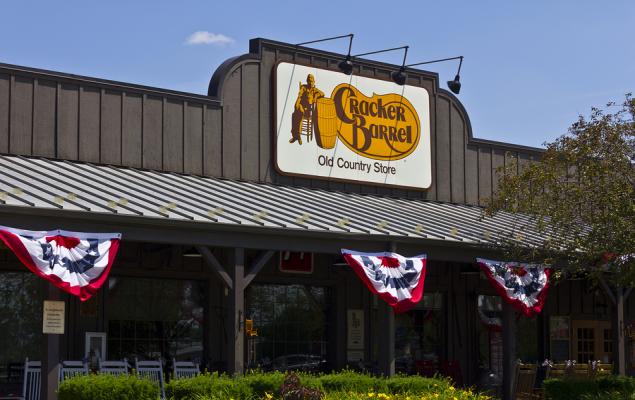
Cracker Barrel’s fiscal Q4 2026 adjusted EBITDA rose 11.4% to $62.1 million from $55.7 million, including a $9.1 million net tariff-refund benefit after $5.9 million of an approximately $15 million refund was reinvested. The company projects fiscal 2027 adjusted EBITDA of $180–$200 million, supported by menu-mix improvements, cost savings and productivity initiatives, but Q4 traffic fell 6.1% year over year and labor costs rose to 37.5% of revenue from 36.5%. Fiscal 2027 EPS is projected to increase 81.3%; shares gained 28.8% over the past year, while the industry declined 12.8%.
Analysis
The key signal is the quality, not the headline size, of the EBITDA growth. Removing the $9.1 million net tariff-refund benefit leaves fourth-quarter adjusted EBITDA of roughly $53 million—below the prior-year quarter’s $55.7 million. That makes FY2027 guidance an execution test: traffic recovery and labor productivity must replace a nonrecurring earnings contribution while the company invests in food quality.
The second-order risk is that menu upgrades improve mix but do not necessarily restore visits among lower-income guests. If traffic remains weak, fixed-cost deleverage can offset better check mix; the higher labor burden is already evidence of that mechanism. Conversely, sustained traffic improvement could produce operating leverage without relying on broad price increases, but the article provides no evidence yet that this is occurring at scale.
Near term, the market may reward the guidance and recent estimate revisions; over the next 1–3 months, sequential traffic, labor expense as a share of sales, and mix/food-cost outcomes matter more than the tariff-adjusted Q4 comparison. Over 6–18 months, durable dinner demand and repeat visits—not one-time refunds—determine whether the low sales multiple is a value opportunity or a persistent-discount signal. The cited outperformance of CAKE and BJRI is not sufficient evidence for a relative-value trade: their business mix and operating trajectories differ. Falsification of a recovery thesis would be continued traffic declines, labor costs staying elevated despite sales improvement, or a cut to the $180–$200 million EBITDA outlook.
AllMind Terminal
AI-powered research, real-time alerts, and portfolio analytics for institutional investors.
Request TrialMarket Sentiment
Overall Sentiment
mildly positive
Sentiment Score
0.20
Ticker Sentiment
Key Decisions for Investors
- Do not chase the reported Q4 EBITDA growth as proof of an earnings inflection. Treat CBRL as a conditional long, not a confirmed turnaround.
- For a 1–3 month entry, wait for sequential traffic improvement alongside stabilization or decline in labor expense as a percentage of revenue. If both confirm, build a modest CBRL long; if traffic remains negative and labor stays elevated, avoid or reduce exposure.
- Track FY2027 guidance against realized operating drivers: dinner traffic, menu mix, food costs, and support-function savings. A guidance cut or failure to convert traffic improvement into labor leverage invalidates the long thesis.
- Do not use the article’s relative share performance or forward P/S figures alone to short CBRL against CAKE or BJRI; verify comparable demand, margins, and valuation assumptions before considering a pair.
More News
- Rigetti Computing vs. D-Wave Quantum: Which Quantum Computing Stock Is the Better Buy?
- World Bank warns of AI concentration risks as it lifts East Asia and Pacific growth outlook to 4.5%
- Jefferies cuts RXO stock rating on C.H. Robinson acquisition
- Goldman Sachs downgrades Nike stock rating to sell on market share concerns
- Samsung, SK Hynix shares drop as Q3 earnings loom
- SpaceX stock climbs to highest since June, returning Musk to trillionaire status
From AllMind Research
- Anthropic IPO Preview: Valuation, Timing, and What to Watch
- Shein After the IPO: Venue, Valuation, and What Must Be Proved
- What AI Research Tools Should a Small Hedge Fund Buy First?
- AI Tools for Family Offices: A Stack by Decision Type
- Reading Conviction in the Tape: What Level 3 Order Book Data Really Tells Discretionary PMs