
Huawei stelt voor AIDC-gecentreerd volledig optisch netwerk OTN van de volgende generatie voor
Source: PR Newswire
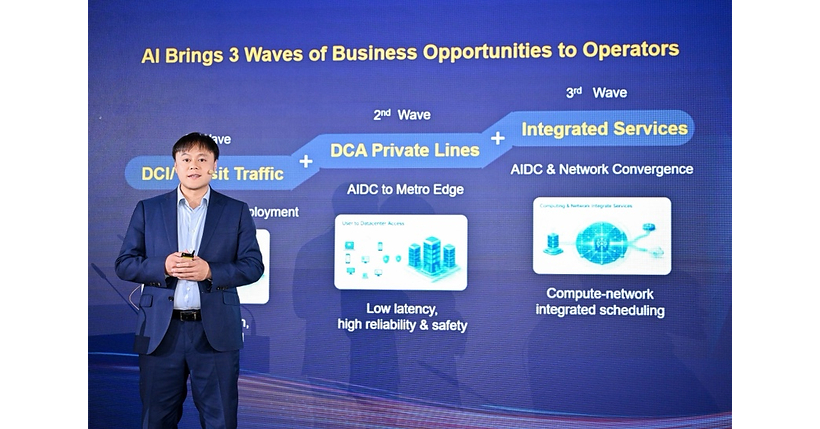
At NetworkX 2026, Huawei presented its next-generation OTN solution and LIGHTS all-optical network strategy for AI data center infrastructure, targeting data center interconnect and data center access scenarios. The offering includes 800G-to-2T capacity for DCI, plus DCA capabilities such as one-hop OXC, millisecond-level WSON, 10 Mbps-to-1 Gbps fgOTN, and quantum key distribution; Huawei says the network can support differentiated, higher-value operator services.
Analysis
AI networking may shift the investment payoff from raw bandwidth toward assured latency, uptime and security—but the commercial value accrues only if operators can charge for those service levels and keep utilization high enough to earn back the upgrade capex. Huawei’s product claims do not establish customer orders, deployment economics or incremental operator revenue.
The second-order winners are optical-equipment vendors such as Ciena and Nokia if hyperscaler and carrier spending broadens beyond Huawei’s addressable markets; component and fiber suppliers could benefit as well, but only where deployments require incremental capacity rather than better use of existing fiber. Huawei’s pitch also raises substitution risk for incumbent transport vendors: a bundled network architecture could pressure pricing if operators standardize on fewer suppliers. Procurement restrictions, interoperability requirements and customer concentration could limit that pressure and split the market geographically.
Near term, treat this as competitive positioning, not an earnings catalyst. Over 1–3 months, look for named operator awards, capex guidance and evidence of paid AI-connectivity services. Over 6–18 months, the key test is whether premium service revenue grows faster than network investment. The contrarian risk is that AI traffic grows while operators remain price-takers: higher capacity then supports utilization but not returns. Falsify the monetization thesis if operators raise capex without improving service revenue or returns on invested capital; falsify the vendor-share thesis if Huawei wins material deployments in markets open to competing suppliers.
AllMind Terminal
AI-powered research, real-time alerts, and portfolio analytics for institutional investors.
Request TrialMarket Sentiment
Overall Sentiment
mildly positive
Sentiment Score
0.15
Key Decisions for Investors
- No directional trade on this announcement alone. It is a vendor presentation, not verified demand; avoid treating the stated capacity and reliability capabilities as realized financial outcomes.
- Set an alert on Ciena and Nokia around operator and hyperscaler order disclosures and forward guidance. Consider a relative-value long in optical equipment versus telecom operators only if order growth broadens and operators’ capex guidance does not outrun service-revenue growth; exit the thesis if orders or guidance roll over.
- For the next 1–3 months, track operator disclosures for paid AI-connectivity contracts, pricing and utilization—not just announced pilots. Without those data, regard operator monetization as unproven and do not pay for a premium-service thesis.
- Over 6–18 months, monitor vendor awards by region, interoperability and sourcing constraints, plus operator returns on invested capital. A material Huawei win where alternatives are available would increase competitive pricing risk for incumbent vendors; capex increases without improving service revenue would weaken the broader AI-optical investment case.
More News
- Why did CoreWeave stock get crushed this week? Look to this corner of the debt market for clues
- AI stock sell-off ramps up over debt-fueled data center spending fears: ‘Full-blown crisis of confidence'
- Dow falls 189 points as AI stocks slide and oil prices surge
- Wall Street Anxiety Spreads as AI Rout Meets $110 Oil Shock
- Wall Street's fear gauge is ripping. Traders see it going even higher
- All the news about the iPhone Duo