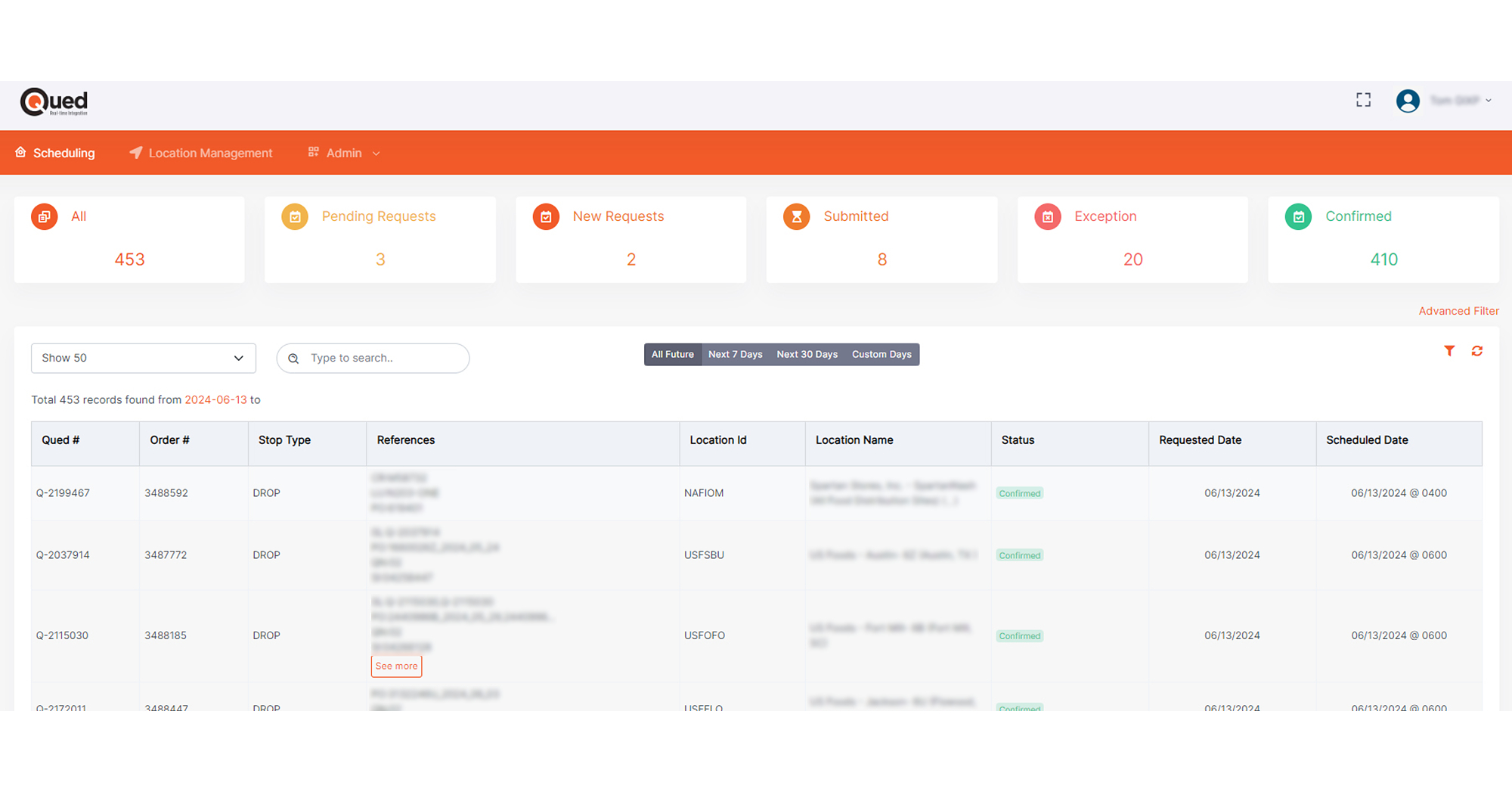
Qued announced a partnership with Don Hummer Trucking that automated appointment scheduling across the carrier’s operations, confirming more than 10,000 appointments via Qued. Performance metrics reported include a 94.2% confirmation rate and 98.8% success on email-based scheduling, with Qued selecting real-time appointment slots based on ETAs, facility capacity, and historical performance. The news is operationally positive for logistics efficiency, but it is unlikely to move broader markets materially.
This is a workflow-efficiency signal, not a revenue step-change. The economically relevant read-through is that appointment automation can shave dispatch/admin overhead and, more importantly, reduce empty time around docks; that matters most for carriers with dense shipper networks and enough volume to amortize integration costs. For public comps, the first-order beneficiary is not a pure-play software name so much as any truckload or brokerage platform that can show SG&A leverage and lower detention exposure over the next 1-2 quarters.
Second-order, this slightly widens the gap between operators with clean data/TMS integrations and smaller fleets still running manual back offices. That should favor large, process-disciplined names such as JBHT, KNX, ODFL, and CHRW if they can translate automation into better asset turns or lower cost per load; the incremental advantage is likely measured in basis points, not a regime shift. The loser set is the long tail of labor-heavy intermediaries and carriers where manual appointment work remains embedded in service costs.
The main risk is extrapolation: a single customer win does not prove enterprise adoption or a durable earnings lift. Near term, look for evidence in 1-3 months from broader rollouts, dispatcher headcount commentary, or any disclosed reduction in detention/dwell; over 6-18 months, the thesis only matters if these tools become standard infrastructure across shipper facilities. For TISI specifically, there is no clear economic linkage here, so this looks more like a sector watch item than a tradable catalyst.
Contrarian view: the market may be overestimating how much AI workflow tools can change freight economics when the real bottleneck is dock capacity, not scheduling intelligence. If appointment success rates stay high but on-time delivery, trailer turns, and brokerage margins do not improve, the enthusiasm should fade quickly.
AI-powered research, real-time alerts, and portfolio analytics for institutional investors.
Request TrialOverall Sentiment
mildly positive
Sentiment Score
0.18
Ticker Sentiment
