
CART-Blutdruckmessgerät zeigt Nutzen bei der Blutdrucküberwachung von Patienten mit Vorhofflimmern und Herzinsuffizienz
Source: PR Newswire
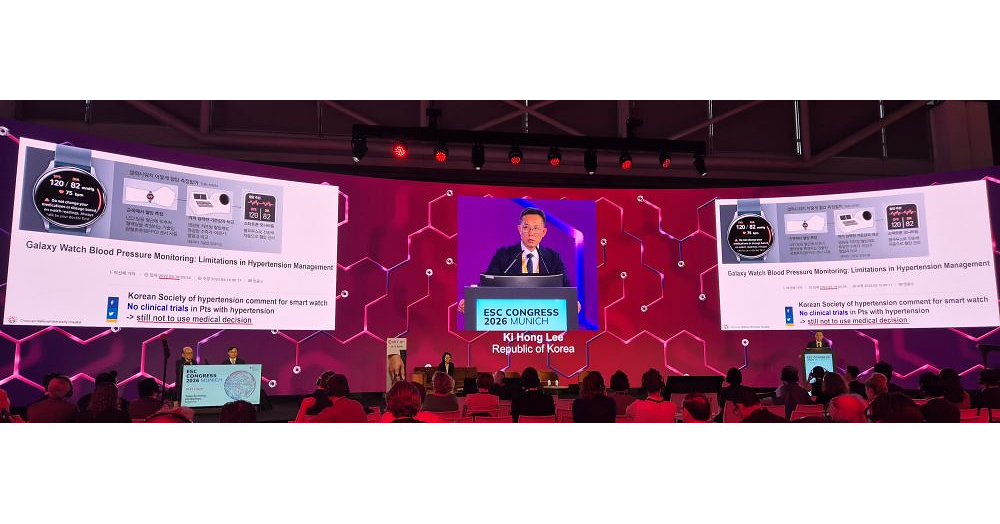
Sky Labs presented clinical data at ESC Congress 2026 showing its CART smart-ring blood-pressure monitor achieved roughly an 80% usable-data rate in atrial-fibrillation patients and met ESH allowable-error criteria in severe heart-failure patients with mean ejection fraction of 29%. The cuffless, AI-enabled device has been deployed in more than 2,000 Korean medical facilities and accumulated over 300,000 prescriptions, while becoming the first ring-based cuffless monitor included in Korean hypertension guidelines. The company said it will accelerate expansion into Europe and global markets following the clinical validation and guideline inclusion.
Analysis
There is no direct listed-equity exposure to Sky Labs, and the announcement is unlikely to alter near-term earnings for broad medtech. The more relevant read-through is competitive: clinically validated cuffless blood-pressure monitoring raises the bar for consumer wearables seeking medical-grade positioning, creating potential differentiation pressure on Apple (AAPL), Samsung Electronics (005930.KS), Garmin (GRMN), and privately held Oura. However, validation data alone does not establish European reimbursement, regulatory clearance, physician workflow integration, or durable unit economics—the four gating items that determine whether a monitoring device becomes a recurring-care platform rather than a hardware niche.
Over the next 1-3 months, the key catalyst is evidence of EU regulatory progress or reimbursement pilots, not additional conference presentations. If cuffless monitoring is adopted in hypertension and heart-failure pathways, it could eventually shift value toward remote-patient-monitoring vendors and away from episodic ambulatory-monitoring workflows; likely beneficiaries include Philips (PHG) and ResMed (RMD) only where BP, sleep, and chronic-care data are integrated into reimbursed clinical programs. The contrarian view is that irregular-rhythm accuracy is clinically valuable but commercially narrow: high-acuity patients require clinician oversight, and reimbursement may constrain adoption more than sensor performance. The thesis is falsified if EU authorization, payer coverage, or independently published longitudinal outcome data fail to emerge within 6-12 months.
AllMind Terminal
AI-powered research, real-time alerts, and portfolio analytics for institutional investors.
Request TrialMarket Sentiment
Overall Sentiment
moderately positive
Sentiment Score
0.62
Key Decisions for Investors
- No immediate directional trade: Sky Labs is not publicly listed and the disclosed evidence does not yet create a measurable earnings revision for AAPL, GRMN, PHG, RMD, or MASI.
- Set a 6-12 month alert for European CE/MDR clearance, national reimbursement decisions, and prospective outcomes data; a positive reimbursement decision would justify reassessing long PHG or RMD as remote-care platform beneficiaries.
- Monitor AAPL and GRMN for medical-grade cuffless BP product claims or regulatory filings. Avoid treating consumer wearable functionality as equivalent to reimbursable clinical monitoring until validation in arrhythmia populations and payer acceptance are independently confirmed.
- For RMD, watch whether hypertension and post-apnea BP metrics become incorporated into its cloud-care offering; absent a disclosed monetization pathway, sleep-related BP monitoring remains strategically interesting but financially immaterial.
More News
- OpenAI Trims Target Value & Volvo Cars Cuts 2,500 Jobs
- PG&E’s CEO says AI is ‘the best thing that could’ve ever happened to the grid’
- The mobile ambitions of SpaceX see telecom stocks get hit again. What the latest developments mean.
- Wake up! The long bond’s up two points!
- US tech stocks tumble as investors fret over AI spending
- Mark Zuckerberg owns 13% of Meta but controls 61% of its votes. California’s wealth tax would bill him on the 13%