
Latino Voters Threaten to Sink Republicans in Midterms
Source: Bloomberg
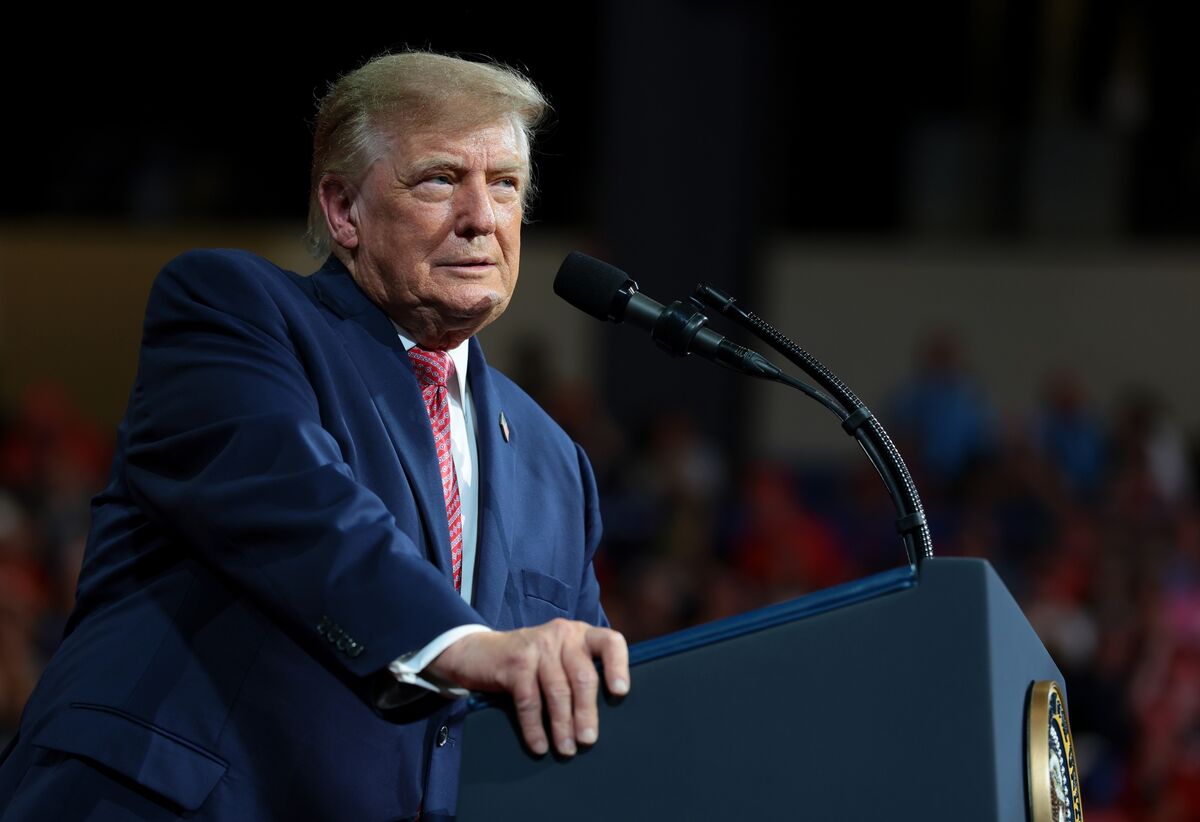
The article preview says declining Latino support for Trump could hurt Republican candidates in key midterm states. It also flags $277 million in spending by MAGA Inc., but provides no further details or market implications.
Analysis
This is a political-risk signal, not yet an investable earnings revision: the excerpt provides no polling detail, state-by-state shifts, or evidence that voter movement will persist through election day. The market mechanism is chiefly a change in the probability of unified government and policy follow-through. If the reported erosion becomes durable, expectations for major Republican-led tax, immigration, energy, and regulatory initiatives could be marked down; conversely, a weaker legislative mandate may reduce the probability of abrupt policy changes. That creates offsetting effects, not a clean sector-wide winner.
The second-order exposure is labor supply. A more restrictive immigration agenda can raise wage and operating-cost pressure for labor-intensive agriculture, construction, hospitality, and food processing; reduced odds of such enforcement could ease that risk, but would not itself guarantee labor availability. These are conditional channels, not evidence of company-level impact. The near-term signal is weak: absent specific polls and market-implied election odds, avoid treating a newsletter headline as a catalyst. Over 1–3 months, watch whether state-level polling and candidate outcomes confirm the shift; over 6–18 months, the key question is whether it changes governing control and policy implementation. A durable polling reversal, or results showing no meaningful down-ballot effect, would falsify the political-risk thesis.
AllMind Terminal
AI-powered research, real-time alerts, and portfolio analytics for institutional investors.
Request TrialMarket Sentiment
Overall Sentiment
neutral
Sentiment Score
-0.10
Key Decisions for Investors
- No directional trade on this excerpt alone. It lacks the polling sample, trend, state coverage, and comparison with market-implied election probabilities needed to price the information.
- Track reputable state-level polling, special-election results, and prediction-market odds for control of Congress. Reassess policy-sensitive exposures only if these indicators move consistently over several weeks.
- Use labor-intensive sectors as a scenario screen, not a trade: test portfolio sensitivity to changes in immigration enforcement expectations and wage costs, especially in agriculture, construction, hospitality, and food processing.
- Falsifier/watch item: if subsequent polling stabilizes or improves for Republican candidates, or the reported Latino shift fails to translate into competitive-state movement, remove any incremental assumption of lower odds for Republican policy priorities.
More News
- Meta ordered to pay $25 billion in case related to Cambridge Analytica scandal
- Meta Boosts Bet on AI With Spending Outlook
- Meta ordered to pay $25 billion penalty over the Cambridge Analytica case
- Billionaires fleeing California could turn a $30 billion tax windfall into a $39 billion loss, Stanford economists warn
- Putin agrees ‘in principle’ to resume talks with Washington and Kyiv to end war in Ukraine—but still isn’t ‘fully satisfied’ with proposals
- Witkoff heads to Russia for Putin talks as Zelenskyy insists 'nothing about Ukraine without Ukraine'
From AllMind Research
- Anthropic IPO Preview: Valuation, Timing, and What to Watch
- Shein After the IPO: Venue, Valuation, and What Must Be Proved
- What AI Research Tools Should a Small Hedge Fund Buy First?
- Bitcoin's 52% Crash Proves It's a Tech Stock: Here's What That Means for Portfolio Construction
- What Is an AI Investment Research Platform?