
Domino's targets stronger cash flow from 2027, Panmure Liberum keeps 'buy' rating
Source: proactiveinvestors.com
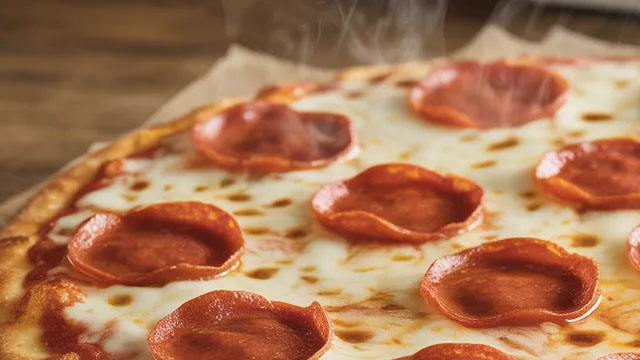
Panmure Liberum retained its buy rating on Domino's Pizza Group and set a 300p target price, arguing that recovering order growth and improved supply-chain efficiency could strengthen cash flow from 2027. The broker noted that years of store, digital and supply-chain investment outpaced order growth, lowering orders per store and weakening profit conversion. The outlook is positive but dependent on a sustained recovery in demand and improved utilization of the expanded operating base.
Analysis
The investable question is whether incremental orders can absorb a largely fixed UK commissary and logistics cost base without further store-level cannibalization. If order density turns, EBITDA can inflect faster than sales because delivery routing, food procurement and central overhead are already funded; conversely, weak density leaves franchisees exposed to labor and rent inflation, raising the risk of slower unit development or demands for economic support. The broker’s 2027 cash-flow premise should therefore be treated as a KPI thesis, not a near-term earnings catalyst.
Near term, DOM is likely more sensitive to monthly/quarterly order trends, promotional intensity and franchisee profitability than to a long-dated valuation framework. A meaningful improvement in order growth that is bought through discounts would be lower quality: it may lift headline sales while worsening franchisee economics and company-level margin. The relevant second-order beneficiary of a genuine density recovery is not necessarily DOM equity alone; it would also reduce competitive pressure on UK quick-service peers such as Just Eat Takeaway (TKWY) and Deliveroo (ROO) only if consumers shift from aggregators toward direct ordering.
Consensus may underappreciate the asymmetry around capacity utilization: modest order acceleration can produce material operating leverage, but the inverse is also true if UK discretionary demand softens. Given the low-impact, broker-led nature of the signal and the absence of independently verifiable current trading data, there is no reason to chase a rating-driven move. The thesis is falsified by two consecutive reporting periods of flat-to-down order density, renewed franchisee closures, or margin guidance that fails to improve despite higher sales.
AllMind Terminal
AI-powered research, real-time alerts, and portfolio analytics for institutional investors.
Request TrialMarket Sentiment
Overall Sentiment
mildly positive
Sentiment Score
0.28
Ticker Sentiment
Key Decisions for Investors
- Keep DOM on a 1-3 month watchlist rather than initiating on the broker note; go long only after reported like-for-like order growth and orders per store both improve for at least one reporting period without a step-up in discounting. Initial risk budget should assume downside to the prior trading low if consumer demand or franchisee economics disappoint.
- For a 6-18 month position, use a staged long DOM structure: initiate one-third after independently confirmed order-density improvement, add after margin/FCF guidance validation, and cap exposure if operating-margin guidance is cut. The payoff is operating-leverage-driven multiple expansion; the primary risk is that volume recovery is promotion-funded rather than structural.
- Monitor ROO and TKWY as competitive read-throughs: sustained direct-ordering gains at DOM alongside stable aggregator order volumes would support an expanding pizza category, while DOM gains paired with aggregator weakness would indicate share transfer and increase the durability of the DOM thesis.
- Require evidence on franchisee store-level profitability, delivery labor costs and supply-chain utilization before underwriting 2027 cash flow. If these metrics are unavailable at the next results update, maintain no-trade status rather than extrapolating broker assumptions.
More News
- Burger King is betting on local franchisees to fuel its U.S. comeback
- Trump vs Europe as US presses for release of emergency diesel stocks
- Anthropic warns government attitudes may hurt customer ties, IPO prospectus shows: Reuters
- Your health insurance premiums may take a big jump in 2027 — here's why
- Anthropic to invest $100 million to train AI engineer talent
- Paramount and Warner Bros. Discovery to Merge Into Skydance (SKYD). Will Skydance Achieve David Ellison’s "Quality Storytelling" Vision?