
Supreme Courts of Singapore and Korea Sign New Arrangements to Support Cross-Border Civil and Commercial Disputes
Source: PR Newswire
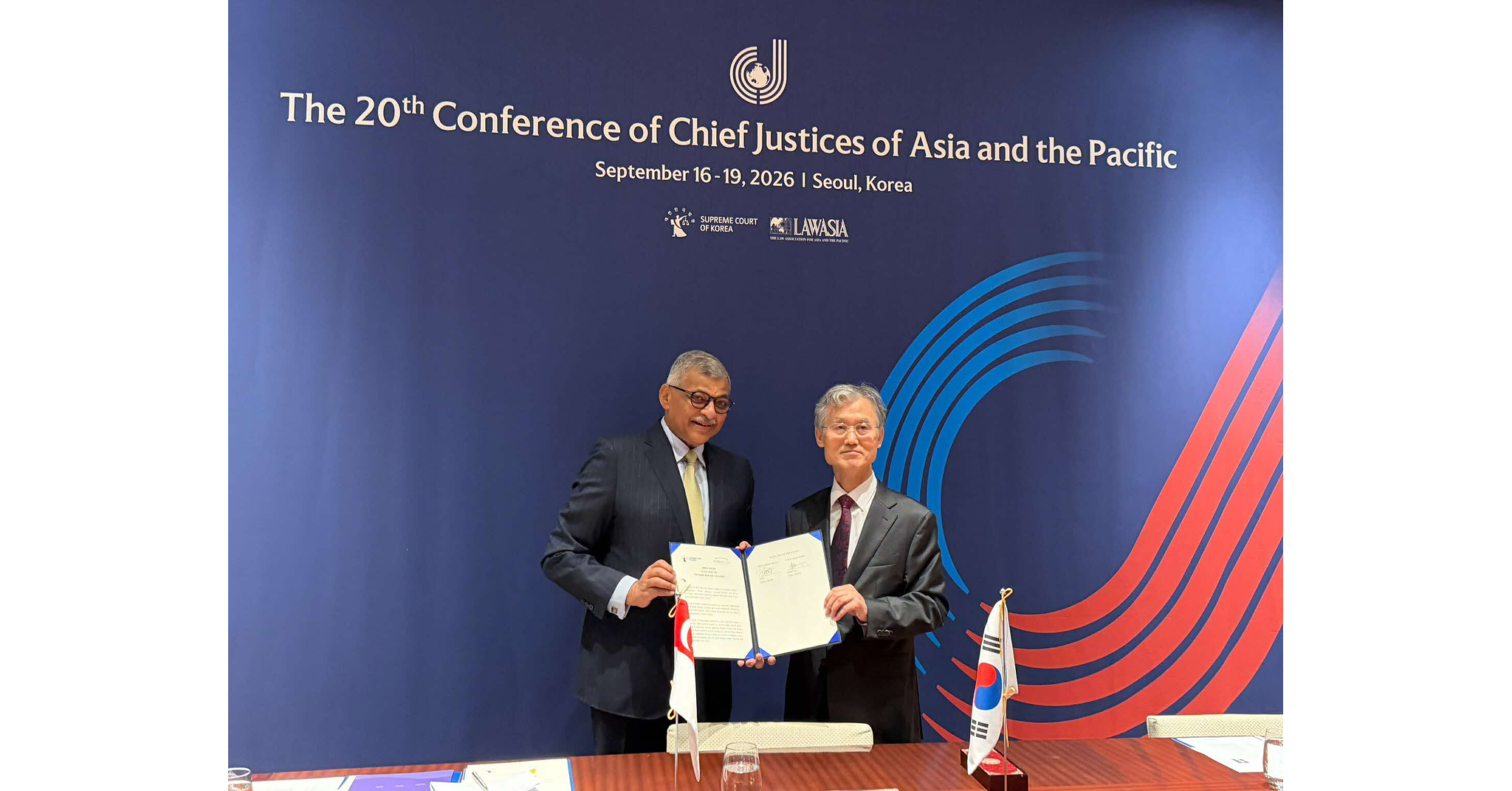
The Supreme Courts of Singapore and Korea signed two arrangements on 16 September 2026 to streamline cross-border civil and commercial dispute resolution. The Memorandum of Guidance clarifies procedures for recognizing and enforcing monetary judgments between the jurisdictions, while the MOU creates a channel for courts to exchange information on foreign law and judicial practice. The measures should improve legal certainty for companies and litigants with cross-border assets or commercial disputes, though the near-term market impact is limited.
Analysis
This is a friction-reduction development rather than an earnings event: it marginally lowers expected recovery costs and asset-flight optionality for Singapore–Korea commercial counterparties. The most direct beneficiaries over 6–18 months are banks, trade-finance providers and insurers with meaningful bilateral corporate flows—DBS (D05.SI), UOB (U11.SI), OCBC (O39.SI), KB Financial (105560.KS), Shinhan (055550.KS) and Samsung Fire & Marine (000810.KS)—but the effect is too diffuse to alter near-term estimates or valuation multiples.
The non-obvious consequence is negotiating leverage. More predictable monetary-judgment enforcement can reduce required collateral, guarantees and pricing buffers in bilateral contracts, modestly supporting working-capital efficiency for Korean exporters using Singapore as an ASEAN treasury or arbitration hub. Singapore-listed logistics/industrial REITs with Korean tenants are only indirect beneficiaries; the arrangement does not address non-monetary remedies, insolvency recognition, regulatory penalties, or automatic enforcement, leaving the highest-stakes distress scenarios materially unresolved.
No immediate trade is warranted: implementation remains dependent on case-specific judicial treatment, and this is not a treaty creating a new reciprocal enforcement regime. A measurable investable signal would be lower legal-reserve expense, reduced credit-loss provisions on cross-border corporate exposures, or disclosures of increased Singapore–Korea trade-finance volumes over the next 2–4 reporting cycles. The thesis is falsified if courts apply narrow public-policy or procedural exceptions, or if enforcement timelines and collateral requirements do not improve in observed cases.
AllMind Terminal
AI-powered research, real-time alerts, and portfolio analytics for institutional investors.
Request TrialMarket Sentiment
Overall Sentiment
mildly positive
Sentiment Score
0.30
Key Decisions for Investors
- No directional position on this announcement; treat it as a 6–18 month monitoring catalyst rather than a source of near-term alpha.
- Add DBS (D05.SI), UOB (U11.SI), OCBC (O39.SI), KB Financial (105560.KS) and Shinhan (055550.KS) to a watchlist for quarterly disclosures on Korea/Singapore trade-finance balances, cross-border corporate loan growth and legal/credit-cost trends.
- For existing long Singapore-bank exposure, view any demonstrated reduction in collateral intensity or credit-loss volatility on bilateral corporate books as a modest incremental ROE upside catalyst; do not underwrite more than de minimis earnings benefit before disclosed volumes emerge.
- Monitor the first contested recognition cases over the next 12–24 months. Evidence of rapid enforcement without broad public-policy exceptions would strengthen the case for a small long Singapore financials versus regional-bank basket; adverse precedent would eliminate the benefit.
More News
- Bank of Japan raises interest rates to 31-year high, flags concerns over inflation
- Italy to deploy warships to protect shipping through Bab al-Mandeb
- UN mission finds evidence of U.S. war crimes in Iran; Washington rejects report
- Oil prices fall as Saudi supply hopes outweigh fresh Houthi strikes
- California AG Says Paramount-WBD Merger Would Hurt the State
- Explainer-What commodity markets can expect from the Trump-Xi summit
From AllMind Research
- Anthropic IPO Preview: Valuation, Timing, and What to Watch
- Shein After the IPO: Venue, Valuation, and What Must Be Proved
- What AI Research Tools Should a Small Hedge Fund Buy First?
- Bitcoin's 52% Crash Proves It's a Tech Stock: Here's What That Means for Portfolio Construction
- What Is an AI Investment Research Platform?