
Trust AI Just Made Your X-Ray Fight the Insurance Company.
Source: PR Newswire
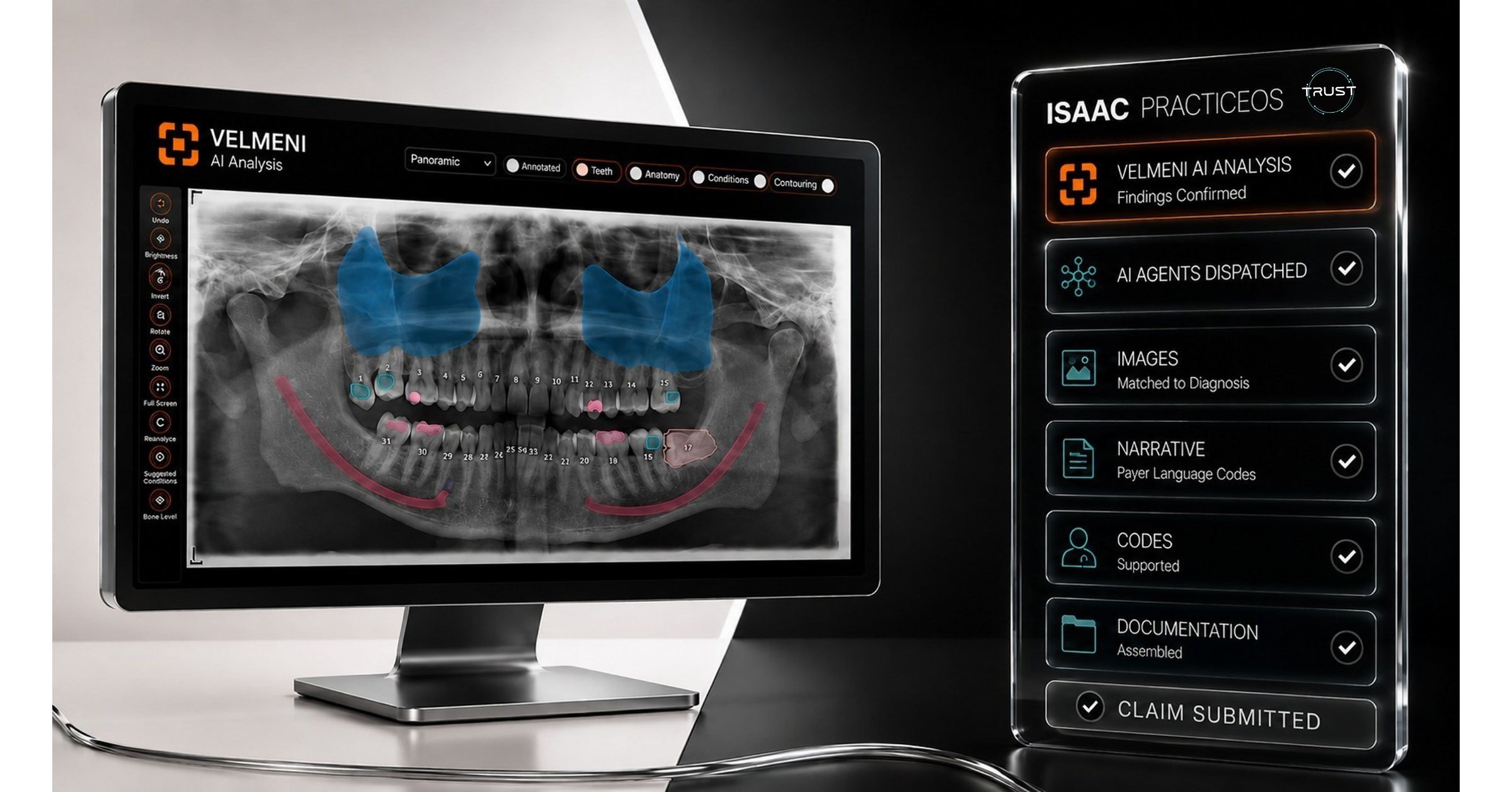
Trust AI integrated VELMENI’s FDA-cleared 2D/3D dental-radiograph AI into Isaac PracticeOS, automating the assembly of insurance claims while requiring licensed-dentist and billing-specialist review before submission. The platform combines imaging AI, revenue-cycle management and claims workflows for $299 per month, and is being marketed as recovering revenue from previously delivered but unbilled dental treatment. The integration is available immediately, though the announcement provides no quantified revenue-recovery results or financial impact.
Analysis
The economic relevance is not image-analysis accuracy alone; it is whether automated documentation lifts clean-claim rates and shortens days-sales-outstanding without raising audit exposure. If the bundled price is accurate, the offer could pressure incumbent dental practice-management vendors whose revenue depends on fragmented workflow modules, particularly Henry Schein's Dentrix ecosystem (HSIC) and Dentsply Sirona's DS Core/digital workflow strategy (XRAY). The more consequential second-order effect is on outsourced dental billing: automation can reduce labor per claim, but human review requirements limit near-term gross-margin expansion and make scale, payer-rule maintenance, and denial-management outcomes the real moat.
There is no disclosed public-equity exposure to Trust AI or VELMENI, and the release provides no independently verifiable adoption, retention, collections uplift, denial-rate, or customer-acquisition data. In the next 1-3 months, this is primarily a private-company execution event rather than a tradable catalyst. Over 6-18 months, verified evidence that integrated AI/RCM lowers DSO or increases net collections could force established dental software platforms to accelerate acquisitions or discount bundled offerings; conversely, payer scrutiny of retrospectively reconstructed documentation, elevated post-payment audits, or weak clinician adoption would rapidly impair the claimed ROI.
The contrarian view is that the addressable "missed revenue" pool may be less recurring than promotional case studies imply: backlog recovery is a one-time benefit, while ongoing monetization depends on maintaining payer-compliant narratives and avoiding incremental denials. The product may therefore be strongest as an RCM-services wedge, not a durable replacement for core practice-management systems. Watch for externally reported net-collection improvement after adjustments and clawbacks, not gross claims submitted.
AllMind Terminal
AI-powered research, real-time alerts, and portfolio analytics for institutional investors.
Request TrialMarket Sentiment
Overall Sentiment
moderately positive
Sentiment Score
0.48
Key Decisions for Investors
- No immediate position: neither private vendor has a confirmed listed-equity vehicle, and the disclosed information is insufficient to quantify revenue impact on HSIC or XRAY.
- Place HSIC and XRAY on a 6-12 month competitive-disruption watchlist; investigate dental-software renewal commentary, RCM attach rates, and discounting in quarterly calls. A measurable rise in integrated AI/RCM demand or weaker recurring-software growth would support a relative underweight versus diversified healthcare distributors.
- Monitor public dental-service operators and dental-benefits administrators for evidence of higher claim denial or audit activity tied to AI-generated documentation. Any broad payer pushback would be a negative read-through for automation vendors and a potential near-term support for incumbent manual RCM providers.
- Require three validation datapoints before treating this as an investable dental-software theme: customer cohort retention, net collections/DSO improvement measured after denials and recoupments, and evidence that the $299 bundle is economically sustainable after licensed-review labor. Failure on any of these would falsify the high-margin platform narrative.
More News
- Next week brings major risks for the stock market, just as the AI trade keeps faltering
- AI Doubts Spread Cracks in Equities, Credit Markets: Evening Briefing Americas
- Kinder Morgan, Energy Transfer and Williams could benefit from cheap natural gas
- CrowdStrike CEO's alarming prediction — plus, the sell-off spreads beyond tech
- Vertex reports positive IgAN trial data, FDA decision due Nov. 30
- The real test for Moderna’s cancer vaccine isn’t about beating Keytruda. It’s keeping cancer from coming back in the long term.