
Gigasheet Launches AI Agent for Healthcare Claim Benchmarking and Cost Containment
Source: PR Newswire
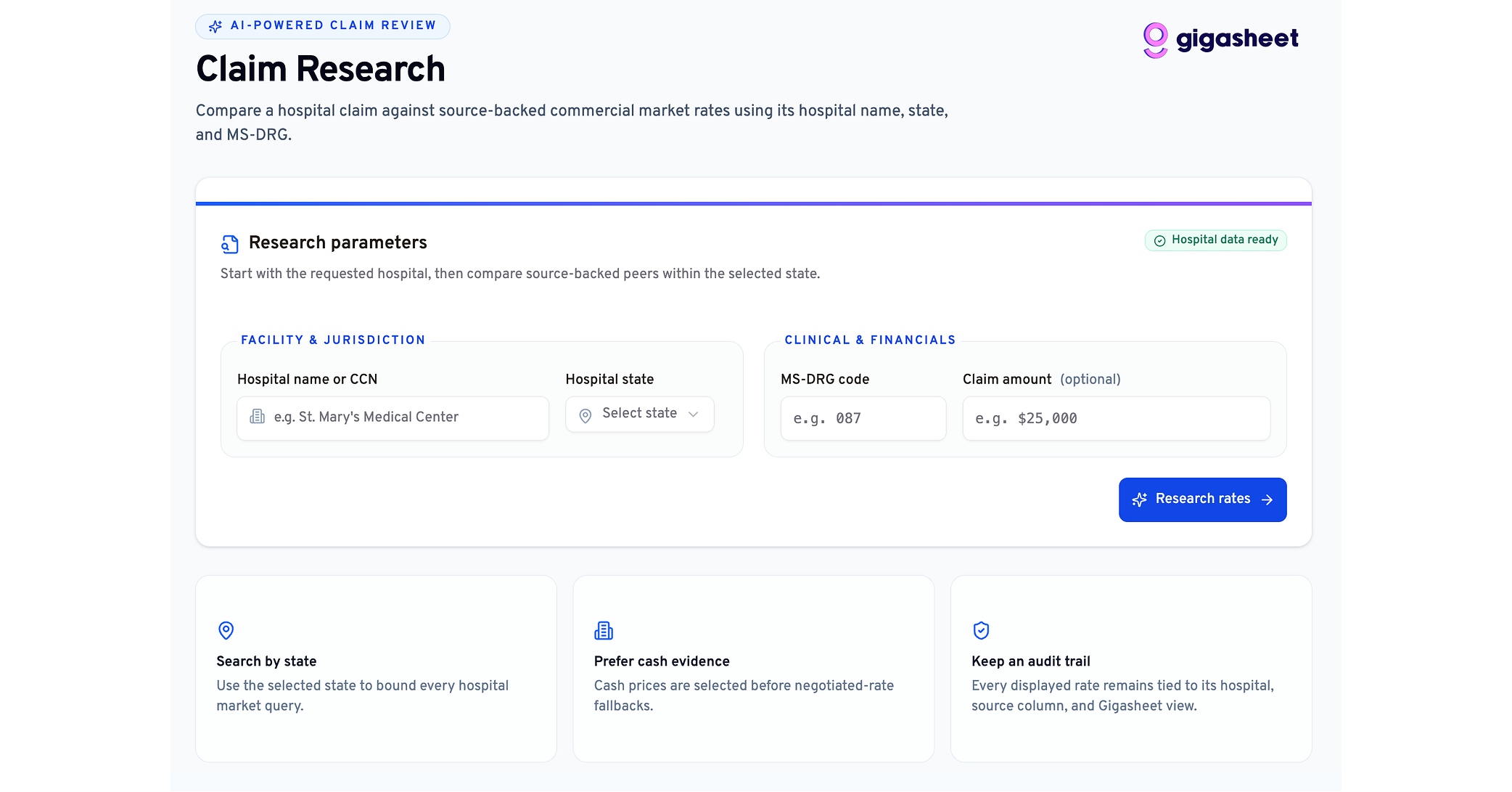
Gigasheet launched an agentic AI tool for healthcare claim benchmarking that it says can make medical-claim investigations up to 10 times faster. The product uses federal healthcare price-transparency data, evaluates comparable providers, payers and geographies, and can generate geographically adjusted Medicare reimbursement benchmarks. The capability targets payment-integrity firms, litigation-support teams and stop-loss carriers, leveraging Gigasheet's database of more than 15 trillion published negotiated rates.
Analysis
This is not a standalone catalyst for listed managed-care equities, but it reinforces a medium-term margin pressure point: transparency data is becoming operational rather than merely regulatory. If claim-review workflows can identify defensible outliers at materially lower labor cost, self-insured employers and stop-loss carriers gain leverage in reimbursement disputes and renewals. The greatest economic exposure sits with hospital systems and specialty providers whose realized rates depend on opacity, particularly in concentrated local markets; the listed insurer benefit is less direct because many large plans already possess proprietary claims and contract data.
The key second-order question is whether automated benchmarks become admissible and trusted in appeals, litigation, and network negotiations. Over 6-18 months, broader adoption could compress payment-integrity vendor labor revenue while expanding their addressable market through lower-cost case triage; it could also pressure repricing intermediaries such as MPLN if transparent market-rate evidence reduces reliance on legacy network-discount narratives. Near term, the launch is a private-company product claim with no independently verifiable customer adoption, savings capture, or accuracy data, so it does not justify a directional trade.
Contrarianly, price files are noisy, incomplete, and often poorly aligned to a specific clinical episode; false comparables can create provider abrasion and raise appeal costs. The economic value will depend less on reported research-speed gains than on hit rate: dollars actually recovered or avoided per reviewed claim, net of overturns. Watch for evidence of integrations with TPAs, stop-loss carriers, or major payment-integrity platforms over the next 1-3 months; those distribution wins would be more consequential than product demonstrations.
AllMind Terminal
AI-powered research, real-time alerts, and portfolio analytics for institutional investors.
Request TrialMarket Sentiment
Overall Sentiment
moderately positive
Sentiment Score
0.42
Key Decisions for Investors
- No immediate position: treat the September product demonstration as a diligence event, not a revenue catalyst, because neither pricing, contracted customers, nor realized savings economics are disclosed.
- Place MPLN on a 6-12 month watchlist for downside risk rather than shorting now. Escalate only if employer/TPA disclosures show transparent-rate benchmarking displacing network-based repricing, or if MPLN reports worsening revenue retention or pricing; a credible turnaround in adjusted EBITDA or client retention would falsify the bearish read.
- Monitor UNH, ELV, CI, HUM, and CNC earnings commentary for payment-integrity savings and medical-cost trend. A measurable reduction in administrative expense or unfavorable-claims development attributable to automation would support relative longs versus hospital operators, but absent quantified savings the impact is too diffuse to trade.
- For healthcare-services exposure, favor a relative-risk framework: avoid adding to hospital names with high commercial-pay mix and concentrated markets until rate-transparency litigation and payer-contract commentary clarify whether negotiated-rate dispersion is narrowing over the next 2-4 quarters.
More News
- Australia’s central bank chief warns inflation risks materialising
- This AI-picked stock jumps 18% on Amazon’s $8 billion power deal
- Asian stocks rise as oil retreat eases inflation fears, BOJ in focus
- California AG Bonta on Paramount-Warner Bros., Meta and AI
- A breakout in the 10-year Treasury yield could hold back stocks if it reaches this level
- Fed rate decision and Warsh comments roiled markets. Where to find opportunities