
zReports Launches zReports Health to Bring Decision Intelligence to Healthcare Facility Choices
Source: PR Newswire
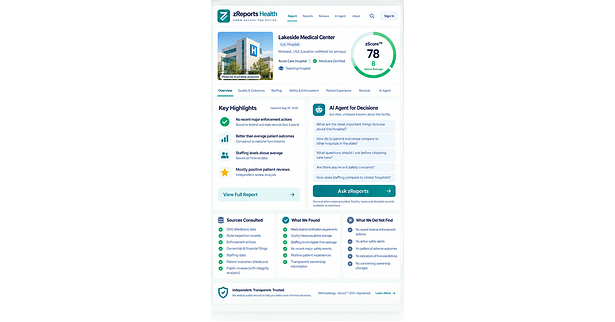
zReports launched zReports Health, an AI-enabled decision platform covering more than 130,000 U.S. healthcare facilities, including IVF centers, nursing homes, dialysis providers and surgery centers. The platform aggregates public inspection, staffing, enforcement and ownership records into a published zScore methodology and offers conversational AI assistance for consumers. zReports plans to distribute the product to employers through benefits brokers and consultants for the 2027 plan year, while maintaining that covered facilities cannot pay to edit or manage reports.
Analysis
There is no directly investable issuer disclosed, and the launch itself is not yet a tradable earnings event. The relevant listed-company exposure is indirect: transparency around facility quality can shift referral volumes toward scaled operators with stronger compliance infrastructure and away from fragmented, citation-prone independent facilities. Over 6-18 months, this is marginally favorable for publicly traded operators such as HCA, EHC and USPH, whose centralized governance, reporting capabilities and brand equity can convert quality disclosure into share gains; it is more problematic for highly local nursing-home, home-health and behavioral-health operators dependent on opaque referral channels.
The more immediate competitive implication is for incumbent health-navigation and benefits platforms. ACCD, DOCS and private benefits-navigation vendors face a low-cost feature threat if facility-level data becomes a standard employer-benefit module, although zReports has not disclosed payer, broker or employer contracts, pricing, usage, or data-refresh economics. Near-term revenue impact is therefore immaterial; the 1-3 month catalyst is evidence of distribution through major benefits consultants, while the real 2027 opportunity depends on employer-plan adoption and whether the product demonstrably changes utilization or avoids adverse outcomes.
Contrarian view: healthcare data aggregation is easier to launch than to monetize. Public-record completeness, timeliness, methodology credibility, and liability management are the bottlenecks; a static score can also be less decision-useful than network inclusion, physician referral patterns and real-time capacity. The thesis is falsified if the platform secures a top-tier broker/channel partnership plus disclosed paid-employer penetration, or if established navigation platforms add comparable facility-quality data without incremental customer-acquisition cost.
AllMind Terminal
AI-powered research, real-time alerts, and portfolio analytics for institutional investors.
Request TrialMarket Sentiment
Overall Sentiment
mildly positive
Sentiment Score
0.35
Key Decisions for Investors
- No standalone position on this announcement; maintain a watch alert rather than force exposure because there is no public zReports security and no disclosed commercial metrics.
- Monitor ACCD and DOCS over the next 1-3 months for product responses or employer-navigation commentary. Consider a tactical short only if zReports announces a major broker distribution agreement and either company simultaneously guides to slower net retention or higher sales-and-marketing spend; absent those signals, competitive impact is too speculative.
- For 6-18 month healthcare-services exposure, favor HCA over smaller facility-dependent operators via a modest long HCA / short IHF pair only after evidence that quality transparency influences referrals. The long leg benefits from scale and compliance capacity; invalidate if HCA reports worsening quality metrics, adverse regulatory actions, or material volume deceleration.
- Track 2027 benefits-enrollment announcements: paid covered lives, broker partners, employer renewal rates, facility-data refresh cadence, and demonstrated utilization savings are the minimum evidence required before assigning a meaningful valuation impact to the theme.
More News
- Here’s the ‘core economic flaw’ in the AI bull case as stock and bond trades unravel, according to a top economist
- 5 big analyst AI moves: ’Uniquely catalyst-rich’ months ahead for SpaceX
- Brookfield to open Qatar office as it expands Middle East operations
- Xencor reports phase 1 data for cancer drug XmAb819
- The experience economy keeps defying expectations. Maybe we’ve been looking at it all wrong
- The U.S. military and NASA have power problems. Nuclear microreactors might solve both