
MSI XpertStation WS300 Based on NVIDIA DGX Station Now Available
Source: PR Newswire
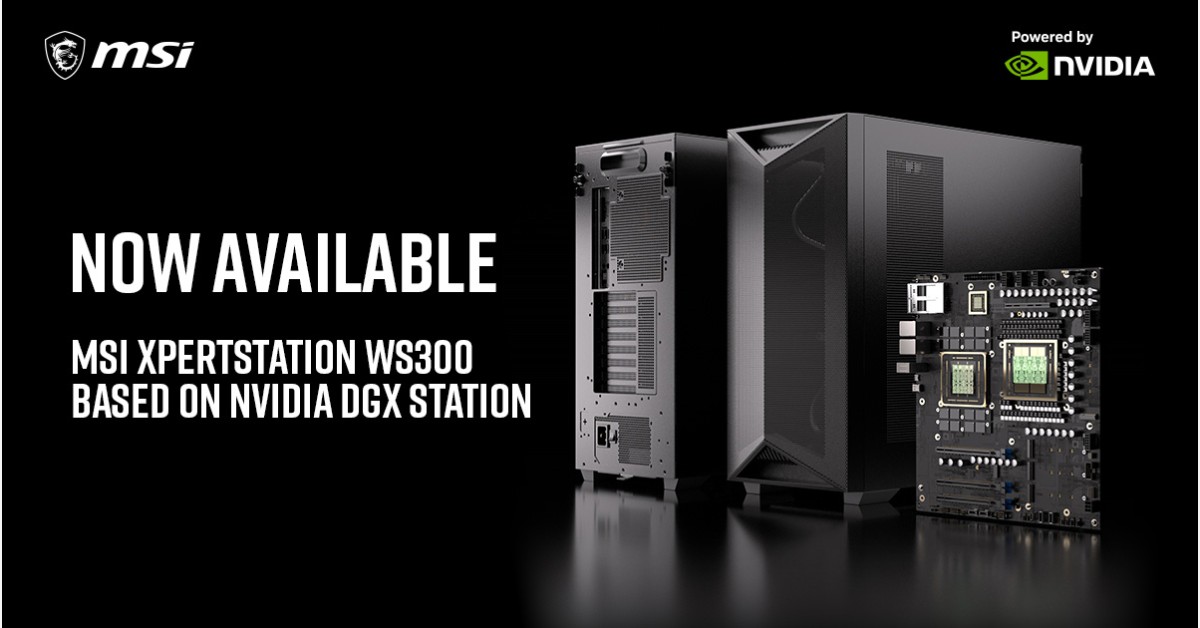
MSI says its XpertStation WS300—based on NVIDIA DGX Station architecture—is now shipping, powered by the NVIDIA GB300 Grace Blackwell Ultra desktop superchip. The system targets local enterprise AI with up to 748GB coherent memory and dual 400GbE networking, and it supports clustering two units for scaling. MSI positions it as ready for production use on arrival, aiming to reduce recurring cloud inference costs and enable secure, policy-controlled agentic deployments via NVIDIA NemoClaw/OpenShell.
Analysis
This is less about one workstation SKU and more about NVIDIA turning “local AI” into a repeatable enterprise category. The second-order bullish read for NVDA is that high-end inference is no longer confined to hyperscalers; it is migrating into developer endpoints, regulated workflows, and sovereign-data environments where customers will pay for premium silicon plus networking, memory, and software lock-in. That expands the TAM beyond data center racks and supports continued mix shift toward higher-value systems rather than commodity GPUs.
The nearer-term beneficiaries are the surrounding stack: Micron and SK Hynix on coherent-memory intensity, networking vendors tied to NVIDIA interconnect, and channel OEMs that can bundle deployment services. The likely loser is incremental cloud inference share over 6-18 months if enterprises increasingly keep always-on workloads on-prem; that is a slow-burn revenue deferral risk for AMZN, MSFT, and GOOGL rather than a near-term headline hit. For MSI, the financial impact is probably limited unless this becomes a material enterprise pipeline, because branded launch announcements usually carry more signaling value than earnings impact.
The key risk is that this is still an early adoption proof point, not evidence of broad unit volume. If enterprise AI spending stays cautious, these systems can become prestige demos rather than a meaningful procurement wave, and NVDA’s upside would remain already priced unless channel data confirms sell-through. Falsifiers over the next 1-3 months: no improvement in NVDA’s enterprise/partner commentary, weak OEM order visibility, or cloud vendors reiterating accelerating AI capex with no sign of on-prem substitution.
AllMind Terminal
AI-powered research, real-time alerts, and portfolio analytics for institutional investors.
Request TrialMarket Sentiment
Overall Sentiment
mildly positive
Sentiment Score
0.25
Ticker Sentiment
Key Decisions for Investors
- Maintain a modest long NVDA bias, but treat this as confirmation rather than a fresh catalyst; best entry is on any post-event weakness over the next 1-2 sessions. Risk/reward is favorable only if channel checks show real deployment demand, not just press-release activity.
- Pair long NVDA / short XLK or a basket of cloud-exposed mega-caps (AMZN, MSFT, GOOGL) for a 1-3 month horizon if follow-up commentary points to on-prem inference adoption. The thesis is mix shift, not absolute AI demand destruction.
- Long MU as a second-order beneficiary if enterprise local AI systems begin standardizing on very large memory footprints. Use this as a watchlist trade rather than an immediate conviction position until workstation shipment volumes are visible.
- Avoid chasing MSI on the announcement alone; the likely economic capture is modest unless order flow or margins re-rate. If MSI can show sustained enterprise backlog or gross margin expansion in the next earnings cycle, revisit.
- Set an alert for NVDA enterprise/channel commentary and hyperscaler AI capex guides over the next quarter; if cloud vendors are still accelerating while local systems remain niche, the on-prem substitution thesis is not yet actionable.
More News
- Stocks saw new highs and big declines: How the volatile AI trade moved last week's market
- Nvidia GPUs are everywhere. Here are the ways companies are accessing them
- Cerebras Is About as Big as Nvidia's Data Center Business Was Nearly a Decade Ago. The Similarities Mostly End There.
- Nvidia in talks to acquire Reflection AI or increase investment, FT reports
- As companies pour billions into Earth-based AI infrastructure, Google is taking the data center race off-planet
- Why Nvidia’s stock is dodging the AI credit scare that is crushing Broadcom and Oracle