
Steel Dynamics Q3 Pre-Announcement Is Nothing Unusual
Source: seekingalpha.com
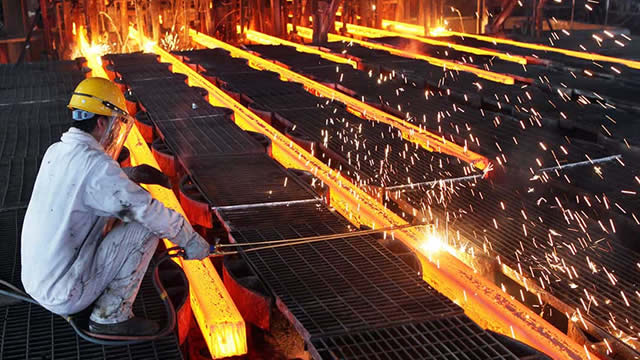
Steel Dynamics pre-announced Q3 EPS of $5.34-$5.38, supported by metal-margin expansion and record steel shipments. Q3 revenue is expected to reach $6.42B, up 5.5% sequentially and 33% year over year, reflecting robust demand from non-residential construction, energy, automotive and industrial customers. Steel fabrication is improving, with backlog nearly 50% above the prior year, while all three aluminum cold mills are now operational.
Analysis
The earnings upside should command a higher-quality valuation than a pure hot-rolled-coil beta trade because Steel Dynamics is monetizing volume through downstream fabrication, where backlog converts over multiple quarters and reduces dependence on spot steel pricing. That mix advantage favors STLD over Cleveland-Cliffs (CLF) and U.S. Steel (X), whose earnings are more exposed to contract resets, automotive production volatility, and legacy integrated-mill cost structures. The key second-order benefit is operating leverage: incremental fabrication utilization and aluminum-mill throughput can expand consolidated margins even if steel spreads merely hold rather than continue widening.
Near-term, the principal question is whether the pre-announcement has already pulled forward the Q3 beat and FY estimates. A sustained rerating requires management to demonstrate that fabrication backlog translates into pricing and margin retention, not just revenue conversion, while the aluminum platform reaches efficient utilization without a prolonged startup-cost drag. Watch domestic HRC pricing, scrap spreads, fabrication order intake, and automotive build schedules over the next 1-3 months; a sharp HRC correction or weakening non-residential bookings would quickly reframe the result as a cyclical peak.
The consensus risk is likely underestimating the capital intensity and execution curve of aluminum expansion. If aluminum utilization ramps faster than expected, STLD gains a differentiated exposure to can-sheet, automotive lightweighting, and reshoring demand; if it does not, depreciation and fixed costs could dilute returns just as steel margins normalize. The appropriate trade is therefore relative rather than an unhedged steel-sector beta position.
AllMind Terminal
AI-powered research, real-time alerts, and portfolio analytics for institutional investors.
Request TrialMarket Sentiment
Overall Sentiment
strongly positive
Sentiment Score
0.72
Ticker Sentiment
Key Decisions for Investors
- Initiate a 3-6 month long STLD / short CLF pair, sized beta-neutral. Thesis: STLD's downstream fabrication and EAF-based flexibility should preserve earnings better through a flat-to-down steel-price environment; exit if STLD fabrication backlog meaningfully declines or CLF demonstrates superior contract-price realization.
- Add to STLD only after the full release confirms fabrication margin expansion and aluminum utilization progress, rather than chasing the pre-announcement reaction. Target a 10-15% relative return versus CLF or X over two quarters; risk is a broad HRC-price reversal that overwhelms mix differentiation.
- Use XME as a sector hedge against an outright STLD long if portfolio steel exposure is required. Reduce the hedge if domestic HRC pricing remains firm and fabrication order intake continues to improve; increase it if steel service-center inventories begin rebuilding or construction indicators weaken.
- Set a Q4 earnings watch item for aluminum segment profitability and capex guidance. A disclosed delay in ramp efficiency, higher-than-expected startup costs, or incremental capital spending without return targets would falsify the higher-multiple thesis and warrant reducing STLD exposure.
More News
- Iran vows 'painful' retaliation as Trump piles on pressure ahead of UN General Assembly meeting
- Oil falls as crude flows remain 'surprisingly strong'
- Trump & Xi to Meet Amidst Friction on Wars, Tech, Trade
- Here are the 3 big things we're watching in the stock market this week
- China slows humanoid robot IPO rush as hype outruns reality
- How Trump and Xi went from tariff war to trade truce