
Crypto Options Approach Half of Bitcoin Derivatives Market as Bybit Captures 28% of Tracked Volume, Glassnode Report Finds
Source: PR Newswire
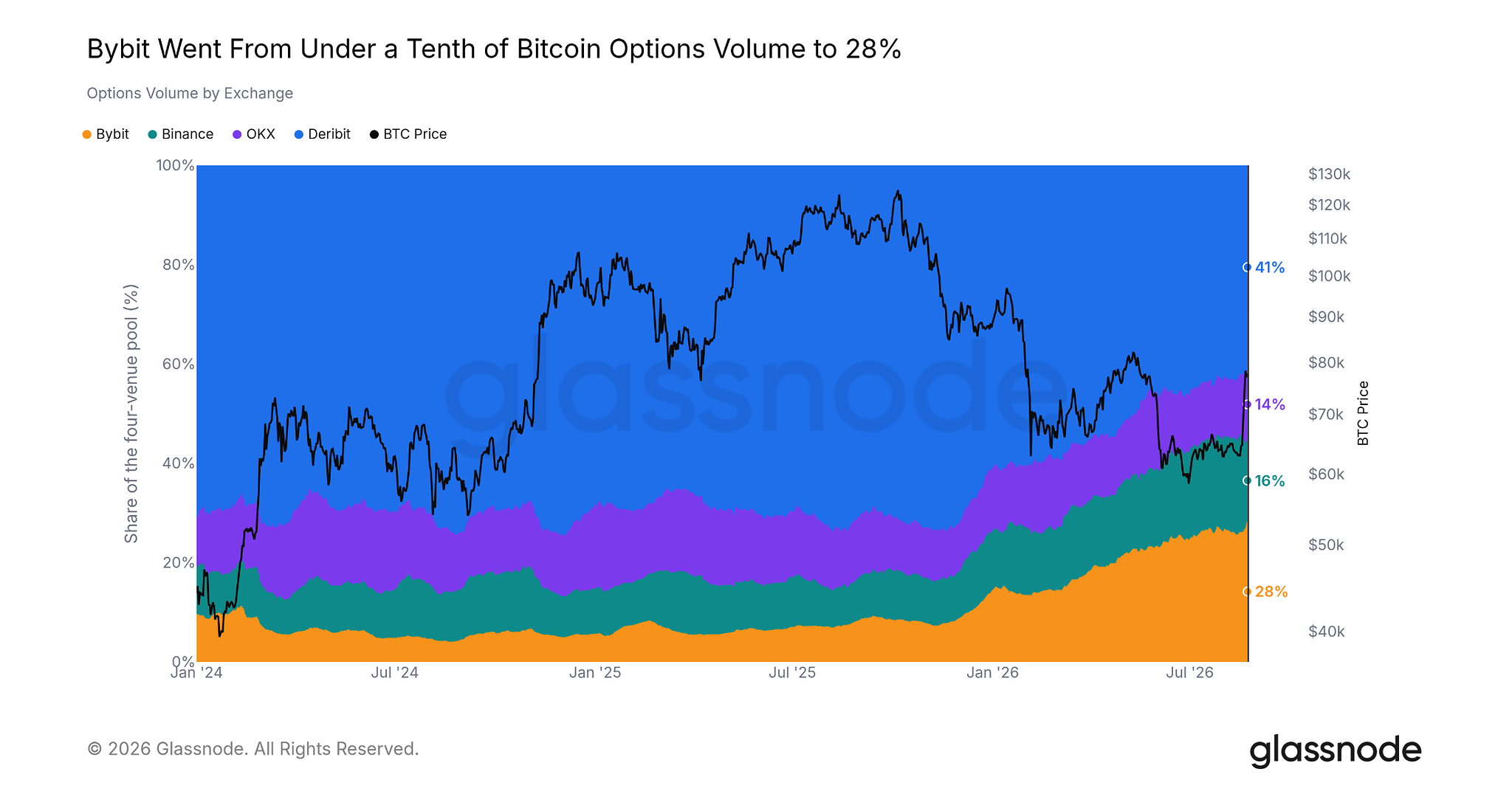
Glassnode research finds crypto options increased from roughly 25% to nearly 50% of derivatives notional open interest, while dated-futures volume has fallen about 97% from 2021 as trading shifts toward perpetuals and options. Bybit's share of tracked Bitcoin options volume rose from under 10% to 28%, and its options book expanded to $2.33B from $529M in its first month. Bybit also led tracked Ether options volume for 143 consecutive days and held 97.1% of tracked tokenized-gold options open interest, underscoring its growing derivatives-market position.
Analysis
The investable implication is not Bybit-specific—Bybit is private—but that crypto risk transfer is migrating from linear leverage into volatility products. That should deepen implied-volatility surfaces, make dealer gamma positioning more consequential around ETF flows, token unlocks and macro events, and ultimately increase the value of regulated clearing, margining and block-liquidity infrastructure. CME is the listed beneficiary only if institutional participants choose regulated venues for that migration; the cited dataset explicitly excludes CME, so offshore volume-share gains cannot be read as evidence of CME share loss.
Near term, this is weak as a directional crypto signal: greater options use can suppress realized volatility through hedging in quiet markets, then amplify spot moves when concentrated dealer hedges must be adjusted near large strikes. Over 1-3 months, monitor CME crypto options average daily volume, open interest, bid/ask spreads and institutional commentary for confirmation that the structural shift is crossing into regulated markets. Over 6-18 months, offshore venues with concentrated liquidity face a non-linear regulatory and counterparty-risk discount; a compliance event, stablecoin disruption, or exchange deleveraging episode would favor CME's trust premium while impairing the assumed durability of offshore liquidity leadership.
Contrarian view: faster turnover is not necessarily durable liquidity. It can reflect short-dated speculation and incentive-driven flow, which produces headline volume but less dependable depth during stress. The more important test is whether market makers maintain tight spreads and orderly liquidation through a volatility shock; until that is independently verified, this is an industry-structure watch item rather than a catalyst for a listed-equity re-rating. RDDT has no identifiable earnings or valuation linkage to the reported market-structure change.
AllMind Terminal
AI-powered research, real-time alerts, and portfolio analytics for institutional investors.
Request TrialMarket Sentiment
Overall Sentiment
moderately positive
Sentiment Score
0.48
Key Decisions for Investors
- No immediate standalone trade on the release. Keep CME on a 1-3 month watchlist; upgrade only if reported crypto options/open-interest growth and transaction-revenue commentary demonstrate regulated-market participation rather than offshore substitution.
- For existing CME exposure, use a relative framework: long CME versus a basket of exchange-sensitive crypto proxies only after a regulatory or counterparty stress event widens the regulated-versus-offshore liquidity premium. Thesis is falsified if CME crypto ADV/OI fails to improve through the next two reported operating-stat periods.
- Avoid treating RDDT as a crypto-derivatives expression; there is no direct revenue sensitivity, balance-sheet linkage, or disclosed operating catalyst in the available information.
- For digital-asset books, set alerts around unusually large BTC/ETH option-expiry concentrations and spot-to-strike proximity; consider reducing unhedged beta into expiry windows rather than chasing reported venue-volume trends. The actionable signal is a sustained rise in implied volatility alongside deteriorating spot liquidity, not options volume alone.
More News
- Is the AI safety debate about safety or control?
- Yen weak ahead of BOJ decision; rate hike expected
- Gold Climbs Amid Sliding Dollar, Yields
- This AI-picked stock jumps 18% on Amazon’s $8 billion power deal
- Asian stocks rise as oil retreat eases inflation fears, BOJ in focus
- A breakout in the 10-year Treasury yield could hold back stocks if it reaches this level