
Dongguk University Researchers Develop New Ultrathin Battery Platform With Enhanced Energy Density
Source: PR Newswire
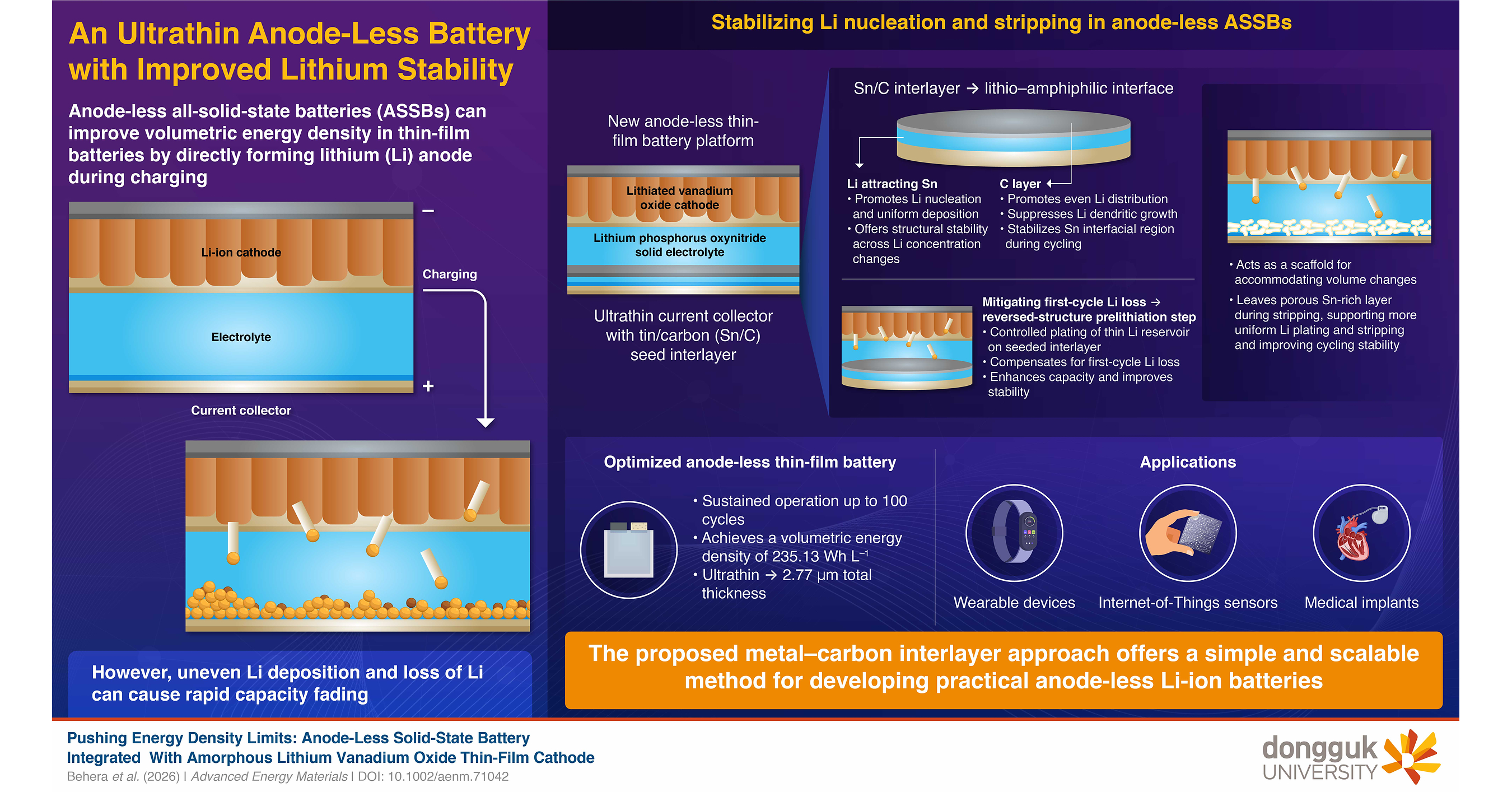
Dongguk University researchers reported an anode-less thin-film solid-state battery reaching 235.13 Wh/L at the 100th cycle at 0.01 C, with an overall thickness of 2.77 micrometers. An ultrathin tin/carbon interlayer and prelithiation were used to guide lithium deposition and compensate for lithium loss; the results are a research demonstration, not a commercial product launch.
Analysis
Investment read-through is narrow: this is a promising interface result for micro-scale thin-film cells, not evidence that the economics or performance of automotive solid-state batteries have changed. The reported result is tied to one LVO/LiPON laboratory architecture and a very low cycling rate; it does not establish commercially relevant areal capacity, fast-charge behavior, long-duration cycling, manufacturing yield, or cost. The claimed industrial-scale relevance therefore remains a hypothesis.
The second-order trade-off is important: prelithiation may compensate for lithium loss, but adding a controlled lithium-deposition step introduces process, handling, and quality-control burdens that could erode the simplicity advantage of anode-less designs. If the approach proves manufacturable, the nearer beneficiaries would be specialist thin-film battery developers and suppliers of deposition/coating equipment and materials—not necessarily mass-market cell makers. Incumbent liquid-electrolyte or EV battery economics are unlikely to move on this evidence alone.
Timing: negligible fundamental impact for listed battery equities today; over 1–3 months, look for independent replication and fuller cell metrics; over 6–18 months, the relevant test is transfer to larger-area cells with commercially meaningful loading, rate, and cycle life. Contrarian point: the thin form factor may matter more than headline energy density for wearables, sensors, and medical devices, but the press release does not establish customer qualification or a production path. No broad ASSB trade is justified absent validation.
AllMind Terminal
AI-powered research, real-time alerts, and portfolio analytics for institutional investors.
Request TrialMarket Sentiment
Overall Sentiment
mildly positive
Sentiment Score
0.30
Key Decisions for Investors
- Do not add broad solid-state or EV-battery exposure on this announcement alone; treat it as a low-impact research signal rather than a near-term earnings catalyst.
- Put thin-film battery developers and coating/deposition suppliers on a watchlist, not a buy list. Reassess only when independent data disclose areal capacity, cycle retention beyond 100 cycles, practical charge rates, cell area, and reproducible manufacturing yield.
- Track whether prelithiation can be controlled at scale without undermining safety, throughput, or cost. Evidence of a required high-complexity lithium-handling step would weaken the commercial case even if lab cycling improves.
- Falsify the cautiously positive thesis if larger-format tests show rapid capacity fade, poor performance at practical rates, or no credible route from the demonstrated LVO/LiPON stack to repeatable production.
More News
- Binance co-CEO Richard Teng says hackers used fake job interviews, AI tool to steal $6.3 billion in crypto 108511116
- AMD stock jumps 7% on earnings as data center revenue nearly doubles
- Marvell-Lumentum Deal Puts Optical Networking at the Center of the AI Boom
- The Strait of Hormuz closure has cost Europe an extra $142 billion for the same energy it was already buying
- Marvell Technology could plunge on latest multibillion-dollar acquisition
- Disney Plans Thousands of Layoffs Companywide