
BYD’s New EV Charges Ultra-Fast But God’s Eye Self-Driving Software Needs Work
Source: Bloomberg
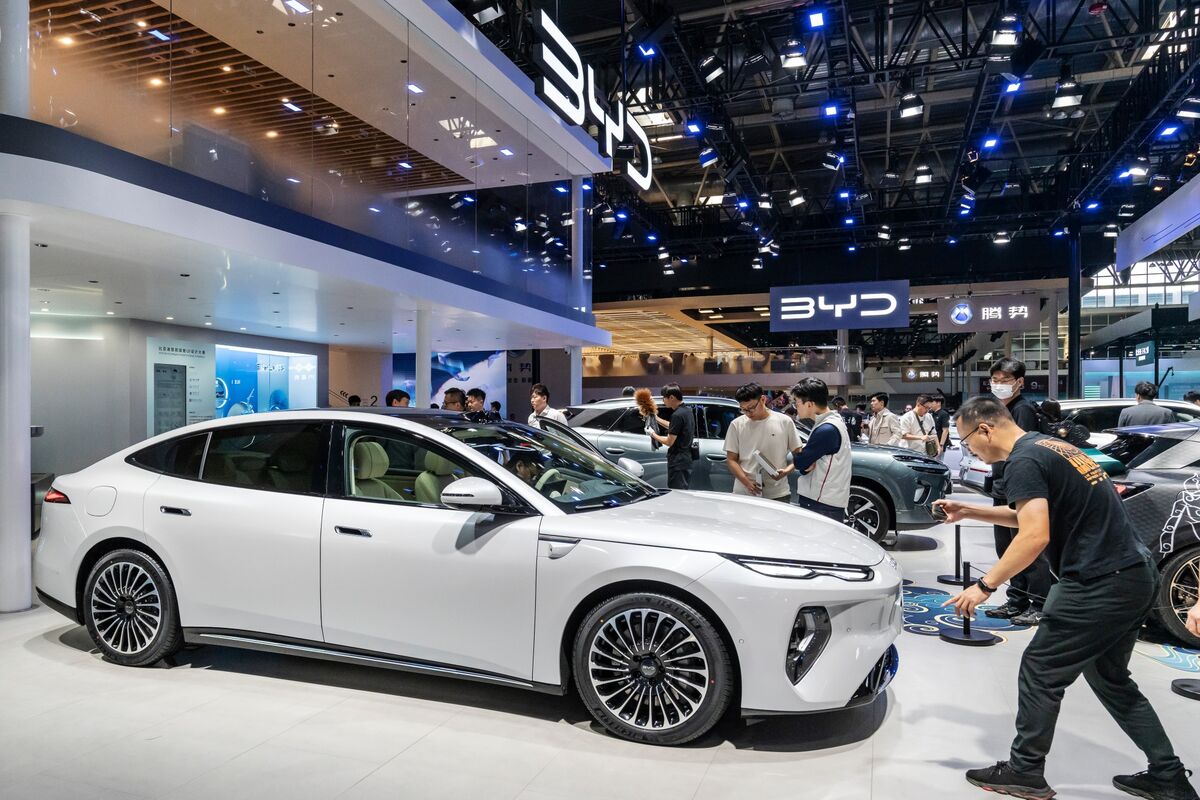
BYD's new electric sedan demonstrated strong ultra-fast-charging and battery capabilities in a Shanghai road test, reinforcing the company's leadership in EV battery technology. However, its driver-assistance software underperformed, with the review cautioning drivers to remain ready to take control. The mixed product assessment highlights a potential software gap for BYD despite its hardware strengths.
Analysis
The relevant investment question is whether BYD can sustain a hardware-led premium while advanced driver-assistance systems become a decisive purchase criterion in China. Charging speed reduces a highly visible adoption friction, but software deficiencies can limit take rates on higher-trim vehicles, raise warranty/liability costs, and constrain gross-margin mix improvement. This matters more for BYD than for pure volume competition: its valuation upside increasingly depends on moving buyers into higher-price models rather than simply defending unit share through aggressive pricing.
Near term (days to 3 months), this is unlikely to alter delivery estimates absent evidence of weak orders or elevated customer complaints. The more actionable read-through is competitive: Huawei-backed ADAS ecosystems—principally linked to SERES (601127 CH) and Chery partners—and XPeng (XPEV), which markets urban-navigation capability as a core differentiator, may gain consideration among technology-focused buyers. Tesla (TSLA) retains software brand equity, but its China benefit depends on regulatory approval and localized feature rollout rather than BYD’s execution alone.
Over 6-18 months, BYD's charging leadership could become less differentiating as 800V architectures and high-power charging networks diffuse across Chinese OEMs. The contrarian view is that ADAS quality is not yet the mass-market gating factor: price, charging access, and reliability still dominate for BYD's core customer. A material negative thesis requires confirmation that software limitations impair premium-model mix, not merely unfavorable road-test impressions; monitor quarterly vehicle ASP, automotive gross margin, and high-end-brand delivery growth against XPeng and Huawei-affiliated peers.
AllMind Terminal
AI-powered research, real-time alerts, and portfolio analytics for institutional investors.
Request TrialMarket Sentiment
Overall Sentiment
mixed
Sentiment Score
0.05
Key Decisions for Investors
- No standalone directional trade on this product review; treat it as a watch item until BYD reports evidence of weaker premium-model mix or guides to incremental software/R&D spending.
- For China EV exposure over the next 1-3 months, consider a relative-value basket long XPEV versus short a broad China EV proxy (KARS) only after XPEV demonstrates sustained delivery outgrowth; the thesis is ADAS-driven mix differentiation, while the stop is a renewed BYD-led price-cut cycle that compresses the entire sector.
- Monitor BYD’s next earnings for automotive gross-margin erosion of more than 150 bps sequentially alongside declining ASPs; that combination would support a more defensive stance on Chinese EV suppliers and battery-material names exposed to continued price competition.
- Avoid using TSLA as a direct short-term hedge to BYD software risk. Add TSLA only if China ADAS regulatory approvals or localized feature launches provide a distinct catalyst; without that, the read-through is too indirect and China pricing remains the dominant earnings variable.
More News
- What investors need to know about Alphabet's stock-busting earnings report
- Our next steps for Alphabet stock after earnings disappoint at nearly every turn
- Fortinet’s stock is taking a dive after earnings. Here’s why.
- Wendy's shares jump 15% as Nelson Peltz's Trian offers $1.4 billion to buy burger chain
- Microsoft's Big Bets on AI Start to Pay Off
- Google's Gemini 4 Carbon looks like a diamond in the rough