
PayerParity Publishes 5,000-Claim Test Against the CMS Web Pricer: Every Inpatient Claim Within $1.00, Largest Gap 22 Cents
Source: PRWeb
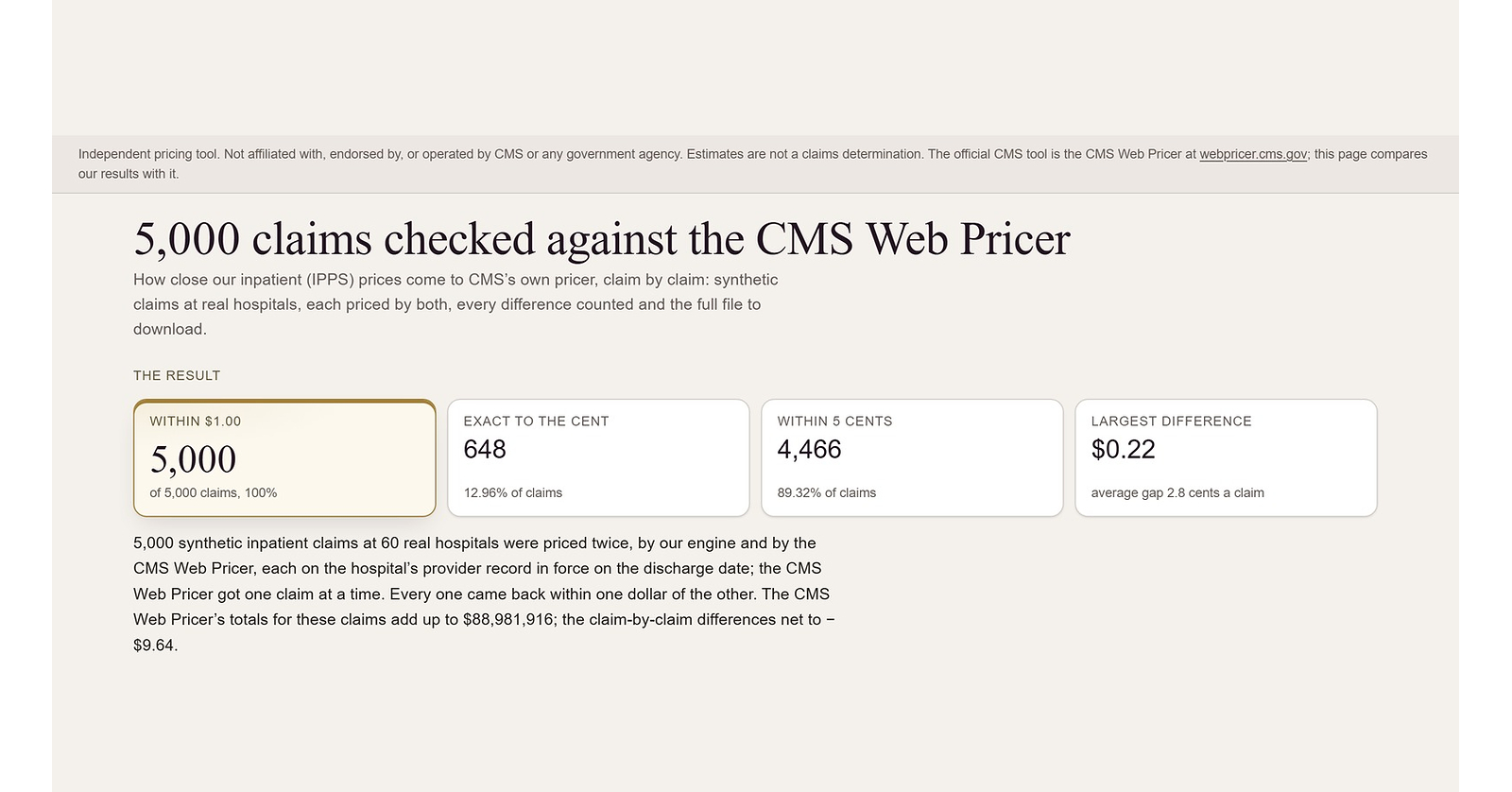
PayerParity reported that all 5,000 synthetic Medicare inpatient claims in its public test priced within $1.00 of the CMS Web Pricer; the largest gap was 22 cents and the average absolute difference was 2.8 cents across $88,981,916 in payments. The test used records from 60 hospitals and included 298 transfer claims and 165 cost outliers. The company is offering health plans free access and no-charge pricing for up to 50,000 plan-specific scenario claims; the release is promotional and the published accuracy test covers inpatient claims.
Analysis
PayerParity’s strongest potential advantage is not a few cents of pricing accuracy; it is making the calculation inspectable. If payer teams use that transparency as a procurement benchmark, vendors competing for pricing and payment-integrity work could face lower prices or pressure to expose their own calculation logic. The countervailing effect is that a tool that makes payment calculations easier to audit may reduce dispute-handling friction, rather than create equivalent savings in claims expense.
The evidence is narrower than the commercial pitch: it supports replication of CMS inpatient pricing on a synthetic test set, not live-claim accuracy, correct contract interpretation, realized savings, or performance across the other product lines. A free 50,000-claim evaluation is a customer-acquisition offer, not proof of willingness to pay. The key 1–3 month signal is whether evaluations convert into paid deployments; over 6–18 months, broader product credibility depends on independently verifiable results beyond inpatient claims and evidence of repeatable customer economics.
Potentially exposed competitors include payment-integrity and claims-pricing vendors such as Optum, Cotiviti, and Zelis, but the article establishes no displacement or revenue impact for them. The larger listed health insurers should not be repriced on this announcement alone: any savings depend on adoption, contract terms, claim volume, and operational use. The contrarian risk is treating transparent arithmetic as a moat; incumbents can potentially match the feature, while payer procurement and integration cycles may limit a small entrant’s reach.
AllMind Terminal
AI-powered research, real-time alerts, and portfolio analytics for institutional investors.
Request TrialMarket Sentiment
Overall Sentiment
mildly positive
Sentiment Score
0.25
Key Decisions for Investors
- No directional equity trade on this release alone. PayerParity’s financials, customer conversion, and commercial pricing are undisclosed, and the test does not establish insurer-level savings.
- Treat this as a diligence alert for payment-integrity and pricing vendors: watch for disclosures of pricing concessions, lost renewals, or adoption of claim-level audit tools. Consider a relative short only if such evidence appears; do not infer it from the product launch.
- For a 1–3 month follow-up, seek paid-pilot conversion, recurring contract wins, and independently checked results on real-world claims and contract scenarios. Failure to show conversion would weaken the competitive-disruption thesis.
- Payer teams can consider a parallel-pricing pilot, but should validate live-claim performance and contract logic before relying on outputs in payment decisions; CMS-rate replication alone is not proof of recoverable overpayment.
More News
- Marvell to buy Lumentum in $115 billion deal in AI data-center bet
- Marvell, Lumentum tout historic $115B deal to create ‘category leader' in AI connectivity
- Palantir reports booming U.S. commercial revenue growth, topping government for first time
- Anthropic releases amended IPO prospectus with third-quarter financials
- Coinbase has been battered over the past month. Morgan Stanley says steer clear
- The AI boom is facing another supply crunch. This time it’s the amount of capital available to feed Silicon Valley’s endless need for cash