
New Research: Visual Basic 6 Drives Two-Thirds of Legacy Modernization Demand
Source: PR Newswire
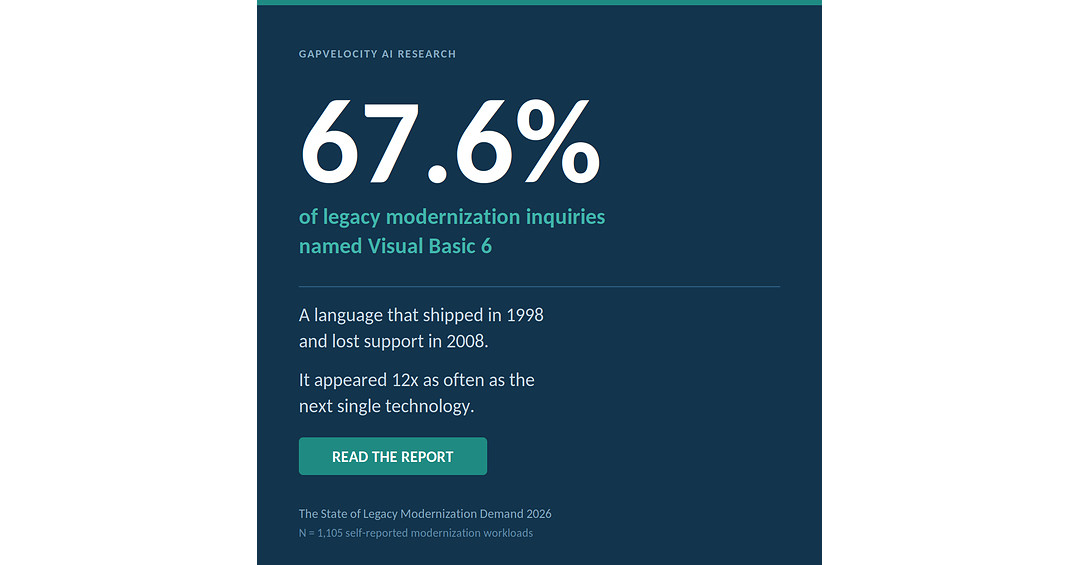
GAPVelocity AI’s “State of Legacy Modernization Demand 2026” report finds Visual Basic 6 drives 67.6% of legacy modernization inquiries (747 of 1,105 organizations), with pre-2000 technologies representing 83% of demand. It also highlights that inquiry counts can mislead: VB6 accounts for ~68% of organizations by count, but only ~30% when weighted by code volume, with PowerBuilder and Clarion rising to ~32%. The company frames AI modernization claims as requiring validation against real target stacks, and will demo VB6-to-Blazor modernization on Azure via its VELO platform on Sep. 16, 2026.
Analysis
The commercial read-through for MSFT is less about a one-quarter revenue pop and more about ecosystem gravity. Enterprise modernization still sits in the long-tail of pre-2000 code, which means the real economic prize is owning the target stack when those projects finally move from discovery to rewrite. That favors Azure, .NET/Blazor, and Foundry as the default landing zone, so Microsoft can quietly gain workload stickiness even if the original migration spend is booked elsewhere.
The second-order winner set is likely a mix of niche migration tooling and labor-heavy integrators, but the margin profile is different for each. Software vendors can scale the same playbook across many apps, while services firms may see higher deal flow but lower hours per conversion as AI compresses routine refactoring work. The biggest loser is not a named legacy platform so much as internal IT budgets that get forced into a multi-step modernization program rather than a clean SaaS replacement.
Near term, this is an attention catalyst, not a fundamental catalyst: webinar/demo day, then a few quarters of pipeline evidence. The contrarian point is that the headline demand share is probably too Microsoft-skewed to extrapolate broadly, and the hard part is not code translation but business-rule extraction, testing, and governance. If Azure growth or Foundry attach does not show up in the next 1-2 earnings cycles, the stock should treat this as marketing noise rather than a monetizable trend.
AllMind Terminal
AI-powered research, real-time alerts, and portfolio analytics for institutional investors.
Request TrialMarket Sentiment
Overall Sentiment
mildly positive
Sentiment Score
0.15
Ticker Sentiment
Key Decisions for Investors
- Do not initiate a fresh MSFT trade solely on this report; treat it as a watch item until Azure/Foundry attach is visible in earnings commentary. Falsifier: no mention of modernization-driven pipeline over the next 1-2 quarters.
- On a 3-5% pullback in MSFT, consider a small defined-risk call spread 2-4 months out to express the ecosystem-attach thesis. Risk/reward is acceptable only if you believe modernization spend will translate into cloud consumption, not just partner revenue.
- If follow-up channel checks show migration tooling reducing billable effort per project, pair long MSFT / short a services-heavy IT basket (ACN, CTSH, EPAM) for 1-3 months. The trade works if software capture rises faster than labor content; exit if services firms guide to higher consulting utilization.
More News
- Nvidia GPUs are everywhere. Here are the ways companies are accessing them
- AI's Supercharging a Scam Economy Bigger Than the Cocaine Trade
- Microsoft's Nadella says AI needs an ‘emergency brake’ that humans control
- Big Tech is betting $700 billion on AI. Healthcare will decide whether the bet pays off
- Microsoft’s Satya Nadella says AI models need an ‘emergency brake’
- Microsoft leans on open weight model from Chinese AI lab to challenge Jev