
AMD: Winning The Next Phase Of The AI Supercycle
Source: seekingalpha.com
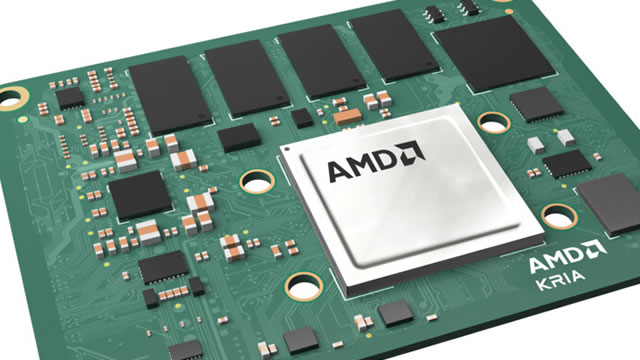
AMD is described as Bullish, citing Helios rack-scale systems plus acquisitions to drive agentic AI inference and to challenge Nvidia’s CUDA moat. The thesis rests on multi-gigawatt hyperscaler contracts and a stated ~30% tokens-per-dollar cost advantage, supporting long-term EPS growth and margin expansion. Key downside risk highlighted is a potential U.S. ban on Chinese optical transceivers, which could disrupt Helios deployments and pressure AMD’s elevated forward valuation.
Analysis
AMD’s opportunity is not just unit share; it is whether hyperscalers start valuing inference throughput per dollar more than software familiarity. If that happens, the upside shows up first in deployment velocity and mix, then in gross margin leverage as rack-scale systems scale, but the market will pay for proof of conversion rather than rhetoric. The choke point is no longer only accelerators; optics, interconnect, and rack integration become the gating item, so any policy disruption there can delay revenue recognition even if demand is intact.
NVDA remains the cleaner “default” winner in the near term because CUDA and bundled software reduce implementation friction when buyers want immediate capacity. That makes AMD’s bull case more fragile than it looks: hyperscalers can pursue lower tokens-per-dollar while simultaneously extracting price concessions, which may cap AMD’s multiple expansion before it meaningfully changes earnings. The consensus may be underestimating how quickly a supply-chain or export-control headline can compress a high-forward-multiple name whose thesis depends on flawless execution.
Over 1-3 months, the key catalyst is whether announced rack-scale wins translate into visible shipment cadence; over 6-18 months, the question is whether AMD builds enough software and systems lock-in to sustain share without constant pricing pressure. A U.S. move on Chinese optical transceivers is the main tail risk: it would slow deployments, hurt sentiment first, and only later show up in estimates. Falsifiers are simple: delayed hyperscaler rollouts, weaker-than-expected AI revenue conversion, or NVDA commentary showing no share leakage.
AllMind Terminal
AI-powered research, real-time alerts, and portfolio analytics for institutional investors.
Request TrialMarket Sentiment
Overall Sentiment
mildly positive
Sentiment Score
0.35
Ticker Sentiment
Key Decisions for Investors
- Initiate a small relative-value long AMD / short NVDA pair on any post-news weakness, with a 1-3 month horizon; target 10-15% relative outperformance if deployment confirmations continue, and cut if AMD shipment timing slips or NVDA reasserts pricing power.
- Do not chase AMD outright here; wait for either hyperscaler order conversion or a cleaner regulatory read-through before adding directional exposure. The valuation is too dependent on execution proof to pay up in front of policy risk.
- Buy AMD 3-6 month call spreads only if U.S. optics/export headlines stay quiet and the next catalyst confirms rack deployment cadence; this keeps upside exposure while limiting downside if the thesis stalls.
- Set an alert on U.S. restrictions around optical transceivers and rack interconnects; if the policy risk escalates, reduce AMD exposure immediately and rotate toward the more defensible incumbent ecosystem in NVDA.
- If the next earnings cycle shows no acceleration in AI revenue conversion despite the announced wins, treat that as a thesis break and take profits on any AMD long before the market de-rates the multiple.
More News
- AI agents are agreeing and acting: machines are now smarter than humans. Their principals merely agree
- Nvidia CEO Jensen Huang emerges as Trump's top ally in AI safety debate
- Buying This Hidden Software Stock Might Just Give You Massive Exposure to the Anthropic IPO
- OpenAI Just Beat Google, Meta, and Amazon To This Key Milestone. Is It Bullish for AI Stocks.
- California’s billionaire tax will ‘kickstart a movement’ that spreads to more states, the federal government and other countries, Nobel laureates say
- The Caterpillar Correction Shouldn't Last Much Longer