
Why Dell Technologies stock is gaining 5% today?
Source: invezz.com
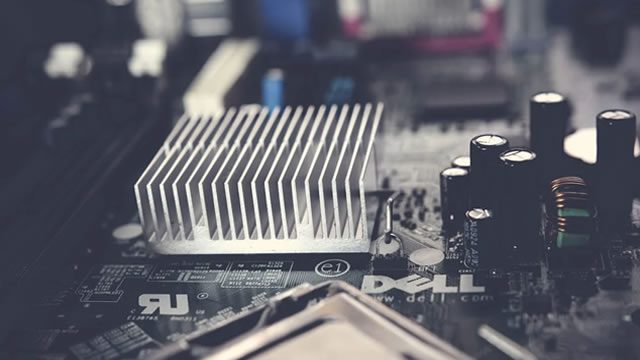
Dell Technologies shares rose more than 5% after Goldman Sachs raised its outlook for the global server market, citing sustained AI-infrastructure demand. Goldman forecasts the server market will reach $1.5 trillion by 2030, implying a 39% CAGR from 2025 to 2030. The revised forecast supports a bullish demand backdrop for Dell's server and AI infrastructure businesses.
Analysis
The key earnings sensitivity is not aggregate AI-server TAM but Dell's ability to convert enterprise demand into higher-margin attach revenue. AI servers are typically lower gross-margin than storage, services and commercial PCs, while requiring substantial inventory and receivables financing; revenue upside without mix discipline could lift working capital and leave EPS less responsive than bullish unit assumptions imply. The more direct AI infrastructure monetizers remain NVDA, AVGO, ANET and VRT, which capture scarce silicon, networking and power/cooling content rather than primarily systems integration economics.
Over the next 1-3 months, Dell's valuation will hinge on AI-server backlog conversion, shipment timing and gross-margin guidance rather than further top-down TAM revisions. A strong order book can still disappoint if GPU availability, customer data-center readiness or sovereign/enterprise financing pushes revenue recognition out; this is particularly relevant for large, customized deployments. HPE and SMCI are the closest competitive read-throughs: aggressive pricing or extended lead times from either would indicate that the market is prioritizing share capture over system profitability.
The contrarian view is that a long-duration market forecast has limited incremental value after a single-session rerating. Consensus may be underestimating the risk that hyperscalers internalize more rack integration and that enterprise AI spending remains concentrated in pilots, constraining Dell's pricing power. Conversely, Dell is underappreciated only if management demonstrates that AI deployments pull through storage, networking, support and financing, creating a recurring profit pool rather than a low-margin hardware pass-through.
For the 6-18 month horizon, power availability and data-center construction are likely the binding constraints, favoring VRT and ETN before server OEMs if compute demand remains robust. A sustained move higher in AI infrastructure capital spending should therefore produce greater operating leverage in thermal/power and networking than in Dell unless Dell's services and storage attach rates visibly accelerate.
AllMind Terminal
AI-powered research, real-time alerts, and portfolio analytics for institutional investors.
Request TrialMarket Sentiment
Overall Sentiment
strongly positive
Sentiment Score
0.58
Ticker Sentiment
Key Decisions for Investors
- Do not chase DELL solely on the analyst-driven move; establish a watch trigger around the next earnings report for AI-server revenue conversion, gross-margin trajectory and working-capital commentary. Initiate only if management shows both shipment acceleration and stable/improving margin mix; a guidance cut or material receivables build would falsify the thesis.
- Prefer a 3-6 month pair trade: long VRT or ETN / short DELL in equal beta-weighted dollars. The trade expresses power-and-cooling bottlenecks versus OEM integration-margin risk; cover if Dell reports clear evidence of high-margin services/storage attach or if VRT/ETN order growth decelerates materially.
- For direct compute exposure, maintain NVDA or AVGO over DELL where portfolio constraints permit: silicon and custom-ASIC suppliers retain stronger pricing power during capacity-constrained demand cycles. Reassess if GPU supply normalizes faster than demand or hyperscaler capex guidance weakens.
- Monitor HPE and SMCI results over the next two reporting cycles as competitive pricing signals. Evidence of share-driven discounting, declining server gross margins, or elongated deployment schedules is a negative read-through for DELL and argues against adding exposure.
More News
- Hot or not? The economy’s fate rests on Kevin Warsh’s answer to one key question
- Goldman Sachs stock falls after CEO warns of softer trading
- Americans are so concerned about autonomous vehicles that Minneapolis is considering requiring drivers to sit inside Waymos
- Goldman Chief US Economist: Economy Isn't Overheating
- Goldman says the economy is rewarding capital ownership over labor — and most Americans don’t own enough of it to benefit
- Anthropic IPO will benefit these two mega-cap stocks
From AllMind Research
- Anthropic IPO Preview: Valuation, Timing, and What to Watch
- Shein After the IPO: Venue, Valuation, and What Must Be Proved
- What AI Research Tools Should a Small Hedge Fund Buy First?
- Weekly Update: AI-Powered Report Editing, Investor Relations, and Enhanced Search
- Automating Financial Model Updates: A Source-Controlled Workflow