
Automakers Eye $60.6B in Savings as Fuel Economy Rules Ease
Source: zacks.com
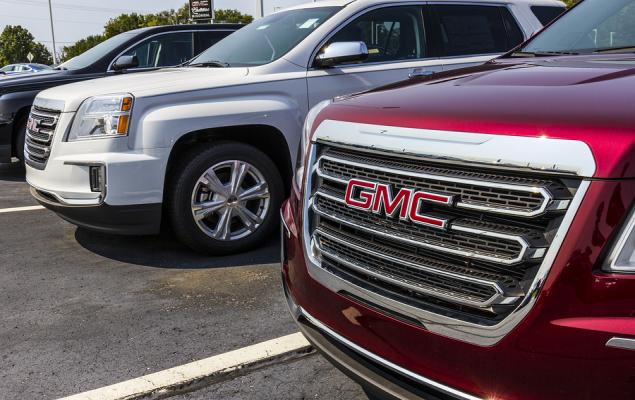
The Trump administration's rollback of Biden-era CAFE standards is projected to reduce automakers' compliance-related technology spending by $60.6B through 2031, lowering the required fleet-average fuel economy target to 34.9 mpg from roughly 50.4 mpg. GM is projected to save $20.4B, followed by Stellantis at $6.6B, Ford at $5.8B, Toyota at $4.5B and Honda at $4.1B; these are cost reductions rather than direct profit gains. NHTSA estimates 2031 vehicle costs could decline by $1,289 if manufacturers pass savings to consumers, while the policy shift may further slow industry electrification investment.
Analysis
The market should not capitalize the stated compliance reductions as near-term earnings: they are multi-year avoided costs, subject to product-cycle decisions, and only a fraction converts to EBIT after pricing, dealer incentives, labor, and reinvestment. GM has the greatest operating leverage because its North American mix is disproportionately trucks/SUVs, but that same mix leaves it most exposed if gasoline rises or residual values weaken. The first tradable signal is not the December effective date; it is 2027-28 capex guidance, EV program impairment charges, and the mix of buybacks versus incremental ICE/hybrid investment over the next two earnings cycles.
The more material competitive consequence is that policy relief narrows the regulatory advantage of hybrid-heavy TM and HMC while improving the economics of legacy Detroit portfolios. However, consumer fuel-cost sensitivity remains a market discipline independent of CAFE: sustained gasoline above roughly $4/gal or a cyclical recession would favor Toyota/Honda hybrids through lower total cost of ownership and better used-vehicle residuals. Suppliers tied to battery content and EV powertrain volumes—APTV, BWA, ALB and QS—face a 6-18 month risk of lower North American order assumptions; ICE/pickup-exposed suppliers such as MGA and DAN may see a modest offset.
Contrarian view: the policy shift may be less bullish for F and STLA than headline savings imply. Both need product investment and aggressive incentives to defend share, making avoided engineering spend more likely to fund price competition than margins. GM is the cleaner relative beneficiary only if it directs the cash toward repurchases/deleveraging rather than defending share in a slowing U.S. SAAR environment; a court stay, state-level zero-emission mandates, or higher fuel prices would quickly compress the regulatory windfall's value.
AllMind Terminal
AI-powered research, real-time alerts, and portfolio analytics for institutional investors.
Request TrialMarket Sentiment
Overall Sentiment
moderately positive
Sentiment Score
0.48
Ticker Sentiment
Key Decisions for Investors
- Initiate a 3-6 month long GM / short F pair, sized market-neutral. GM has the strongest policy-derived North American mix leverage and greater capacity to return cash; target 10-15% relative upside, with thesis invalidated by GM cutting 2027-28 free-cash-flow guidance, materially raising incentives, or announcing incremental EV impairment/capex.
- Do not chase a broad auto-beta rally in CARZ. Treat the regulatory benefit as a watch item until management quantifies annualized capex and compliance-cost savings in guidance; absent that disclosure, the news is unlikely to support a durable multiple rerating.
- Maintain or add TM and HMC on relative weakness rather than shorting them outright. Their hybrid scale remains the hedge against a gasoline-price shock and supports residual values; reassess if U.S. hybrid transaction pricing or hybrid mix declines for two consecutive quarters.
- Establish a 6-12 month tactical underweight in EV-content suppliers APTV and BWA versus XLI, contingent on OEM 2027-28 program-volume revisions. Cover if GM/F confirm stable battery procurement and EV production targets, or if state mandates/court action restore a tighter federal compliance trajectory.
- Set alerts around December implementation and subsequent litigation. A judicial stay or reinstatement of emissions-related constraints is the key reversal catalyst for the GM-over-F and supplier-underweight theses; rising retail gasoline prices are the demand-side falsifier.
More News
- California leads lawsuit against Trump fuel efficiency standards rollback
- The jobs report, Nike's China conundrum, Burger King's franchise bet and more in Morning Squawk
- Ford fends off Hyundai to retain No. 3 U.S. sales position in third quarter
- Chinese auto show debuts in Argentina as their sales surge
- Why is Stellantis stock rallying today?
- GM’s Mary Barra says the EV transition is still the destination—even if the road is longer