
UpKeep Research Finds Maintenance and Operations Teams Have Adopted AI Faster Than Their Companies Have, With Two-Thirds Using It and More Than Half Working Where None Is in Place
Source: PR Newswire
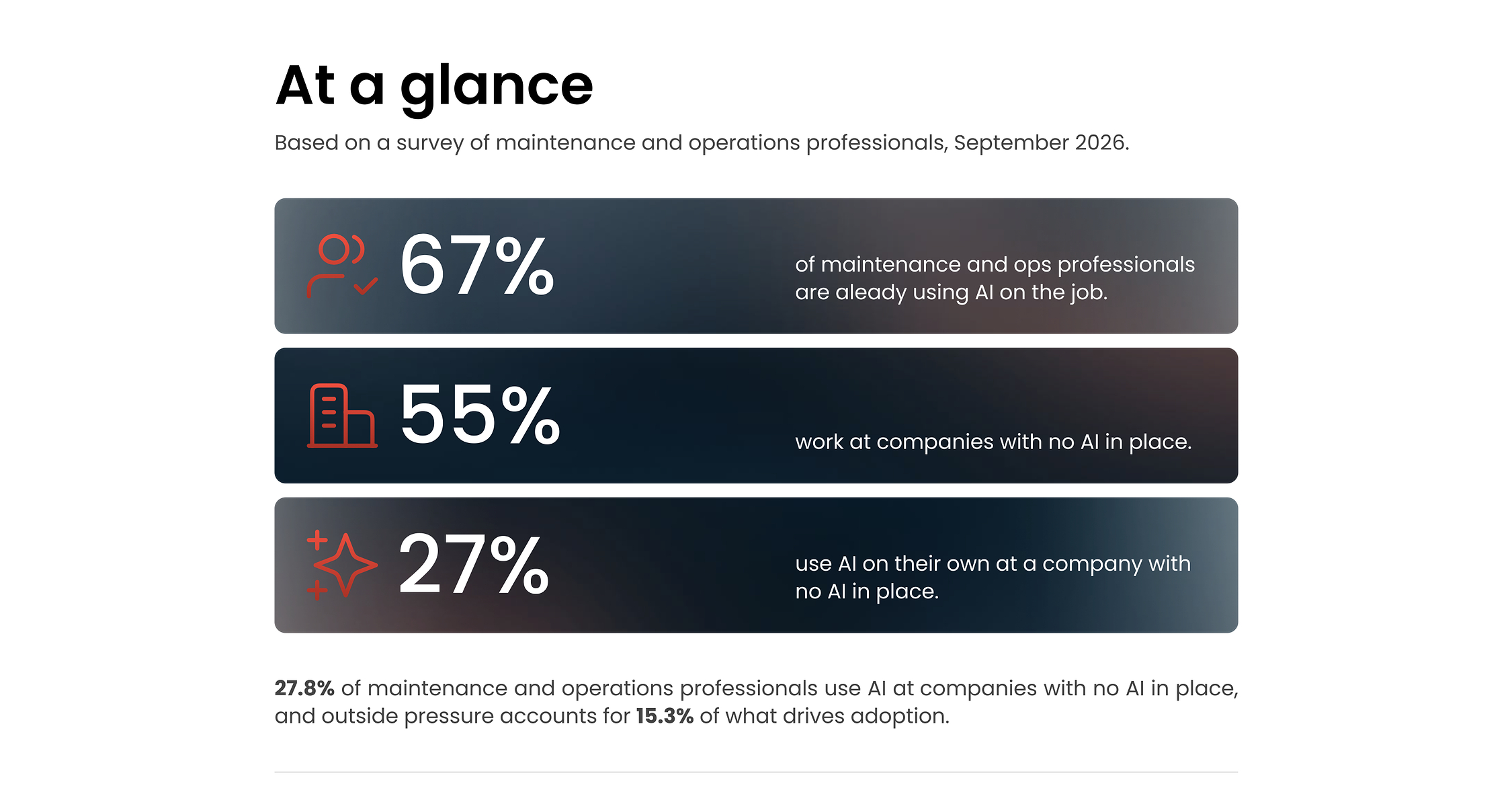
UpKeep’s survey of 518 maintenance and operations professionals found 67.8% use AI at least occasionally, while 55.4% work at organizations with no AI in maintenance or operations. Efficiency was the leading adoption driver (42.9%), and paperwork was the task respondents most often said AI could help with (43.1%); 69.3% said their teams sometimes change processes to fit their software. The report describes adoption opportunities and an Axon Enterprise case study, but provides no company financial results or market reaction.
Analysis
The investable signal is less “AI adoption” than where budgets may go first: administrative workflow automation, not autonomous equipment diagnosis. That favors vendors able to connect work orders, manuals, and asset histories inside governed systems; it is a weaker near-term read-through for AI model providers or predictive-maintenance claims. UpKeep’s customer/prospect survey is directional, not independent evidence of sector-wide conversion or incremental software spend. The gap between individual experimentation and organization-wide deployment points to a likely bottleneck in integration, permissions, and change management—not simply model capability. Incumbent maintenance and enterprise workflow vendors could defend accounts by adding copilots, limiting standalone-platform displacement; value may accrue to systems with installed asset data and distribution rather than the newest AI feature. The Axon example demonstrates a possible workflow improvement, but one locally built tool is not evidence of material consolidated savings or a repeatable product. For Axon, any benefit is likely operational and difficult to underwrite absent adoption scale, labor-hour or inventory metrics, and evidence of improved uptime. Near term, this release alone is not a catalyst. Over 1–3 months, watch vendor commentary for paid AI attach, deployment rates, and renewal/expansion evidence. Over 6–18 months, the structural upside depends on measurable workflow savings and whether customers consolidate systems rather than add another layer. The main reversal risk is pilots failing to clear data-quality, security, or frontline-adoption hurdles, leaving AI usage fragmented and software budgets unchanged.
AllMind Terminal
AI-powered research, real-time alerts, and portfolio analytics for institutional investors.
Request TrialMarket Sentiment
Overall Sentiment
neutral
Sentiment Score
0.10
Ticker Sentiment
Key Decisions for Investors
- No trade in AXON on this case study alone. Treat it as an operational proof point, not an earnings estimate; revisit only if Axon quantifies deployment scale or links it to measurable labor, inventory, or uptime improvement.
- Keep UpKeep and maintenance-software vendors on a diligence watchlist rather than buying an AI theme basket. Verify paid AI adoption, renewal uplift, implementation duration, and customer expansion before underwriting revenue acceleration.
- Prefer a relative-quality screen over a broad AI long: favor established maintenance/workflow platforms with usable asset data and enterprise controls over point tools dependent on isolated employee-built apps. This is a watch item, not a named-ticker recommendation.
- Falsify the adoption thesis if the next 1–3 months of vendor disclosures show pilots without paid conversions, no AI-related expansion in renewals, or persistent implementation/security delays; for Axon, require company-level operating metrics before assigning financial value.
More News
- The world needs Ukraine’s grain. Its farmers are running out of reasons to plant
- Verizon stock heads for worst day since 2002 as SpaceX U.S. network plans whack telcos
- Israel’s economy prospers despite years of war, but prices worry voters
- SpaceX’s Wireless Threat Rises With Spectrum Deal
- SpaceX to buy key spectrum that could help Starlink Mobile become major US cell carrier
- Why is the Chinese stock market missing the AI rally