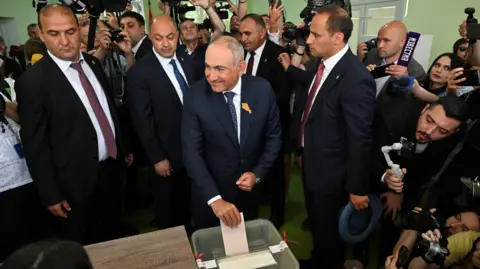
Armenia's ruling Civil Contract Party won 49.8% of the vote in a closely watched election, keeping Prime Minister Nikol Pashinyan on track to deepen ties with the West while remaining in the Eurasian Economic Union. The result comes amid ongoing tensions with Russia, which has reportedly restricted exports of Armenian goods and warned of economic costs from EU alignment. The election is important for regional geopolitics and Armenia's policy direction, but the immediate market impact is likely limited.
The immediate market read is not “pro-Western victory” so much as a temporary reduction in regime-risk discount. The bigger second-order effect is that Moscow’s leverage is now likely to shift from outright political influence to more selective economic coercion: energy pricing, export approvals, border logistics, and remittance friction. That means any relief rally in Armenian assets would likely be front-loaded and fragile unless the government can show credible diversification of gas, transit, and financing within the next 3-6 months.
For regional risk assets, the key winner is Georgia as the nearest substitute corridor for trade and logistics if Armenia keeps drifting westward, while the loser is Russia-facing transport, agricultural, and consumer exporters exposed to retaliation. The supply-chain angle matters more than headline geopolitics: bans on flowers, bottled water, spirits, and produce are low-cost signaling tools that can quickly impair cash flow for SMEs and create localized liquidity stress before it shows up in macro data. That kind of pressure usually hits with a 1-2 quarter lag and is more damaging to private-credit and local bank asset quality than to the sovereign itself.
The contrarian view is that the market may be overestimating the EU upside and underestimating the cost of the status quo. EU accession is a years-long process with weak near-term monetization, while the EAEU still anchors materially cheaper energy and market access; the country can stay politically pro-West and economically dependent on Russia at the same time. The real tail risk is not a clean geopolitical break, but a muddled middle where Armenia gets neither full Russian support nor meaningful EU integration, creating repeated policy shocks and episodic currency pressure. In that regime, the best trades are volatility and relative-value expressions, not outright directional bets on Armenia alone.
AI-powered research, real-time alerts, and portfolio analytics for institutional investors.
Request TrialOverall Sentiment
neutral
Sentiment Score
0.05
