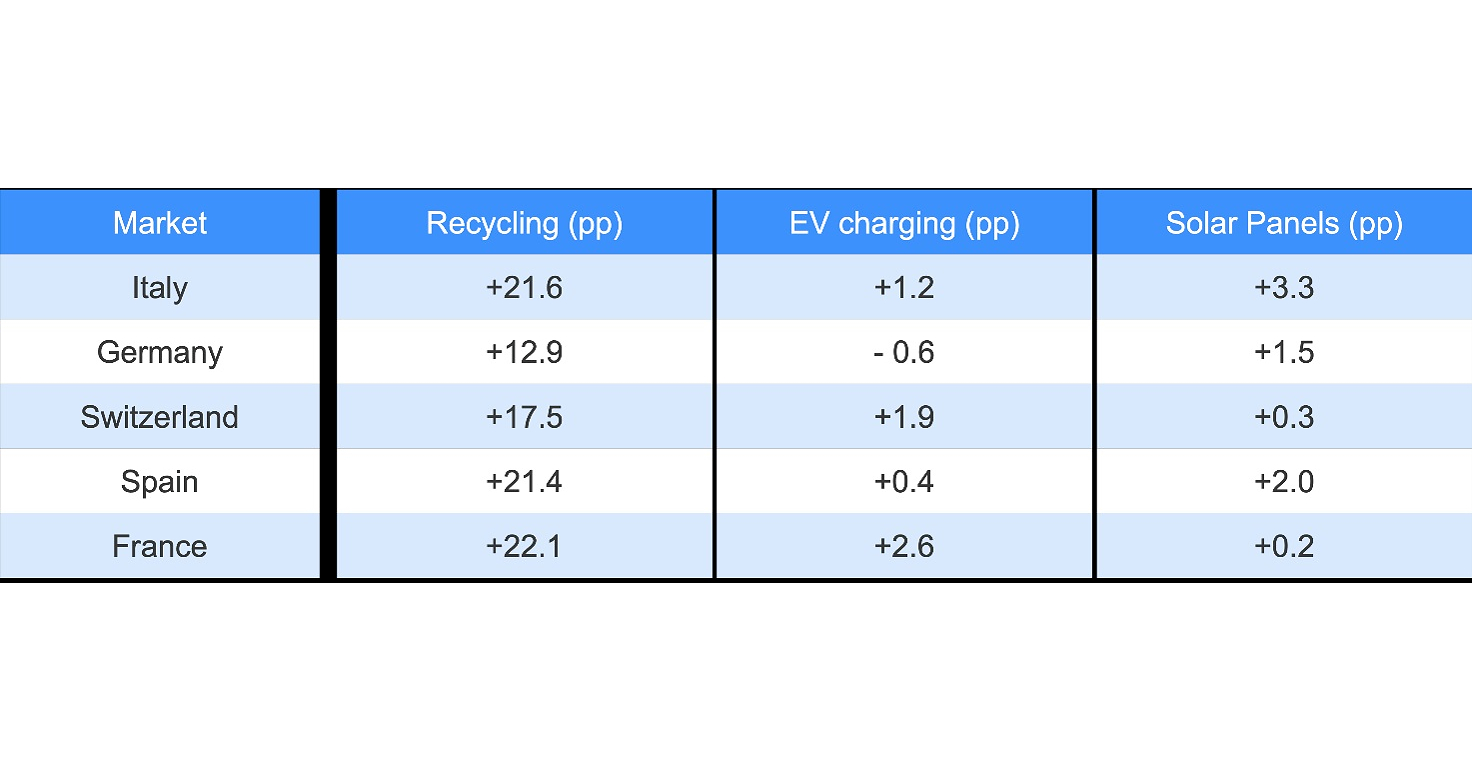
Interhome reports that “sustainable” summer bookings more than doubled from 2020 to 2025 across key European markets, with the sustainable share rising from 16.7% to 29.5% (+12.8pp). In 2025, the sustainable mix was highest in Italy at 40.1%, then Germany (36.1%) and Switzerland (35.9%), while France (16.1%) lagged. The analysis also highlights faster adoption of recycling (notably in France, Italy and Spain) and clearer EV-charging progress in France and Switzerland, supported by owner investments aimed at guest appeal and operating-cost reductions.
This is more useful as a supply-side signal than a pure demand story. If travelers really are sorting by sustainability attributes, the winners are the professionally managed, higher-quality European rental platforms that can finance retrofits and standardize disclosures; smaller owner-operated stock is at risk of losing visibility and occupancy. The second-order beneficiary set is not travel equity per se, but the retrofit ecosystem: EV-charger installers, building controls, efficient appliances, and solar/energy-management vendors that help hosts monetize a higher booking conversion rate and lower operating cost.
The near-term market impact should be limited because the evidence is self-reported and concentrated in one operator’s portfolio; that makes it more of a marketing sample than a broad demand index. The real catalyst path is 1-3 months, when summer booking data from other European managers or OTAs either confirms a green premium or shows it is mostly a quality/premium-location proxy. Over 6-18 months, the structural driver is regulation: energy-labeling, local rental rules, and financing costs will determine whether this becomes a true capex cycle or just a branding exercise.
The contrarian take is that consensus may be overestimating price-insensitive ESG demand. In vacation rentals, sustainability often correlates with newer assets, better maintenance, and higher ADR, so the incremental demand may not be caused by the green attributes themselves. If rates or household budgets tighten, travelers are likely to revert to price and location first, which would quickly expose whether the green premium is real or merely a descriptive label.
AI-powered research, real-time alerts, and portfolio analytics for institutional investors.
Request TrialOverall Sentiment
mildly positive
Sentiment Score
0.25
