
RoboParty Unveils RP1, a High-Performance Full-Stack Open-Source Humanoid Robot at IROS
Source: PR Newswire
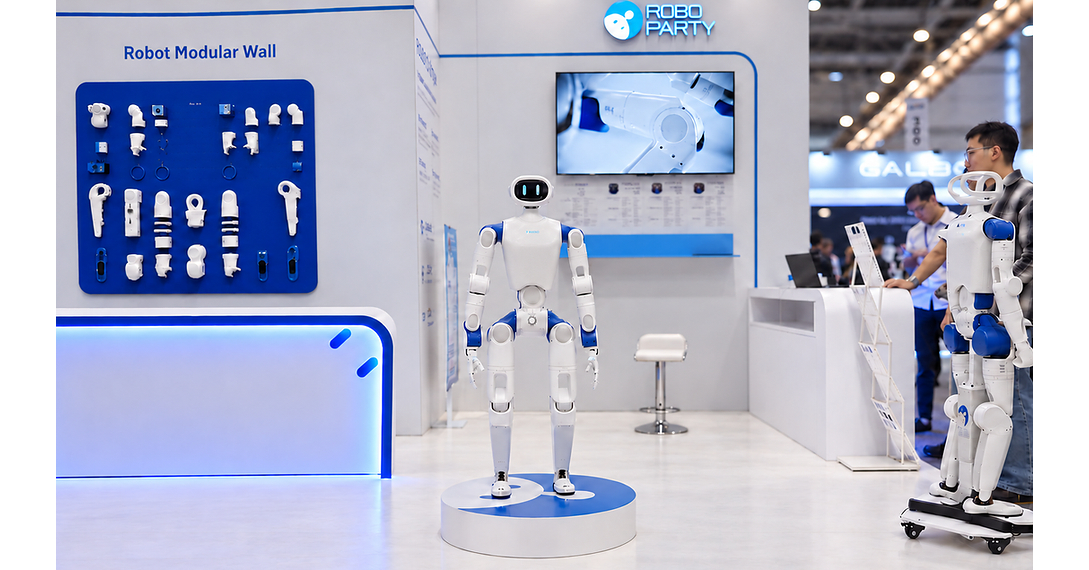
RoboParty unveiled RP1 (ROBOTO 01), which it calls the first high-performance full-stack open-source bipedal humanoid robot, at IROS 2026. RP1 delivers peak joint torque of up to 160 N·m and demonstrated balance recovery under external disturbances using PartyOS and its unsupervised reinforcement-learning control framework. The company plans additional open-source software and hardware releases in October and a mass-production program later in Q4 2026; its existing RPO project has surpassed 2,500 GitHub stars and its developer community exceeds 5,000 members.
Analysis
This is not yet a public-markets earnings event; the relevant signal is that open-source humanoid stacks could commoditize the lower layers of embodied AI faster than closed-platform vendors expect. If credible hardware, control and simulation tools become broadly reproducible, differentiation migrates toward proprietary training data, fleet deployment, safety certification, application integration and manufacturing yield. That is structurally more favorable to NVIDIA (compute/simulation ecosystem), Intel/Mobileye-adjacent edge-compute suppliers and industrial automation integrators than to humanoid OEMs whose valuation rests primarily on proprietary locomotion IP.
Near term, no trade is warranted from a conference demonstration or developer-interest claims. The October roadmap and subsequent production announcement are catalysts only if independently disclosed pricing, bill of materials, delivery lead times, unit commitments and software licensing terms establish that the platform is commercially accessible rather than a research project. A low-cost reference design could pressure private humanoid competitors' fundraising terms and eventually reduce the strategic scarcity premium attached to public robotics proxies such as Symbotic (SYM) and Teradyne (TER), though neither has direct humanoid revenue exposure.
Contrarian view: open sourcing can expand—not destroy—the addressable market for premium components. A larger developer base may standardize interfaces and accelerate demand for high-torque actuators, GPUs, simulation compute and sensors; component vendors retain leverage if reliability and supply qualification matter more than design files. The key 6-18 month question is whether community activity converts into paid hardware shipments and repeat component orders, not repository engagement or trade-show robustness demonstrations.
AllMind Terminal
AI-powered research, real-time alerts, and portfolio analytics for institutional investors.
Request TrialMarket Sentiment
Overall Sentiment
mildly positive
Sentiment Score
0.38
Key Decisions for Investors
- No immediate position based solely on this release; treat it as a watch item until the roadmap specifies unit price, production capacity, paid orders and licensing. Developer-community metrics are not a revenue proxy.
- Maintain a 6-12 month thematic bias toward NVIDIA (NVDA) versus humanoid-platform enthusiasm: long NVDA / short a basket of high-multiple robotics proxies only after a sector-wide humanoid rerating. NVDA benefits if open platforms increase simulation and training workloads; invalidate if embodied-AI capex guidance fails to emerge in data-center demand.
- Monitor TER and Japan-listed harmonic-drive/precision-motion suppliers for evidence of standardized actuator demand. Initiate only after disclosed volume orders or supplier qualification; upside depends on recurring component content, while the primary risk is vertically integrated actuator production.
- Set an alert for disclosed RP1 pricing below established research-humanoid alternatives with delivery inside 90 days. That would increase competitive pressure on closed research platforms, but remains a private-market and supplier-channel implication rather than a direct listed-equity catalyst.
More News
- AI deal boom drives Hong Kong fundraising to record summer
- Trump taps Director of National Intelligence Jay Clayton as AI czar: WSJ reports
- U.S. to lend $4.2 billion to Vistra to boost nuclear power output, source says
- How Nvidia, Micron and a surprising jobs report drove last week's stock action
- US to lend $4.2 billion to Vistra to boost nuclear power output, source says
- What the bond market reveals about Congress, the national debt and the middle class—and where America goes from here