
NeuroRester Announces 75% Sleep Efficiency Boost in Latest Kantar Study
Source: PR Newswire
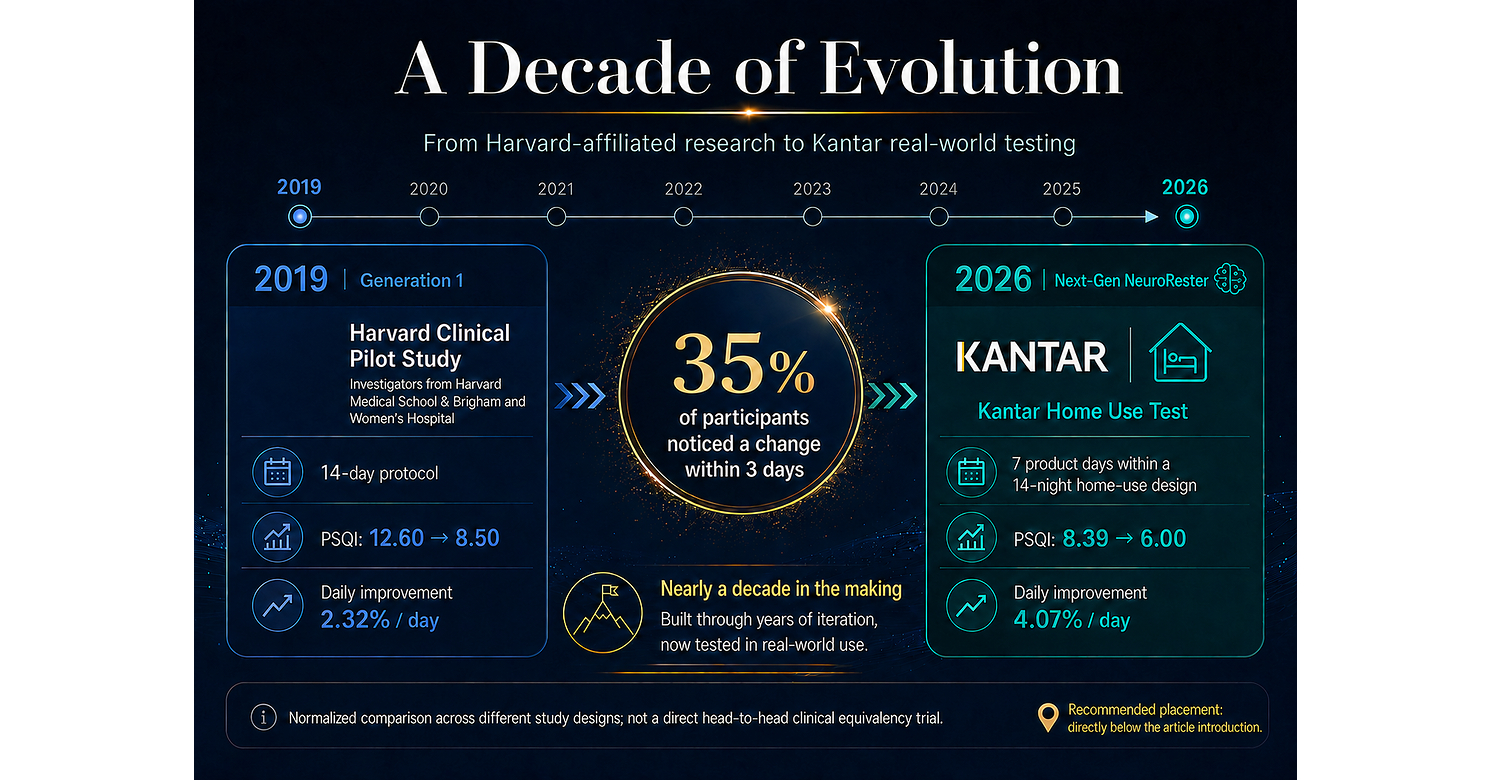
NeuroRester’s next-gen sleep wearable reported meaningful user improvements over 7 nights: “good nights” rose from 34% to 43%, and participants showed the biggest gains in sleep latency and daytime dysfunction. The end-of-test verdict found 73% reported improvement, with 35% noticing benefits within the first three days, supporting the device’s AI-driven personalized wind-down/recovery feedback loop. Product is available online now with full retail availability planned for early September.
Analysis
This is better viewed as a demand-generation release than a fundable evidence event. In sleep/wellness hardware, first-week self-reports rarely translate into durable revenue unless there is repeat use, subscription attach, and low return rates; the real economic question is whether this reduces CAC or simply front-loads enthusiasm. The skeptical read is that a small single-arm sample can lift conversion for a few weeks, but it does not prove habit formation, which is the main driver of lifetime value in this category.
Competitively, any genuine winner would be the ecosystem players with installed devices, app distribution, and longitudinal data — think AAPL/Apple Watch and, to a lesser extent, GOOGL/health-adjacent software — because they can copy the coaching layer without taking hardware inventory risk. The likely loser is the long tail of DTC wellness gadgets whose economics depend on paid social and testimonial marketing; once the novelty fades, margins tend to compress from refunds, ad auction inflation, and weak repeat purchase behavior. The second-order effect is that this may actually raise the bar for every other sleep-tech entrant, forcing them to fund more credible validation before scaling spend.
Catalyst-wise, the next 1-3 months matter more than the launch itself: watch retailer reviews, chargebacks, and 30-day retention rather than the press cycle. Over 6-18 months, the thesis is invalidated if there is no evidence of subscription conversion or if app engagement decays after the first sleep cycle. Contrarian view: the market often underestimates how quickly a "personalized AI wellness" claim becomes commoditized; without proprietary sensors or clinical-grade endpoints, the moat is thin and the multiple should stay discounted.
AllMind Terminal
AI-powered research, real-time alerts, and portfolio analytics for institutional investors.
Request TrialMarket Sentiment
Overall Sentiment
mildly positive
Sentiment Score
0.35
Key Decisions for Investors
- No direct position in TBHC/ZCBD on this release; treat as promotional noise until there is independently verified retention or revenue data.
- Set a 30-day watch item on early September launch metrics: refund rate, repeat usage, and app engagement. If those are weak, fade any sympathy bounce in speculative consumer-wellness names.
- Prefer a cautious long bias in AAPL over any pure-play sleep-wearable exposure if the category starts showing durable adoption; ecosystem distribution is the more durable monetization path.
- If you see a post-launch pop in any small-cap wellness hardware proxy, consider fading it into strength; the risk/reward is poor unless there is evidence of >25-30% repeat usage after one month.
More News
- ‘If nothing is done, it’s almost inevitable’: Ukraine’s Yuriy Ryzhenkov on why steelmaking is on the brink of collapse as Russian bombing intensifies
- Why is LG Innotek stock plunging today?
- TotalEnergies, KKR expand U.S. solar venture with 700 MW addition
- Why is SK Hynix stock sliding today?
- TSMC expected to report sixth straight quarter of record profit thanks to AI boom
- IIF CEO on Rising Global Debt