
Annals of Family Medicine: Study Finds Group Medical Visits Facilitate Four Types of Social Support for Patients With Chronic Pain
Source: PR Newswire
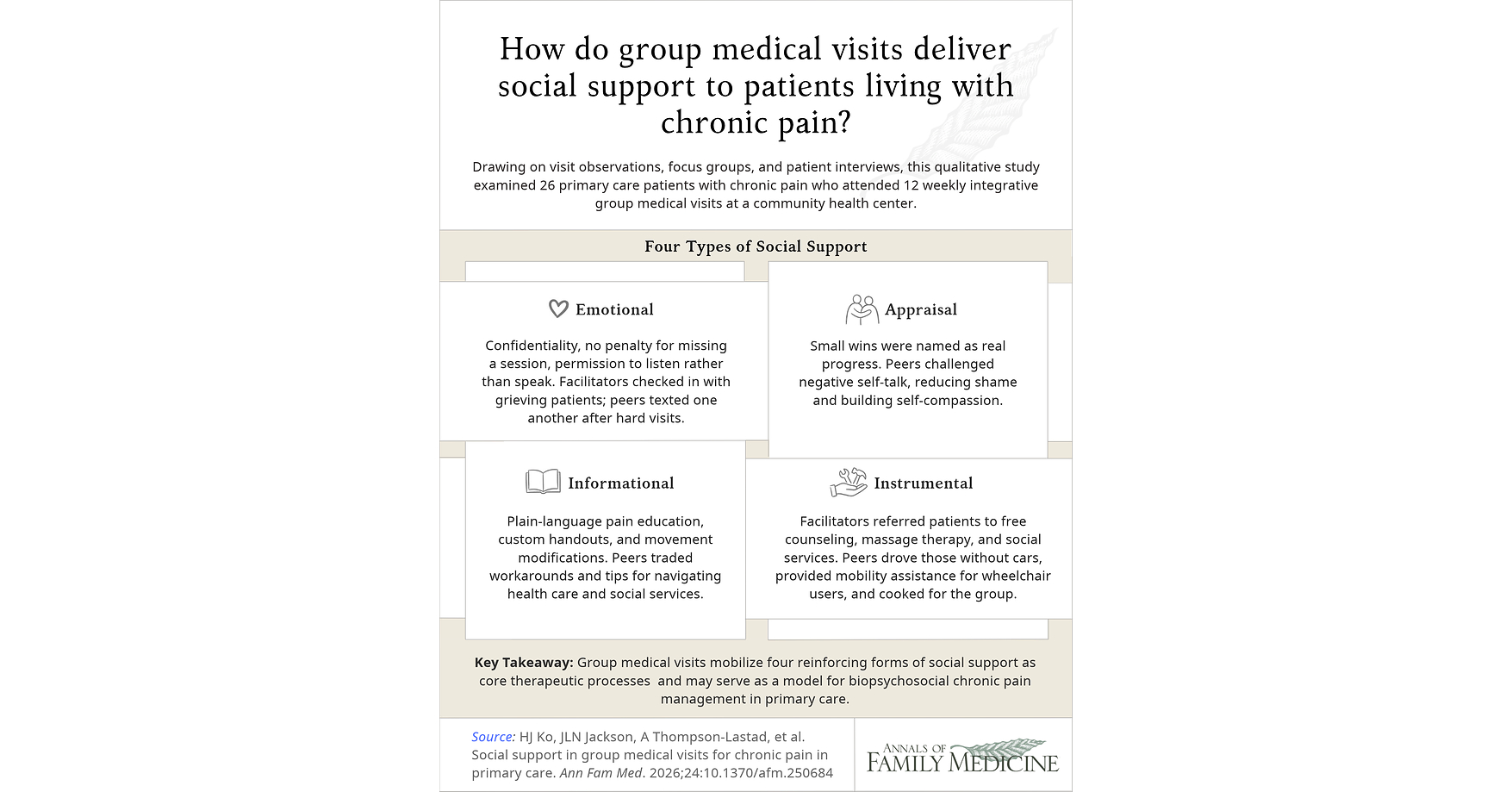
A UCSF-led qualitative study of 26 chronic-pain patients found that 12-week group medical visits in primary care generated emotional, informational, appraisal and practical support. The authors argue the model could scale multimodal, nonpharmacologic pain care by combining billable clinical services, education and peer support while potentially reducing care costs. The findings are early-stage and based on a small qualitative sample, limiting near-term commercial or market implications.
Analysis
This is not investable efficacy evidence: the reported findings are qualitative, drawn from a very small participant subset, and do not establish reductions in pain severity, opioid utilization, emergency-department use, or total medical cost. The commercial implication depends on whether group-based care can improve those hard endpoints while fitting clinician capacity and reimbursement workflows; neither is demonstrated here.
If replicated at scale, the model is directionally favorable for risk-bearing primary-care platforms and Medicare Advantage organizations such as UNH and CVS, where avoidable utilization and behavioral-health access are economically material. The nearer-term beneficiary could instead be providers of workflow, scheduling, remote engagement, and documentation tools, but only if payers recognize a reimbursable pathway; standalone digital-pain vendors face substitution risk because group care can be delivered with relatively low-tech infrastructure.
Over the next 1-3 months, this should not move public healthcare equities. Over 6-18 months, the relevant catalyst is publication of adequately powered trials showing lower opioid prescribing, ED visits, or PMPM cost, followed by explicit CMS or large-commercial-payer reimbursement guidance. A contrary view is that payer adoption will remain slow: two-hour clinician-facilitated sessions may be uneconomic in fee-for-service settings and operationally difficult for already capacity-constrained primary-care networks.
AllMind Terminal
AI-powered research, real-time alerts, and portfolio analytics for institutional investors.
Request TrialMarket Sentiment
Overall Sentiment
mildly positive
Sentiment Score
0.25
Key Decisions for Investors
- No directional trade on this study; treat it as a monitoring item rather than a catalyst for UNH, CVS, HCA, or digital-health equities.
- Add an alert for randomized evidence reporting utilization, opioid-use, and cost outcomes, plus CMS coding or reimbursement changes for group pain-management visits; only then reassess long exposure to risk-bearing primary-care operators over a 6-18 month horizon.
- For any prospective long in UNH or CVS based on chronic-pain care management, require evidence of improved medical-cost ratio or care-management revenue in earnings disclosures; absent measurable economics, the thesis is falsified as a narrative rather than a margin driver.
More News
- SoftBank completes final phase of $30 billion investment in OpenAI
- Amazon seeks to offload $8 billion of Nvidia chips to investors, FT reports
- Amazon seeks to offload $8 bln of Nvidia chips to investors- FT
- Nvidia Faces Questions Over China AI Chip Smuggling Cases
- Broadcom to lend Anthropic up to $42 billion to lease its chips, filing says
- $8.2B acquisition validates AI-picked chip stock: +20% since June
From AllMind Research
- Anthropic IPO Preview: Valuation, Timing, and What to Watch
- Shein After the IPO: Venue, Valuation, and What Must Be Proved
- What AI Research Tools Should a Small Hedge Fund Buy First?
- Capital IQ Alternatives for Research and Deal Work
- Research Workflows, Report Format Selection, and Interactive Synthesis