
Tutti • VM Launches in Early Access: The Google Docs Moment for Cross-Agent Collaboration
Source: PR Newswire
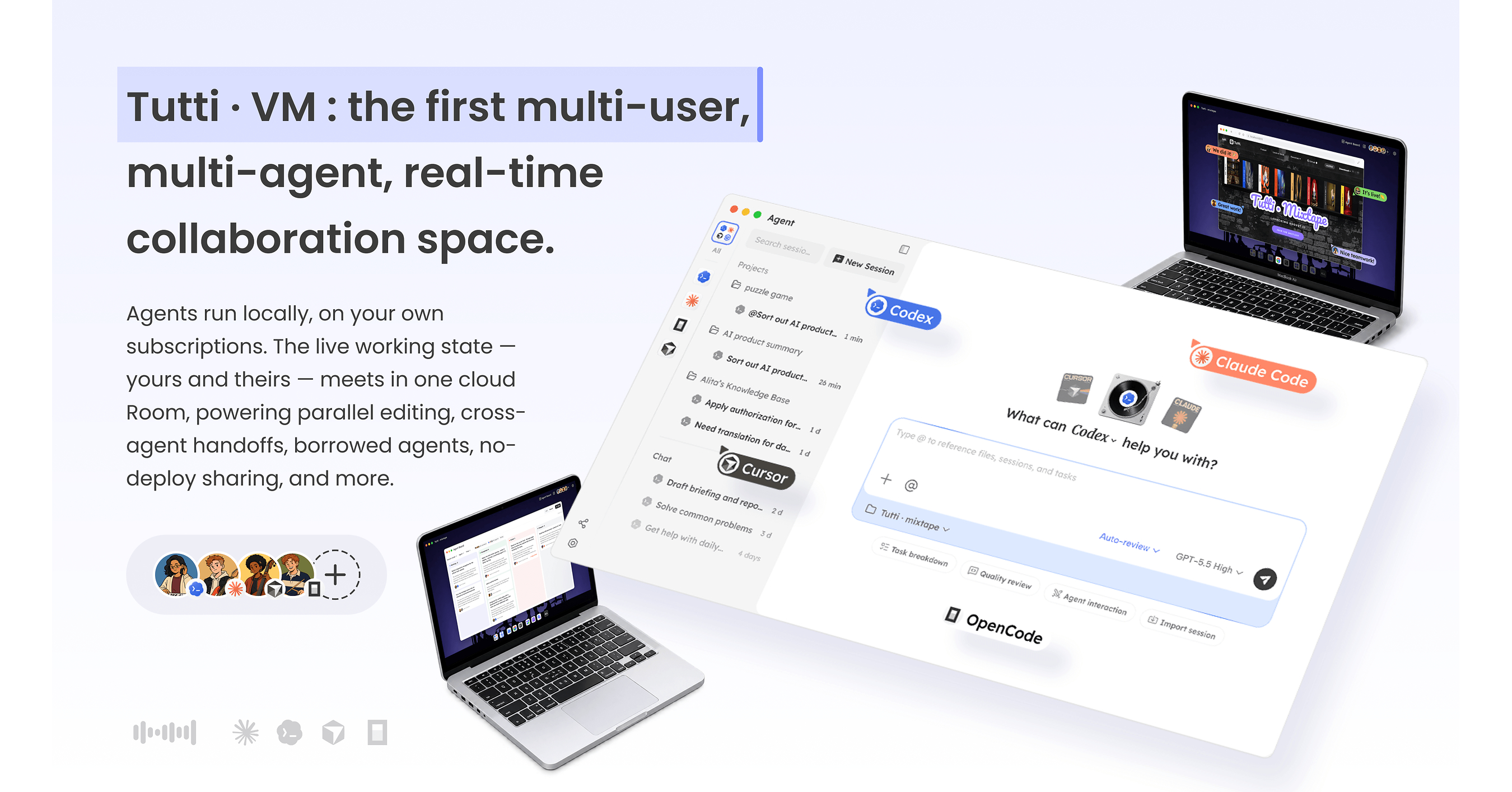
Tutti launched Early Access for Tutti • VM, positioning it as a multi-user, multi-agent real-time collaboration space for coding agents (e.g., Claude Code and Codex) that keeps agent identity and credentials on the user’s machine while sharing via a cloud “Room.” The product claims real-time parallel editing without collisions and supports context handoffs (e.g., @ references) without re-briefing, and it aims to reduce collaboration overhead with collaboration commands instead of full data syncing. Tutti • VM is free during Early Access on a bring-your-own-subscription model, with invite-only rooms and plans for an SDK and private enterprise deployment.
Analysis
This reads more like a product architecture proof-point than an immediate revenue event. The near-term beneficiaries are the underlying model subscriptions and adjacent devtools ecosystems, because the workflow reduces the friction that keeps teams from scaling agent usage beyond a few power users. The more important second-order effect is negative for standalone orchestration/collaboration layers: if the filesystem becomes the collaboration substrate, the moat shifts away from chat-based wrappers toward whoever controls the execution environment and enterprise policy layer.
Over 1-3 months, the market may overestimate the monetization cadence because bring-your-own-subscription suppresses platform ARPU and delays proof that collaboration turns into incremental seats. Over 6-18 months, the real test is whether enterprises accept local identity with cloud sharing; if they do, this could accelerate agent penetration in regulated workflows, but if security teams balk, adoption stays confined to startups and individual developers. That would cap the TAM and keep this closer to a productivity feature than a new platform category.
Contrarian read: the consensus may be too focused on the UI breakthrough and not enough on operational complexity. The hardest bottleneck is not sharing state in real time; it is auditability, policy enforcement, and reproducible behavior across heterogeneous local environments. If users still need heavy human oversight, the promised labor leverage is smaller than the demo suggests, and the economics favor incumbent platforms with distribution rather than a new entrant.
For the listed names, GOOGL is at best a weak indirect beneficiary via broader enterprise AI usage, but this does not look like a material catalyst for the stock. The cleaner market implication is to watch for pressure on pure-play agent orchestration vendors and for a possible lift in enterprise developer productivity tools that can integrate at the filesystem/IDE layer rather than compete at the chat layer.
AllMind Terminal
AI-powered research, real-time alerts, and portfolio analytics for institutional investors.
Request TrialMarket Sentiment
Overall Sentiment
mildly positive
Sentiment Score
0.25
Key Decisions for Investors
- No immediate directional trade in GOOGL/INSO/PPLI/TISI; treat this as an adoption watchlist, not a catalyst, until there is evidence of enterprise conversion or paid-seat expansion over the next 1-2 quarters.
- If looking for a relative-value expression, prefer a basket long of enterprise devtools/platform names with filesystem/IDE integration and short standalone agent-orchestration wrappers over a 1-3 month horizon; the thesis is feature commoditization, not category expansion.
- Set an alert for any disclosed enterprise deployments, compliance certifications, or admin-control features in the next 60-90 days; that is the key falsifier/confirming signal for broader monetization.
- If the product starts shipping paid seat-based plans and conversion data is strong, revisit a long on the broader AI software basket; until then, avoid paying up for names whose valuation assumes rapid agent collaboration monetization.
- Watch for negative read-through on vendors selling cloud-only collaboration layers: if filesystem-native collaboration proves sticky, those vendors may face multiple compression over 6-12 months.
More News
- Musk says Terrafab chip factory could outperform rivals despite challenges
- CBO chief warns it’s ‘probably not plausible’ that a strong economy alone can steady U.S. debt as 5%-6% growth is needed—more than Bessent’s 3% view
- Stocks saw new highs and big declines: How the volatile AI trade moved last week's market
- Will Warner Bros. kill Skydance — or will David Ellison kill Warner Bros?
- Nvidia GPUs are everywhere. Here are the ways companies are accessing them
- How U.S. know-how is fracking Australia into a gas boom, from Texas oilmen to Trump’s energy secretary