
Trump Takes Dealmaking to New York with Packed UN Assembly Agenda
Source: Bloomberg
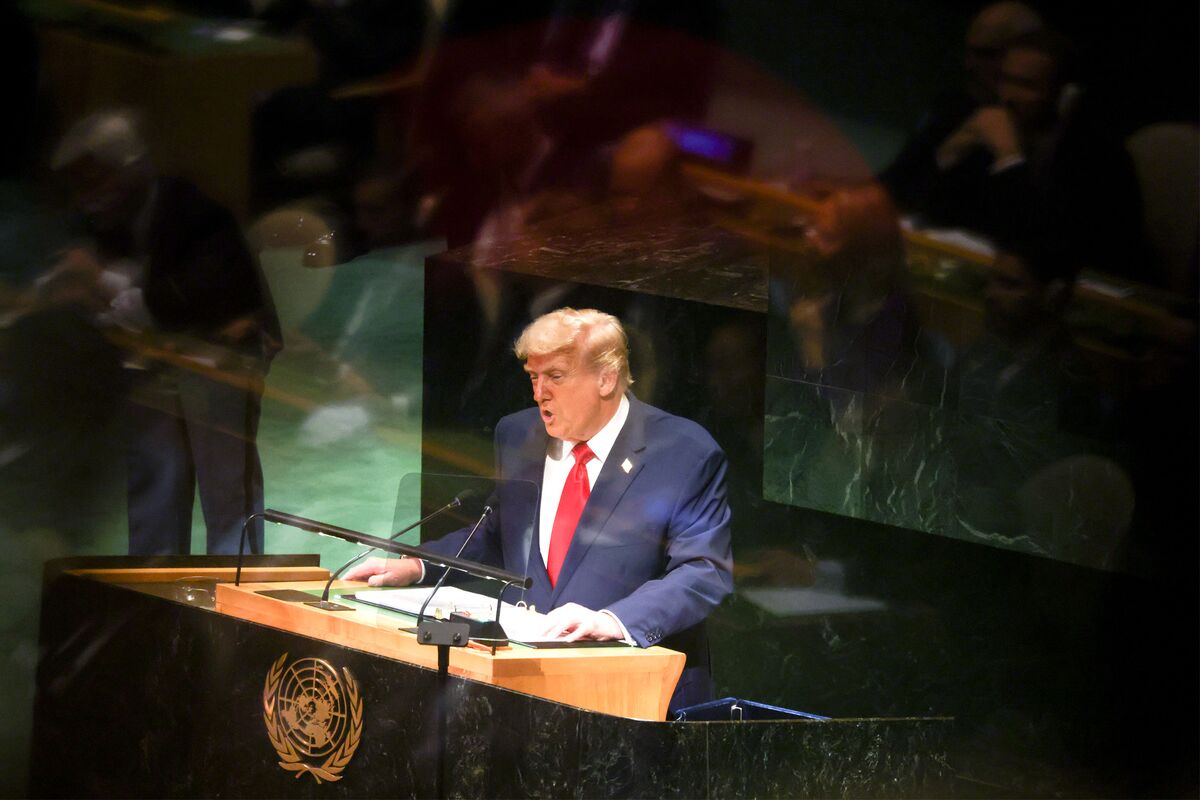
President Trump is taking a dealmaking-focused agenda to the UN General Assembly, with the Iran war, Russia-Ukraine conflict and artificial intelligence expected to dominate discussions. The article provides no specific policy commitments, agreements or market-relevant financial figures, but the meetings could shape future geopolitical and technology-policy developments.
Analysis
This is primarily an event-risk setup rather than a directional fundamental catalyst. With no disclosed policy deliverable, the highest-probability market effect is a temporary bid for geopolitical hedges—defense (ITA/XAR), oil (USO/XLE), gold (GLD), and cybersecurity (CIBR)—followed by reversal if meetings produce no sanctions, export-control, or military-spending commitments. Broad equity risk appetite is more exposed to an adverse diplomatic headline than it is supported by constructive rhetoric, particularly in high-duration AI software and semiconductors where elevated multiples leave little room for a volatility shock.
The non-obvious transmission channel is policy sequencing: new restrictions involving energy flows, Russian trade, or advanced-compute exports would affect European industrial margins and Asian semiconductor supply chains before the largest US defense primes see revenue. Conversely, any credible de-escalation framework would pressure the geopolitical premium embedded in crude and defense multiples, while benefiting airlines (JETS), transports (IYT), and European equities (FEZ). Over the next 1-3 months, watch for formal sanctions notices, changes in AI-chip export licensing, NATO procurement commitments, and oil-market risk-premium movements—not summit language—as the tradeable catalysts.
Consensus may overpay for headline hedges because diplomatic events often generate volatility without changing cash-flow estimates. A durable repricing requires an executable policy mechanism: appropriated defense spending, enforceable restrictions, disrupted physical supply, or a verified ceasefire. Until such evidence emerges, this is better handled with defined-risk hedges and relative-value expressions than outright macro beta.
AllMind Terminal
AI-powered research, real-time alerts, and portfolio analytics for institutional investors.
Request TrialMarket Sentiment
Overall Sentiment
neutral
Sentiment Score
0.00
Key Decisions for Investors
- No immediate directional trade: treat the event as a volatility watch item until a formal sanctions, export-control, or procurement announcement provides a measurable earnings catalyst.
- For a 2-6 week hedge, consider a small long XAR or ITA versus short SPY position; use a 5% relative underperformance stop, as defense outperformance without contract/funding follow-through is likely to mean-revert.
- If Brent rises more than $5/bbl on verified supply-disruption risk, favor long XLE versus short JETS for 1-3 months; exit if Brent retraces below the pre-event level, which would signal that the move was geopolitical premium rather than physical tightness.
- If advanced-compute export restrictions are formally expanded, investigate short SMH versus long CIBR rather than shorting semiconductors outright; validate with affected-company revenue exposure and licensing details before entry.
- If a credible de-escalation agreement is independently verified, fade defense/oil strength through a long JETS or FEZ versus short XLE relative-value trade, with reassessment if implementation deadlines slip or physical energy flows remain impaired.
More News
- Wall Street’s Nasdaq hits all-time high as AI frenzy gathers pace
- Oil falls on increased Gulf supply and hopes for US-Iran talks
- Data-Center Bet Makes ESDS One of India’s Best New Listings
- Dollar holds near 2-month high as markets weigh rate hikes, Iran diplomacy
- Asia stocks ride tech wave higher, oil stays subdued
- South Korean solar stocks jump as curbs on Chinese sector expected to remain in place