
CodeROI Launches the CodeROI AI Agent: R&D Tax Credits, Section 174, and Software Capitalization on Your AI Spend
Source: PR Newswire
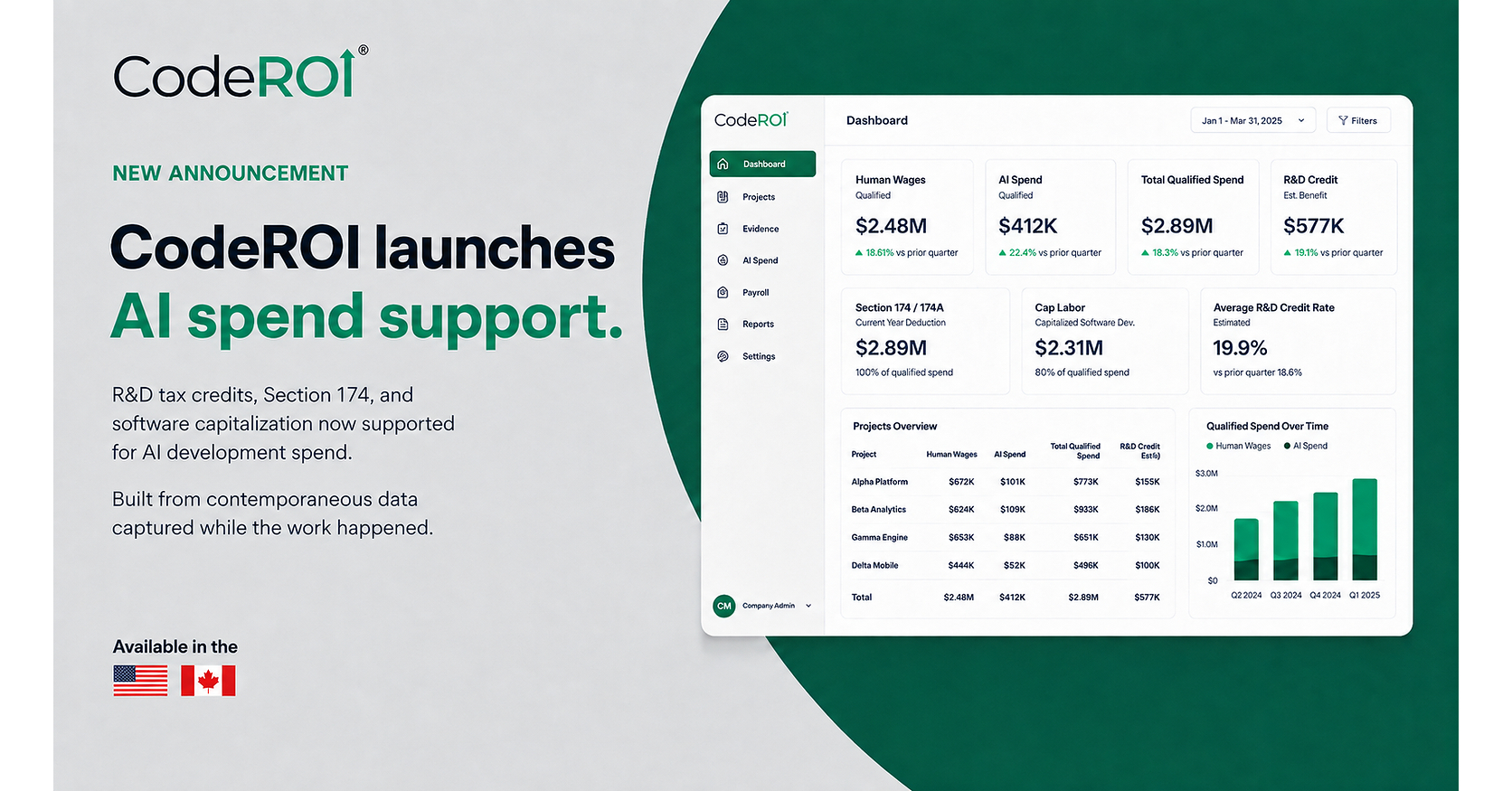
CodeROI launched the CodeROI AI Agent to help firms capture U.S./Canada R&D tax credits, Section 174 treatment, and software capitalization for AI-assisted development by creating deterministic, audit-ready evidence down to each individual code change. The company claims this can accelerate credit qualification into “every quarter” via lower estimated tax payments rather than filing-year timing, potentially boosting total credit claims and capitalized software amounts. It positions the product as a “system of record” (not an AI platform) designed to meet the IRS’s mandatory project-level R&D reporting for tax year 2026.
Analysis
The near-term equity read-through is not a direct revenue windfall for the platform itself; it is a marginal improvement in the after-tax economics of AI deployments. That matters most for hyperscalers and model vendors because CFOs have been the gating factor on expanding inference and agentic-code budgets; if accounting teams can credibly monetize more of the spend, the adoption curve steepens at the margin. The largest beneficiaries are likely the highest-intensity code users, especially mega-cap software and cloud names such as GOOGL and MSFT, but the stock impact is probably second-order unless customers start changing procurement behavior in a visible way.
The bigger loser is the 'AI is pure opex' bear case. If finance teams can now document a meaningful slice of AI-related development as eligible, the headline ROI on internal copilots and coding agents improves, which should support continued enterprise software budgets over the next 1-3 quarters. The counterpoint is that the market may be overestimating how much of AI spend is actually creditable; most spend is still non-development workflow, so the incremental tax benefit may be too small to move 2026 EPS revisions in a material way.
Catalyst risk centers on implementation, not the product announcement. The thesis only matters if tax advisors, auditors, and large taxpayers adopt it quickly during 2026 filing season; otherwise this remains a compliance tool with limited macro beta. The falsifier is simple: if management commentary from GOOGL/MSFT and major software buyers does not mention improved AI budget efficiency or if 2026 guidance still implies flat-to-down R&D intensity, the market will treat this as noise rather than a structural demand tailwind.
AllMind Terminal
AI-powered research, real-time alerts, and portfolio analytics for institutional investors.
Request TrialMarket Sentiment
Overall Sentiment
moderately positive
Sentiment Score
0.35
Ticker Sentiment
Key Decisions for Investors
- Maintain a modest long bias in GOOGL and MSFT into next 1-3 quarters; the trade is on incremental enterprise AI spend durability, not near-term earnings upside. Use a tight thesis stop if Q4/Q1 commentary shows no change in customer AI adoption budgets or if capex/opex discipline tightens.
- Relative-value idea: long IGV / short XLI for 1-3 months if you want to express 'AI adoption gets a tax subsidy' versus industrial cyclicals with no comparable policy support. The risk is that the tax benefit proves too small to change software demand in the near term.
- Watchlist, not a trade yet: long tax/compliance software proxies such as INTU or WDAY only if management commentary starts highlighting AI-related compliance workflows as a monetizable add-on. Without evidence of attach-rate expansion, the announcement is more about CFO optics than vendor economics.
- Set an alert for 2026 corporate tax commentary and guidance revisions from large software buyers; if multiple large enterprises cite lower effective AI-development cost or higher eligible R&D spend, re-rate the AI spend basket higher. If not, fade any initial optimism.
More News
- Semiconductors are out, software is in. Why that’s not about to change anytime soon
- Some companies give AI to everyone. This CEO is doing the opposite
- British watchdog seeks tougher terms around Microsoft's dominance of business software
- The death of humanity
- Benchmarked: Nvidia's RTX Spark notebook delivers serious local AI compute, at a price
- Microsoft wants to make AI cheaper. Will investors actually see the savings?
From AllMind Research
- Anthropic IPO Preview: Valuation, Timing, and What to Watch
- Shein After the IPO: Venue, Valuation, and What Must Be Proved
- What AI Research Tools Should a Small Hedge Fund Buy First?
- How to Build an Automated Research Process for a Fund
- Weekly Update: AI-Powered Report Editing, Investor Relations, and Enhanced Search