
Costco's Kirkland Signature Price Cuts Aim to Widen the Value Moat
Source: zacks.com
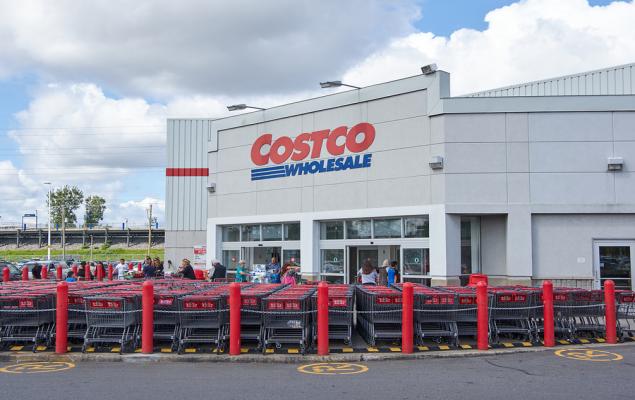
Costco cut prices on several Kirkland Signature staples in fiscal Q4 2026, including walnuts to $9.99 from $13.79 and coffee to $19.99 from $21.99, reinforcing its value positioning. It received $184 million in tariff-related funds ($174 million in refunds and $10 million in interest) and plans to reinvest most additional refunds in member value. Consensus estimates imply current-year sales and EPS growth of 8.3% and 11.8%; EPS estimates rose by $0.36 to $22.87 for the current year and by $0.45 to $24.94 for the next year. Shares fell 3.1% over three months, and Costco carries a Zacks Rank #3 (Hold).
Analysis
The signal is less about four SKU markdowns than Costco choosing to spend pricing power on member value. If Kirkland expands substitution against branded staples, Costco can protect renewal appeal while shifting negotiating leverage toward its own label; national-brand suppliers face greater pressure to fund promotions or defend shelf space. The trade-off is that persistent price investment can dilute merchandise economics unless higher unit velocity, mix, or vendor concessions offset it. Verify comparable-sales/traffic trends, renewal rates, and gross-margin commentary before treating the cuts as evidence of durable share gains.
Tariff refunds are a temporary funding source, not a repeatable margin tailwind. The risk is that members and investors anchor to lower prices while refunds fade, leaving Costco to absorb the cost. Over 1–3 months, watch management commentary on the pace of further price reductions and the next earnings read-through on traffic and merchandise margins. Over 6–18 months, the key structural test is whether Kirkland gains share without weakening perceived quality or supplier economics.
At a premium valuation, the bar for COST is execution, not simply value messaging. The news alone does not justify chasing the shares. A failure of sales momentum to offset price investment—or evidence that margin pressure persists after refund benefits roll off—would challenge the premium; stronger traffic and renewal metrics alongside stable merchandise margins would support it.
AllMind Terminal
AI-powered research, real-time alerts, and portfolio analytics for institutional investors.
Request TrialMarket Sentiment
Overall Sentiment
mildly positive
Sentiment Score
0.25
Ticker Sentiment
Key Decisions for Investors
- No immediate event-driven trade: do not add COST solely on the markdown announcement. Reassess after the next earnings update, focusing on comparable sales/traffic, renewal rates, and merchandise gross-margin direction.
- Watch national-brand suppliers with meaningful exposure to Costco for signs of increased price concessions or lost volume; the article does not identify suppliers, so avoid a single-name short until exposure is verified.
- Treat future tariff refunds as nonrecurring. If Costco continues price investment as refunds diminish, require evidence of volume or mix offset before underwriting the earnings impact.
- Falsification triggers: sustained traffic or renewal weakness alongside ongoing margin compression would undermine the value-moat thesis; improving traffic with stable margins would indicate the price investment is paying back.
More News
- How Christina Zhu turned Sam’s Club into Walmart’s unlikely growth engine in China
- Why ‘China plus one’ is paying off less than Southeast Asia hoped
- AI chatbots recommend shopping at Walmart over just about anywhere else, analysts find
- Samsung, SK Hynix shares drop as Q3 earnings loom
- CH Robinson to Buy RXO for $5.8B in Bet on AI Model
- BPCE acquires 7% stake in Spain’s Banco Sabadell