
Die LONGWELL EC-FanWall-Technologie senkt den Energieverbrauch von CRAH-Ventilatoren um 38 % in KI-Rechenzentren der nächsten Generation
Source: PR Newswire
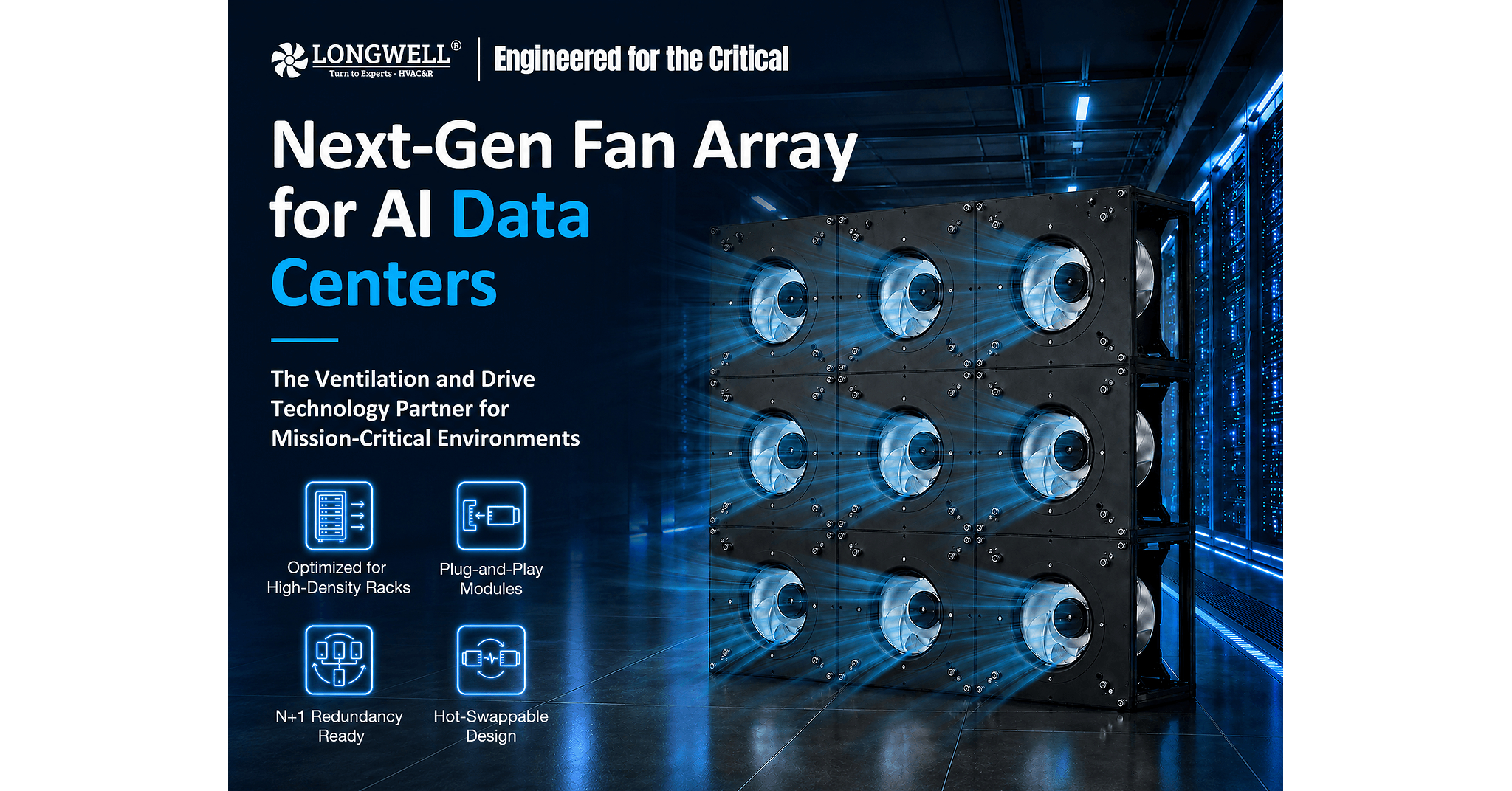
LONGWELL kündigt für KI-Rechenzentren eine Senkung des Energieverbrauchs von CRAH-Ventilatoren um 38% über seine LWBE3G FanWall-Plug-Fan-Array-Plattform an. Das verbessert den PUE-Beitrag des CRAH-Systems von 1,42 auf 1,28 und reduziert den Geräuschpegel um 6,5 dB(A), ohne Ausfälle im Einsatz. Zudem nennt die Meldung eine schnelle Serienreife (von Spezifikationen bis Produktion in 90 Tagen) sowie Lieferungen von 80.000+ Einheiten in 2025 im Rahmen eines 2025–2027 Rahmenvertrags mit 60.000 Mindestabnahme p.a.
Analysis
The key market mechanism is not the fan itself; it is power-denominator expansion. In AI data centers, small PUE gains translate into more usable compute per megawatt, which matters most where utility feeds are the bottleneck. That favors hyperscalers and colocation owners such as EQIX and DLR over a 6-18 month horizon, because better thermal efficiency can defer substation, generator, and chiller capex while improving revenue per site.
The competitive takeaway is that data-center cooling is getting re-priced from a long-cycle, spec-driven purchase into a faster, more modular sourcing decision. That compresses the moat of legacy precision-cooling OEMs and raises the probability that lower-cost component suppliers take share without the incumbent getting a full redesign cycle to respond. VRT remains the cleanest public proxy for the winner bucket, while JCI and TT are more exposed to margin pressure if the market starts rewarding component-level efficiency over installed-base breadth.
The contrarian risk is substitution: above ~100 kW/rack, liquid and hybrid cooling can cap the runway for air-side fan-wall upgrades within 6-18 months. So the near-term narrative is supportive, but the structural benefit may be shorter than the market expects if hyperscalers move straight to direct-to-chip architectures. What would falsify the bullish read is weak repeat-order data, no follow-on design wins across multiple OEMs, or an earnings cycle that shows capex shifting from air-side efficiency to liquid-cooling retrofits instead.
AllMind Terminal
AI-powered research, real-time alerts, and portfolio analytics for institutional investors.
Request TrialMarket Sentiment
Overall Sentiment
mildly positive
Sentiment Score
0.30
Key Decisions for Investors
- Long VRT on a 5-10% pullback over the next 1-3 months; thesis is that AI data-center infrastructure spend increasingly rewards vendors that help monetize constrained power. Risk/reward is roughly 2:1 if backlog and gross margin stay intact; exit if data-center backlog growth slows materially or liquid-cooling commentary accelerates.
- Pair trade: long EQIX / short JCI for the next 3-6 months to express the view that efficiency gains create more sellable capacity for colocation owners while legacy HVAC names face commoditization pressure in data-center cooling. Falsify if EQIX guidance shows no occupancy or pricing benefit from higher efficiency, or if JCI proves it is retaining share with margin expansion.
- Use TT and JCI as fade candidates into strength if the market extrapolates this into a broad HVAC re-rating without order-book confirmation. The upside is limited because the news is project-specific; the downside is multiple compression if the market realizes efficiency wins are not the same as durable pricing power.
- No direct trade on the private supplier story until there is evidence of repeat awards, tariff clarity, and 2027 ramp visibility. Treat it as an alert item, not an investable thesis, because the reported economics may prove highly project- and duty-cycle-specific.
More News
- AI Capex, Gamble or Jackpot?: Market Snapshot
- ‘I told you so’: China’s chip sector is making breakthroughs—and U.S. export controls are the reasons why
- One Singapore ship was sunk, but here's why others are still transiting the Strait of Hormuz
- CoreWeave credit default swaps hit distress levels as investors sour on AI debt
- The IPO drought is driving private equity-owned companies to the debt market to pay investors
- Hybe shares jump 10% as K-pop sensation BTS' tour lifts earnings hopes