
Dashlane Report Names Google, GitHub and HubSpot as Passkey Leaders, yet Adoption Gap Emerges
Source: PR Newswire
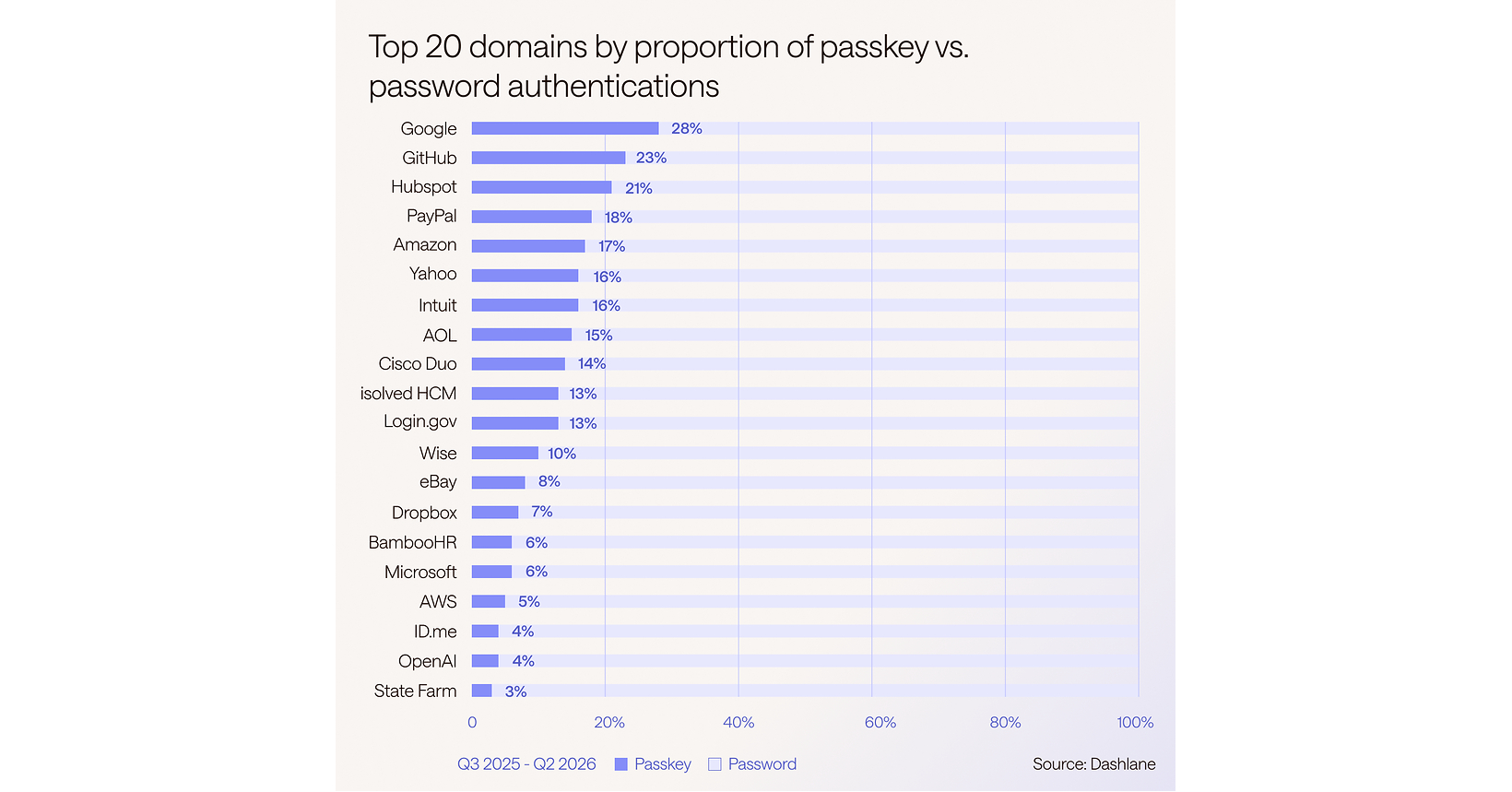
Dashlane's 2026 Passkey Power 20 finds passkeys account for 28% of measured Google logins, 23% at GitHub, 21% at HubSpot, 6% at Microsoft and 4% at OpenAI, despite growing availability. Dashlane users storing at least one passkey rose to 57% from 40% a year earlier, and monthly passkey authentications nearly doubled to 2.5 million; selected services saw Q1-to-Q2 2026 growth of 218%–391%. The findings point to continued adoption momentum but say passkeys remain a minority of logins, with Dashlane urging services to make phishing-resistant authentication the default.
Analysis
This is a product-execution signal, not yet an earnings signal. Low passkey use despite availability implies the main constraint is user behavior and sign-in design—not lack of technical support. For platforms, making passkeys the default could reduce credential-based account risk, but the transition may create near-term login friction, support costs, and lockout risk; forcing adoption is not automatically a net win for engagement.
The competitive read-through is mixed. Alphabet’s default-setting experience suggests interface choices can move adoption, while Microsoft’s low measured share flags an execution gap, not proof of weaker security or a material financial disadvantage. Meta, HubSpot and Experian’s sharp quarterly increases may indicate improving onboarding, but percentage growth can be amplified by a small starting base. Dashlane’s sample reflects authentications it manages, so it is not a market-wide usage census; verify against each platform’s own disclosures before underwriting a trend.
The second-order risk is that optional passkeys leave passwords as a usable fallback: attackers can continue targeting the weaker route, limiting security gains until services retire or constrain legacy credentials. In the next 1–3 months, watch for platform defaults, enterprise rollouts, and independently reported account-takeover incidents. Over 6–18 months, broader enforcement could benefit credential-security providers, but may also commoditize password-manager features as operating systems and platforms embed authentication tools. No listed name here has a sufficiently direct, quantified revenue catalyst for a standalone trade. The contrarian point: adoption growth headlines likely overstate progress; the relevant metric is passkey share of successful logins and whether password fallback is actually reduced.
AllMind Terminal
AI-powered research, real-time alerts, and portfolio analytics for institutional investors.
Request TrialMarket Sentiment
Overall Sentiment
mixed
Sentiment Score
0.05
Ticker Sentiment
Key Decisions for Investors
- No standalone position based on this report. Treat it as a low-confidence industry adoption indicator, not a near-term earnings catalyst for GOOG, META, MSFT, HUBS or EXPN.
- Put Microsoft on a watchlist for product-execution evidence, not an immediate short: revisit only if its own disclosures show persistent adoption weakness alongside higher credential-abuse costs, or if competitors demonstrate measurable security or retention benefits.
- Monitor platform disclosures for passkey share of logins, password-fallback policy, account-takeover rates and authentication-related support costs; these would establish whether adoption translates into financial or risk outcomes.
- Do not extrapolate the reported quarterly growth rates into durable adoption without absolute login counts and a broader sample. A reversal in usage, increased login friction, or evidence that users simply retain password fallback would falsify the bullish security-adoption thesis.
More News
- Applied Materials’ $5 billion AI lab aims to cut chip development time in half—and restore Silicon Valley’s edge
- Meta’s Muse models reach the AI frontier—and kill any hopes to ‘pace’ it
- FBI arrests OpenAI employee accused of planting secret recording device in conference room
- Apple’s new home devices are a bet on its upgraded Siri AI
- Meta shares rise for a second straight day as new AI model family impresses
- Cheap Chinese and open source LLMs could trigger trillion-dollar AI infrastructure 'reset'