
Following industrial investment from Midea Group, Jodell unveils full-stack new products for industrial embodied execution at CIIF
Source: PR Newswire
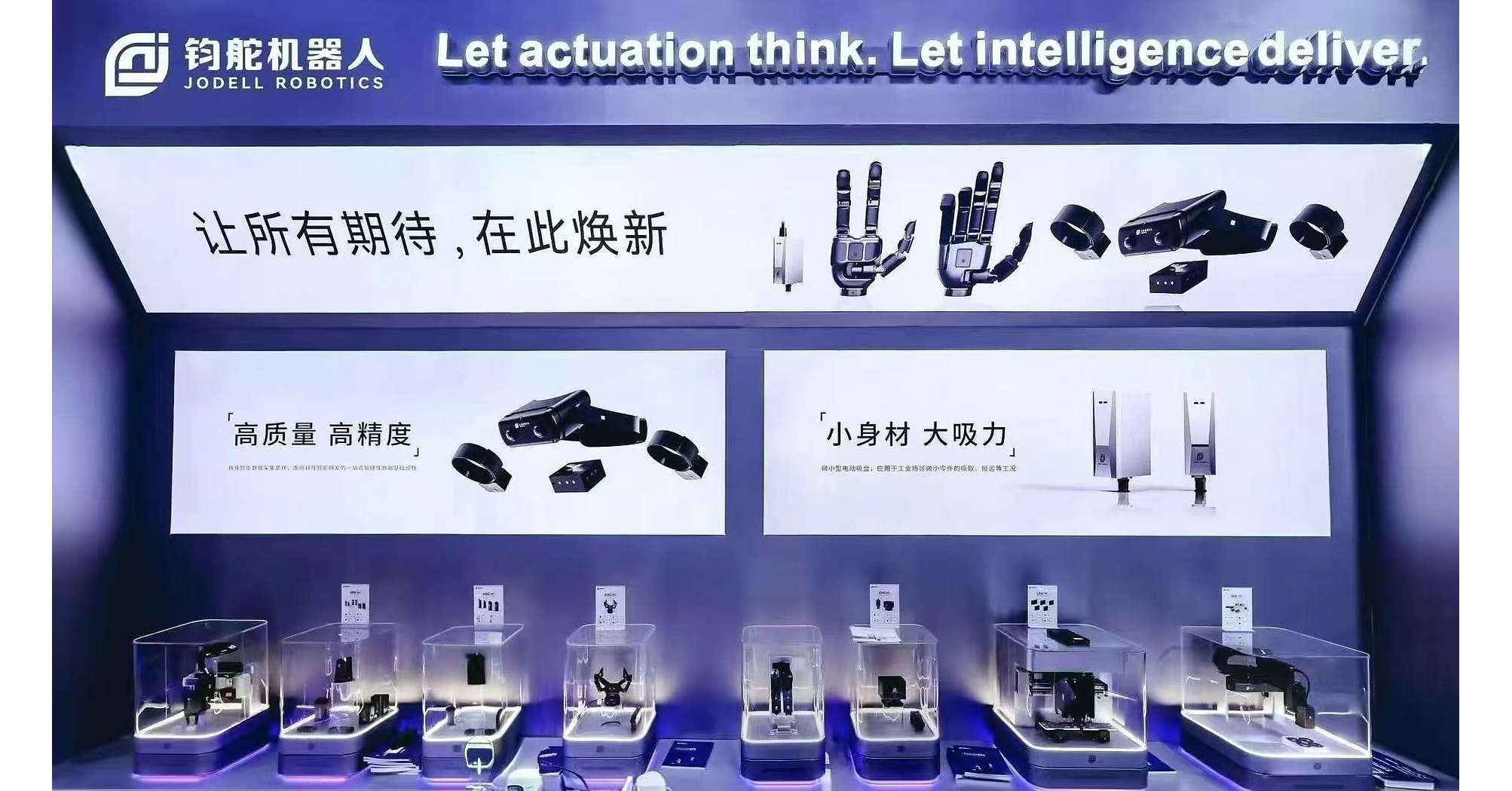
Suzhou-based Jodell Robotics unveiled three industrial embodied-execution products at CIIF after receiving a strategic industrial investment from Midea Group: the Mozart dexterous hand, visuo-tactile sensors and a data-acquisition kit. The company says its portfolio spans 17 series and more than 50 mass-produced products, with annual capacity above 100,000 units and more than 6,000 customers across dozens of countries. The launch expands Jodell’s offering for precision manufacturing, though the article provides no investment amount or market reaction.
Analysis
The investable signal is not the launch itself but a possible shift in value capture: if tactile sensing and dexterous end-effectors materially reduce failed picks, cycle time, or integration work, specialist execution components could capture economics currently accruing to robot OEMs and integrators. That remains a hypothesis; product breadth and stated capacity do not establish utilization, recurring revenue, or factory-level ROI.
Midea’s investment could provide a route to industrial customers and deployment feedback. If that relationship extends through KUKA or Midea’s broader channels, it may accelerate validation; conversely, robot OEMs outside those channels may hesitate to rely on a potentially affiliated supplier. The competitive test is repeatable performance and integration cost versus established automation suppliers such as ABB, FANUC, and Keyence—not the number of product SKUs.
Near term (days), the release is too small and unverified to support a directional public-equity trade. Over 1–3 months, look for named customer deployments, repeat orders, and independently measurable throughput or defect improvements. Over 6–18 months, successful standardization could strengthen the component layer, but sensor durability, calibration, software integration, and factory-specific data transfer are likely bottlenecks. The thesis weakens if pilots fail to convert, deployment remains bespoke, or customers do not demonstrate measurable productivity gains.
AllMind Terminal
AI-powered research, real-time alerts, and portfolio analytics for institutional investors.
Request TrialMarket Sentiment
Overall Sentiment
mildly positive
Sentiment Score
0.35
Key Decisions for Investors
- No immediate trade: the supplied data provides no listed Jodell identity or verified financial contribution, so treat this as a watch item rather than a catalyst for broad robotics exposure.
- Track evidence before underwriting the adoption thesis: customer names and repeat orders, utilization versus stated capacity, product-level revenue and gross margin, sensor failure/calibration rates, and independently verified cycle-time or yield improvements.
- Monitor ABB, FANUC, and Keyence as potential competitive read-throughs, not automatic shorts: the risk to incumbents rises only if Jodell-like systems show lower integration costs and repeatable economics in production.
- Falsification trigger: no conversion from pilots to repeat deployments over the next 1–3 months, or factory evidence that integration and maintenance costs offset productivity gains; confirmation would require repeat orders plus quantified, sustained operating improvements.
More News
- Why did CoreWeave stock get crushed this week? Look to this corner of the debt market for clues
- AI stock sell-off ramps up over debt-fueled data center spending fears: ‘Full-blown crisis of confidence'
- Dow falls 189 points as AI stocks slide and oil prices surge
- Wall Street Anxiety Spreads as AI Rout Meets $110 Oil Shock
- Wall Street's fear gauge is ripping. Traders see it going even higher
- All the news about the iPhone Duo
From AllMind Research
- Anthropic IPO Preview: Valuation, Timing, and What to Watch
- Shein After the IPO: Venue, Valuation, and What Must Be Proved
- What AI Research Tools Should a Small Hedge Fund Buy First?
- Stop Treating AI Like a Chatbot: What Are Agents, SubAgents, MCP, and Skills, and How Do They Actually Work?
- Earnings-Triggered Research Automations: A Control Guide