
Carney Plots EU Partnership as Canada PM Hits Back at Trump’s Tariffs
Source: Bloomberg
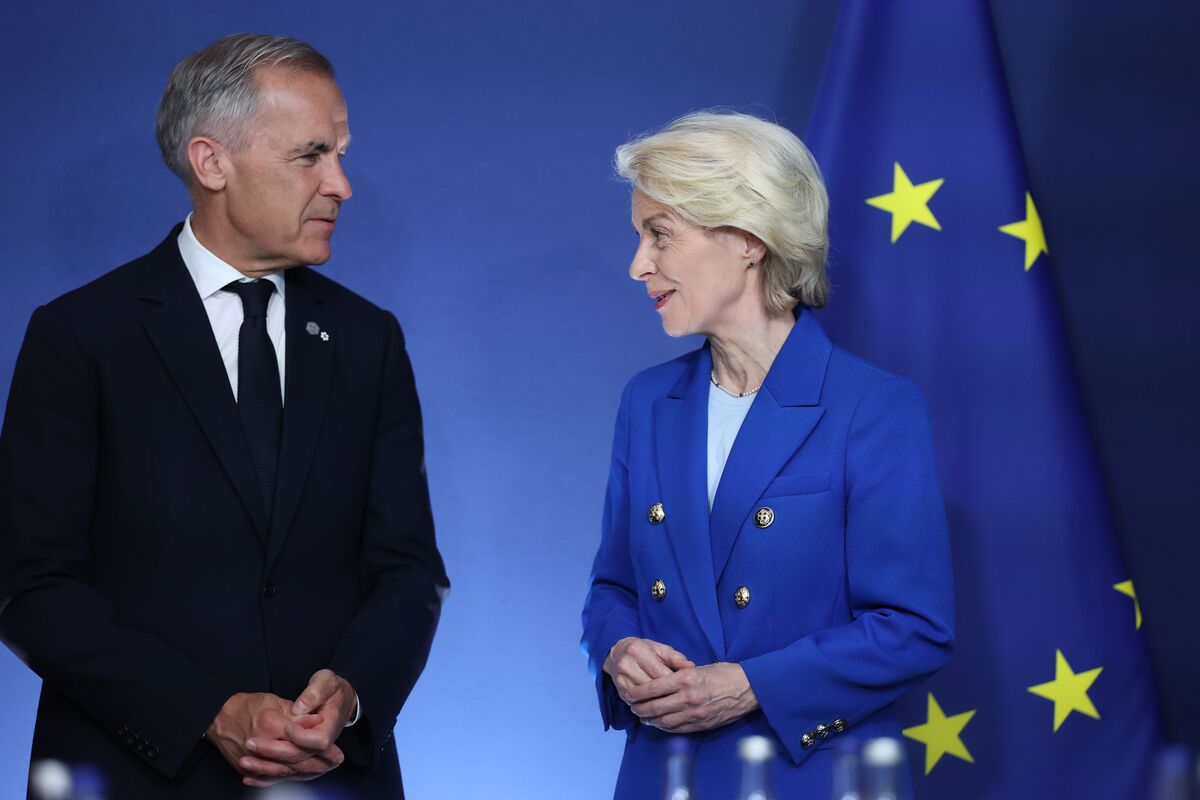
Canadian Prime Minister Mark Carney is advancing a Europe-oriented policy pivot while imposing counter-tariffs on US goods, signaling an escalation in Canada-US trade tensions. The newsletter also flags Republican senators' opposition to a Trump threat involving Bombardier, adding political uncertainty for cross-border trade and aerospace. No tariff rates, affected product values, or timing were provided.
Analysis
The near-term market effect is likely concentrated in companies with embedded cross-border supply chains rather than broad Canadian equities. Retaliatory measures raise procurement costs for Canadian distributors and manufacturers before they create meaningful domestic substitution; firms with US-dollar revenue and Canadian-dollar cost bases may partly offset this, while import-reliant consumer and industrial names face margin pressure if they cannot reprice. The first 1-3 month catalyst is the actual tariff schedule and exemptions, not political rhetoric: product-level coverage will determine whether the impact is inflationary, earnings-dilutive, or largely symbolic.
BBD.A is an imperfect proxy for the dispute. Its business-jet franchise has meaningful US customer exposure, but its earnings sensitivity depends far more on order intake, delivery cadence, aftermarket growth and certification than on bilateral tariff headlines. A threat aimed at Bombardier could nevertheless increase procurement uncertainty for US corporate buyers and government-adjacent customers, potentially delaying orders; that is more damaging to the multiple than to near-term revenue because the backlog provides a buffer. Senate resistance reduces the probability of an immediate punitive outcome, making a large BBD.A selloff on headlines more likely an opportunity than a thesis-changing event.
The second-order risk is that a durable Canada-US rupture pushes Canadian policy toward European defense, infrastructure and industrial partners. Over 6-18 months, that could favor aerospace and engineering suppliers able to qualify into European procurement chains, but it also risks duplicative standards, higher compliance costs and slower capital deployment. Consensus may overstate the benefit of “diversification”: European market access takes years to monetize, while the US remains the dominant customer, financing and parts ecosystem for many Canadian industrial exporters.
The key falsifiers are concrete: BBD.A order cancellations or a book-to-bill ratio below 1.0, a reduction in delivery or free-cash-flow guidance, or tariff language explicitly covering aircraft, aerospace components or US-origin production inputs. Conversely, exemptions for aerospace and a stable backlog would confirm that the issue is primarily a volatility event rather than an earnings impairment.
AllMind Terminal
AI-powered research, real-time alerts, and portfolio analytics for institutional investors.
Request TrialMarket Sentiment
Overall Sentiment
mildly negative
Sentiment Score
-0.25
Ticker Sentiment
Key Decisions for Investors
- Do not initiate a directional BBD.A position solely on the policy headline. Set an alert for a 8-10% headline-driven drawdown without a backlog, delivery or free-cash-flow guidance revision; that would create a potential 3-6 month tactical long, contingent on confirmation that aerospace products are exempt.
- For existing BBD.A longs, retain core exposure but hedge the next 1-3 months of policy volatility with a modest BBD.A put spread or reduce position size into any tariff escalation. Exit the constructive view if management identifies order deferrals, cancellations, or tariff-related margin pressure in its next update.
- Favor a relative-value expression over a broad Canada risk-off trade: long BBD.A only after policy clarity versus short a Canadian import-sensitive consumer/discretionary basket, where tariff pass-through risk is more immediate. The trade requires product-level tariff details before sizing because current information does not establish BBD.A as the primary economic loser.
- Monitor US congressional opposition and any aerospace-specific carve-out as near-term catalysts; a negotiated exemption could remove the BBD.A overhang within days, while a formal aircraft/components measure would warrant reassessing estimates and cutting exposure before the next order-intake disclosure.
More News
- What next for France as riots rattle markets? Three questions facing investors ahead of more protests
- AI Doubts Spread Cracks in Equities, Credit Markets: Evening Briefing Americas
- Stocks Fall as Oil Rally Keeps a Lid on Treasuries
- Chipmakers Post Longest Weekly Drop Since November
- CrowdStrike CEO's alarming prediction — plus, the sell-off spreads beyond tech
- Elon Musk’s dangerous grip on outer space
From AllMind Research
- Anthropic IPO Preview: Valuation, Timing, and What to Watch
- Shein After the IPO: Venue, Valuation, and What Must Be Proved
- What AI Research Tools Should a Small Hedge Fund Buy First?
- Automating Financial Model Updates: A Source-Controlled Workflow
- Weekly Update: Live Event Center, In-App Documents, and Faster Transcripts