
RoboParty Unveils RP1, a High-Performance Full-Stack Open-Source Humanoid Robot at IROS
Source: PR Newswire
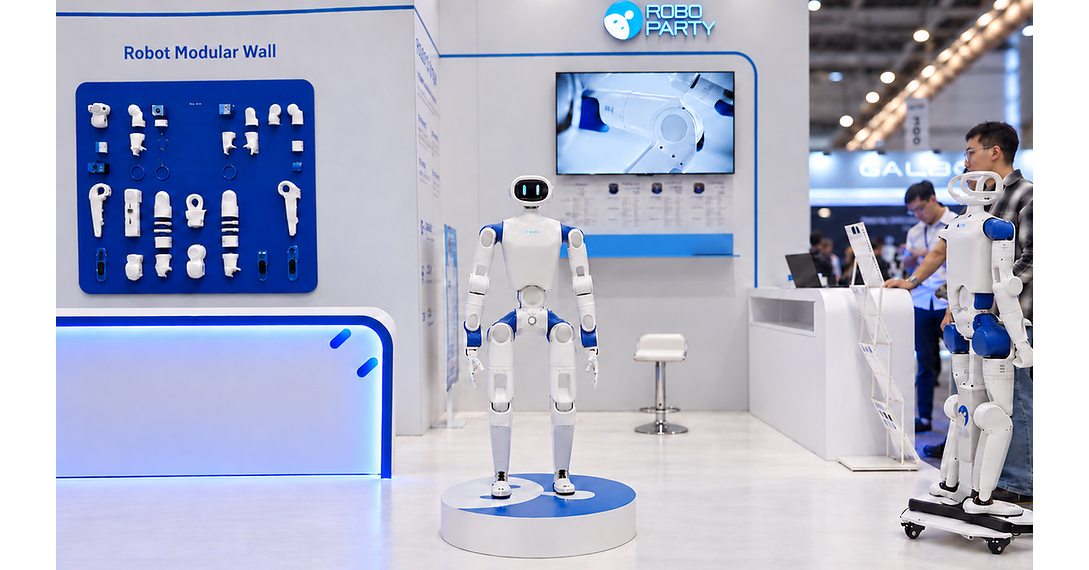
RoboParty unveiled its RP1 (ROBOTO 01) humanoid robot at IROS 2026, positioning it as a high-performance full-stack open-source bipedal platform for robotics and embodied-AI developers. RP1 delivers peak joint torque of up to 160 N·m and demonstrated balance recovery under external pushes and kicks, supported by PartyOS and an unsupervised reinforcement-learning training framework. The company plans additional open-source software and hardware releases and a mass-production program later in Q4 2026; its existing RPO project has over 2,500 GitHub stars and its developer community exceeds 5,000 members.
Analysis
The relevant signal is not a near-term revenue event but potential ecosystem commoditization. An open hardware/control stack can lower the cost and iteration cycle for university labs and smaller embodied-AI teams, shifting differentiation away from basic locomotion software toward actuators, safety certification, fleet reliability, data collection and distribution. That favors component incumbents with production quality and service networks—ABB, FANUC and Harmonic Drive Systems (6324 JP)—more than closed-platform humanoid developers whose valuation rests on proprietary-stack scarcity.
The second-order risk is that open-source adoption fragments interfaces rather than creating a true standard. If the platform attracts developers but lacks repeatable actuator life, payload, uptime, unit-cost and safety data, it remains a research tool with negligible commercial read-through; GitHub engagement is not a demand metric. The October roadmap and Q4 production claims are catalysts over 1-3 months, but absent disclosed pricing, bill of materials, committed volumes and licensing terms, there is no basis to underwrite revenue or margin impact for public robotics suppliers.
Consensus may over-interpret visible dynamic demos as evidence that humanoids are nearing scalable deployment. Recovery behavior is necessary but does not solve manipulation throughput, battery economics, field maintenance or liability—the variables that determine enterprise ROI over the next 6-18 months. Broad humanoid enthusiasm can nevertheless support AI-capex proxies such as NVDA, but this announcement alone is too small to alter their earnings trajectory.
AllMind Terminal
AI-powered research, real-time alerts, and portfolio analytics for institutional investors.
Request TrialMarket Sentiment
Overall Sentiment
moderately positive
Sentiment Score
0.45
Key Decisions for Investors
- No directional trade on the announcement; treat it as a validation watch item rather than a catalyst for NVDA, TSLA, ABB or ROK. Reassess only if the Q4 release includes unit pricing, production capacity, customer commitments and independently reproducible reliability metrics.
- Monitor 6324 JP and 6268 JP for a 1-3 month component-demand narrative bid; do not chase without evidence that the platform sources third-party precision reducers rather than internally integrated modules. A disclosed external component bill of materials would be the trigger.
- Maintain skepticism toward premium valuations in pure-play robotics software/private-market comparables: open tooling can compress software take rates, while manufacturing and service remain the economic bottlenecks. This thesis is falsified by meaningful paid enterprise deployments with recurring software revenue rather than developer adoption.
- For AI-capex exposure, prefer existing positions in NVDA over adding speculative humanoid beta. The trade only gains incremental support if developer adoption produces measurable simulation/training compute demand; absent cloud-spend or hardware procurement data, expected risk/reward is unattractive.
More News
- AI deal boom drives Hong Kong fundraising to record summer
- Trump taps Director of National Intelligence Jay Clayton as AI czar: WSJ reports
- U.S. to lend $4.2 billion to Vistra to boost nuclear power output, source says
- How Nvidia, Micron and a surprising jobs report drove last week's stock action
- US to lend $4.2 billion to Vistra to boost nuclear power output, source says
- What the bond market reveals about Congress, the national debt and the middle class—and where America goes from here