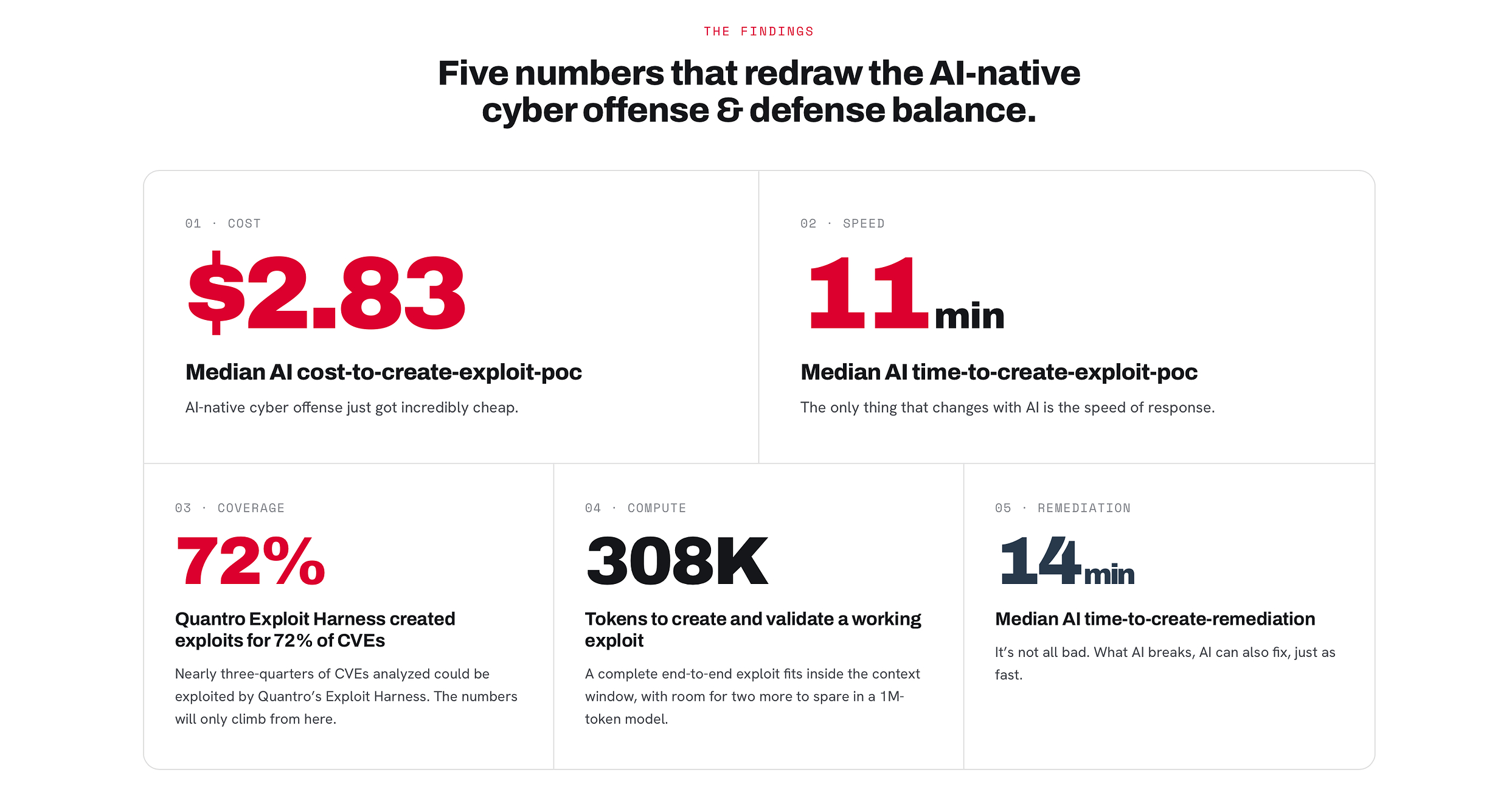
Quantro Security reports that autonomous AI agents turned 3,029 disclosed CVEs into verified working exploits for 2,183 of them (72%), at a median cost of $2.83 and median time of 11 minutes per exploit—collapsing the historic “economic scarcity” barrier. It also finds 73% of AI-exploitable CVEs have EPSS < 0.25 (a common enterprise deprioritization threshold) and 89% are not in CISA’s Known Exploited Vulnerabilities catalog, implying many “ignored” flaws are readily AI-weaponizable. The firm is releasing free tools (AI-XI and AI-Recon) to score exploitability and map exposure from an AI attacker’s perspective.
This is less a one-day cyber headline than a budget re-prioritization event. If AI can generate PoCs cheaply, the pricing power shifts from "find more CVEs" to "reduce exploitable attack surface" and "prove remediation speed," which should favor platform vendors with exposure management, identity, endpoint, and cloud control planes. Legacy vulnerability-management names that monetize triage queues face a messaging problem: customers no longer want more scoring confidence, they want automated suppression and remediation.
Immediate market reaction likely fades because the evidence is vendor-produced, but the 1-3 month catalyst is procurement churn: CISOs will start asking for AI-exploitability scoring in RFPs and may reallocate spend toward tools that operationalize it. That is constructive for PANW, CRWD, ZS, and FTNT, and potentially for adjacencies in asset inventory and exposure management, but a headwind for TENB/RPD-style budgets if buyers decide human-centric prioritization is obsolete. Second-order, cyber insurance and managed security providers may push AI-native exposure scanning as a control requirement, expanding attach rates even if breach counts do not jump immediately.
The contrarian risk is that proof-of-concept generation is not the same as scalable compromise; segmentation, MFA, and EDR still block many incidents. If independent testing shows high false positives or weak linkage to real breach frequency, the fear trade reverses quickly. So the trade is really about a 6-18 month standards shift, not near-term incident counts; the thesis is falsified if enterprise RFPs, budget lines, and vendor guidance do not materially move toward AI-exploitability metrics by the next earnings cycle.
AI-powered research, real-time alerts, and portfolio analytics for institutional investors.
Request TrialOverall Sentiment
strongly negative
Sentiment Score
-0.55
