
Fortitude Gold Drills 6.10 Meters Grading 3.44 g/t Gold Within 21.34 Meters Grading 1.27 g/t Gold at Isabella Pearl Scarlet North
Source: Newswire
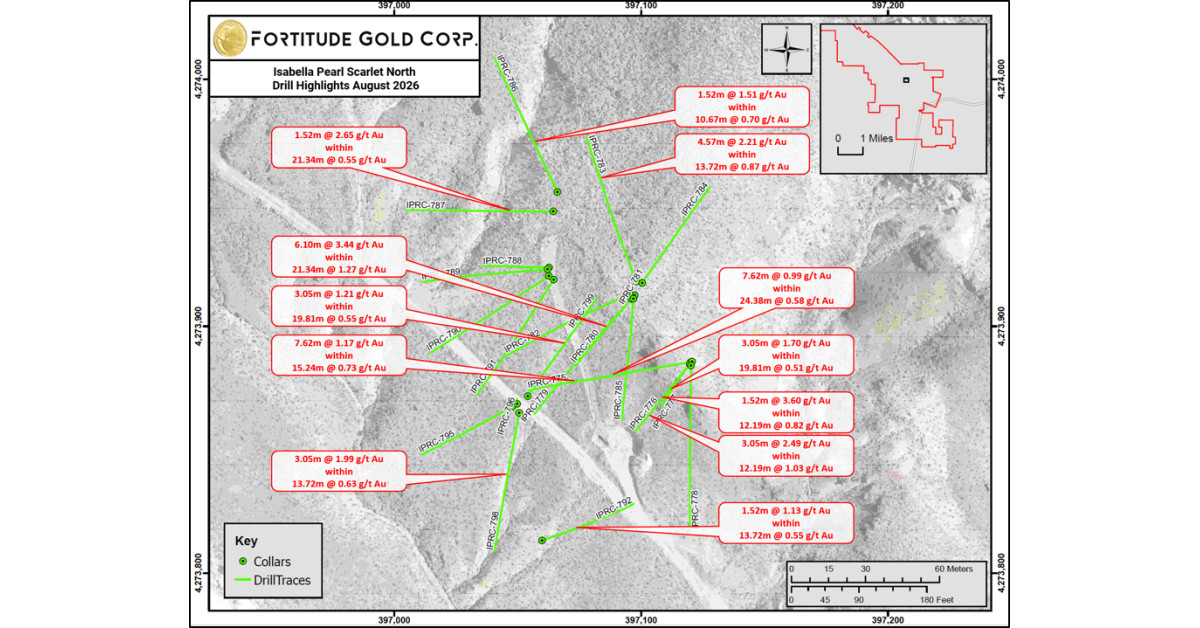
Fortitude Gold reported high-grade gold drill intercepts from the Isabella Pearl “Scarlet North” target, including 6.10m at 3.44 g/t Au within 21.34m at 1.27 g/t. Additional results included 3.05m at 2.49 g/t within 12.19m at 1.03 g/t and 4.57m at 2.21 g/t within 13.72m at 0.87 g/t. The company says oxide step-out results expand mineralization to the northwest, with preliminary metallurgy indicating similar heap-leach extractability and ongoing baseline studies for open-pit permitting with BLM/NDEP.
Analysis
This is incremental positive optionality, not yet a fundamental rerate. The market mechanism is that a small, debt-free producer with nearby oxide potential can extend mine life at low capital intensity, which matters more than headline grade if the ore can be slotted into an existing heap-leach circuit without materially changing strip, recoveries, or permitting scope.
The key second-order effect is cash-flow quality: if follow-on drilling converts this corridor into a mineable satellite feed, FTCO could defend dividend capacity while lowering replacement-asset risk. That is structurally more valuable to a micro-cap producer than a standalone resource update, because it reduces the probability of cash being returned to shareholders while production depletes elsewhere. The upside is asymmetric only if the continuity model holds; otherwise this remains a typical exploration press release with limited balance-sheet impact.
Time horizon matters: over days, the stock can trade on headline momentum and thin liquidity; over 1-3 months, the real catalyst is additional step-out/infill holes plus any resource or pit-shell commentary; over 6-18 months, permitting and metallurgy determine whether this becomes reserve replacement or just paper ounces. The contrarian risk is that investors may be overpricing nearby-mineralization as immediately economic, when the true bottlenecks are tonnage continuity, dilution, and BLM/NDEP timing.
Falsifiers: weak follow-up holes, lower recoveries than expected in metallurgical work, or any sign the corridor is discontinuous enough to require a separate build rather than a short-haul satellite pit. If gold weakens materially, the equity can lose this optionality fast because the market will revalue the ounces at a higher discount rate and ignore distant growth promises.
AllMind Terminal
AI-powered research, real-time alerts, and portfolio analytics for institutional investors.
Request TrialMarket Sentiment
Overall Sentiment
mildly positive
Sentiment Score
0.25
Ticker Sentiment
Key Decisions for Investors
- Do not chase FTCO on the release alone; wait for either a resource update or a clear volume-confirmed breakout, since the move is likely to fade without tonnage continuity data.
- If willing to take micro-cap exploration risk, take only a starter long in FTCO on pullbacks over the next 1-3 weeks and size it as an optionality trade, not a core gold position; thesis breaks if follow-up holes fail to extend the corridor.
- Use GDXJ as the cleaner liquid proxy for positive Nevada/US gold exploration sentiment rather than FTCO itself if the goal is to express a sector view over the next 1-3 months.
- Set an alert for metallurgical or permitting updates from Scarlet North; if management confirms near-surface oxide continuity and existing-plant compatibility, the re-rate probability rises materially, otherwise trim on strength.
- Avoid a short here unless gold prices roll over and FTCO fails to publish meaningful follow-up drilling; the near-term squeeze risk is higher than the downside from this single data point.
More News
- Can Estee Lauder's Innovation Push Unlock the Next Growth Wave?
- Nvidia GPUs are everywhere. Here are the ways companies are accessing them
- Bank of America is bullish on these top stocks ahead of earnings
- As companies pour billions into Earth-based AI infrastructure, Google is taking the data center race off-planet
- How U.S. know-how is fracking Australia into a gas boom, from Texas oilmen to Trump’s energy secretary
- The world needs Ukraine’s grain. Its farmers are running out of reasons to plant
From AllMind Research
- Anthropic IPO Preview: Valuation, Timing, and What to Watch
- Shein After the IPO: Venue, Valuation, and What Must Be Proved
- What AI Research Tools Should a Small Hedge Fund Buy First?
- Weekly Update: Unstructured Data Search, Ask AI, and Advanced Futures Data
- Best AI Stock Research Tools for Professional Investors