
Perpetua Announces New Gold Discovery at Stibnite Gold Project & Continued High Grades from Clark Tunnel Fault Zone
Source: PR Newswire
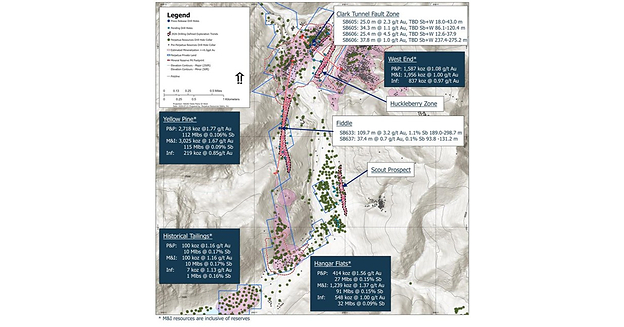
Perpetua Resources completed more than 16,000 meters of 2026 exploration drilling at its Stibnite project, with the first Fiddle hole returning 109.7 meters grading 3.2 g/t gold and 1.1% antimony. Clark Tunnel Fault Zone drilling returned 25.4 meters at 4.5 g/t gold and 25.0 meters at 2.3 g/t; antimony and tungsten assays for those holes are pending. The company says both targets could expand resources or supplement the permitted Yellow Pine pit’s production profile, but further assays and exploration results are not guaranteed.
Analysis
The results improve the project’s option value, but not yet its financeable value: exploration intercepts do not establish mineable tonnes, true widths, recoveries, or incremental project economics. The market should distinguish the CTFZ, which may have a shorter path to mine-plan inclusion because it is within/at the permitted pit, from Fiddle, where conversion to resources and any required permitting could extend the timeline. The large Fiddle interval is encouraging, but the limited follow-up assays leave continuity and geometry unresolved; visible sulfides in pending holes are not grade evidence.
Near term, PPTA may trade on assay headlines and the strategic value of domestic antimony supply. Over 1–3 months, the key catalysts are remaining assays—including CTFZ antimony/tungsten—and evidence that mineralization is continuous beyond isolated intercepts. Over 6–18 months, value depends on resource conversion, mine-plan integration, permitting scope, project financing, and whether added material improves economics rather than simply enlarging the resource. A strategic-supply premium can amplify upside, but cannot substitute for these milestones. The principal reversal risks are weaker follow-up grades, discontinuous mineralization, unfavorable metallurgy, added review/permitting, or financing on dilutive terms. No basis here to infer a change to consolidated production or cash flow.
AllMind Terminal
AI-powered research, real-time alerts, and portfolio analytics for institutional investors.
Request TrialMarket Sentiment
Overall Sentiment
moderately positive
Sentiment Score
0.40
Ticker Sentiment
Key Decisions for Investors
- Treat PPTA as a catalyst-driven exploration/development position, not as a near-term production upgrade. If adding, scale in rather than chase the initial headline; require follow-up assays and technical interpretation before increasing exposure.
- Monitor the next assay releases for continuity across the Fiddle strike, reported true-width/geometric context, and CTFZ antimony/tungsten grades. Strong results would support a resource-conversion thesis; weak or isolated follow-up would falsify the discovery-driven upside case.
- Keep Fiddle and CTFZ valuation cases separate: give CTFZ greater near-term mine-plan relevance, while discounting Fiddle for resource-definition and possible permitting time. Verify whether any Fiddle development would sit within existing approvals before assigning schedule value.
- Reassess after resource or mine-plan updates for incremental recoverable ounces/antimony, metallurgy, capex, and funding requirements. If added mineralization does not improve project economics—or requires material dilution or new regulatory review—the exploration premium is vulnerable to reversal.
More News
- NextDC shares surge 43% after Goodman, Digital Realty stake purchases
- Voters rebuff data centers in every ballot measure except one during the 2026 midterms
- Qualcomm issues disappointing earnings forecast as memory shortage weighs on smartphone sales
- China’s Copper Squeeze Deepens as Buyers Scramble for Spot Metal
- Softbank’s $5.4 bln takeover of ABB robotics unit blocked by China- FT
- After the midterms, Big Tech’s AI data center problem is only getting bigger