
AI Can Help Asset Managers Do More Than Fix Problems Faster
Source: PR Newswire
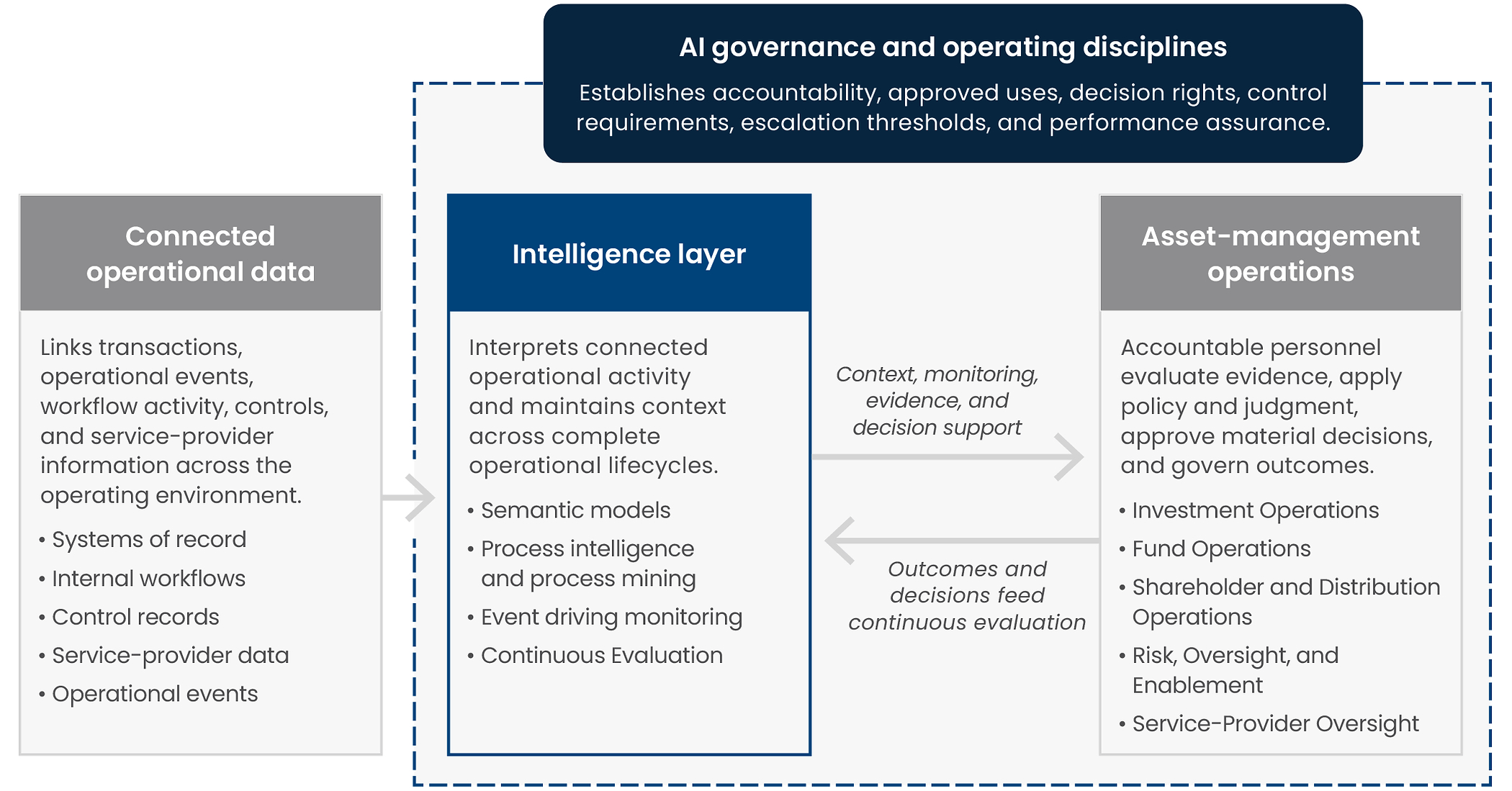
The Investment Company Institute introduced an Intelligent Operating Model outlining how AI could help asset managers prevent recurring operational problems, connect information across systems, and identify risks earlier. The framework targets efficiency and better decision support amid growing complexity, including T+1 settlement and extended trading hours, while emphasizing governance and human accountability. The article describes a proposed industry approach, not quantified adoption or financial results.
Analysis
This is an industry advocacy paper, not evidence of funded deployments or a change in SEC requirements. The near-term signal is therefore stronger for vendor positioning than for asset-manager earnings. If firms buy rather than build, fund-administration and workflow-software providers such as SS&C Technologies, and large custodians such as State Street and BNY, could benefit from demand for data integration and exception management. But procurement, model validation, and legacy-system integration may absorb savings for years; productivity gains could also be competed away through lower fees rather than accrue to shareholders.
The less obvious exposure is operational risk concentration: AI that links trading, shareholder, and valuation data may surface problems sooner, but bad inputs or automation errors could propagate across funds faster and increase remediation or reputational costs. Human review and governance remain gating items, limiting near-term autonomy. The cited SEC director’s encouragement is not a rule or safe harbor.
Time horizon: days, likely limited fundamental impact; 1–3 months, watch for vendor contracts, implementation spending, and measurable exception-rate reductions; 6–18 months, successful deployments could support operating leverage, while fee competition determines who captures it. Contrarian view: the paper frames efficiency as the prize, but better risk detection may be the more valuable use case—and the harder one to prove. No broad sector trade is warranted without adoption and ROI evidence.
AllMind Terminal
AI-powered research, real-time alerts, and portfolio analytics for institutional investors.
Request TrialMarket Sentiment
Overall Sentiment
mildly positive
Sentiment Score
0.25
Key Decisions for Investors
- No immediate directional trade: treat this as a thematic signal, not an earnings catalyst. Avoid paying a premium for generic “AI in asset management” claims absent disclosed deployments and verified outcomes.
- Build a watchlist of fund-administration and custody providers, including SS&C Technologies, State Street, and BNY. Revisit a relative long only after contract wins or reported reductions in settlement exceptions, investigation time, or operating cost per account.
- For any prospective long, verify whether benefits are retained as margin or passed through as lower fees, and whether AI-related spending raises near-term costs. Falsify the efficiency thesis if operating expenses rise without improving exception rates or service metrics over the next several reporting periods.
- Monitor SEC rulemaking and incident disclosures separately from industry commentary. A material valuation, settlement, or data-governance failure tied to automated workflows would challenge the adoption thesis and could raise compliance and remediation costs across providers.
More News
- Analysts react as Binance freezes assets after $6.3 billion security breach
- Stocks slump, bonds leap as AI giants’ spending spooks investors
- Alphabet Erases $500 Billion as ChatGPT, Google AI Cut into Search
- Alphabet’s stock has worst day in over 20 years, dragging the S&P 500 to first loss in four days
- Taiwan Stocks Heads for Correction as Global AI Selloff Deepens
- Asia stocks tumble as AI spending concerns deepen; BOJ holds rates