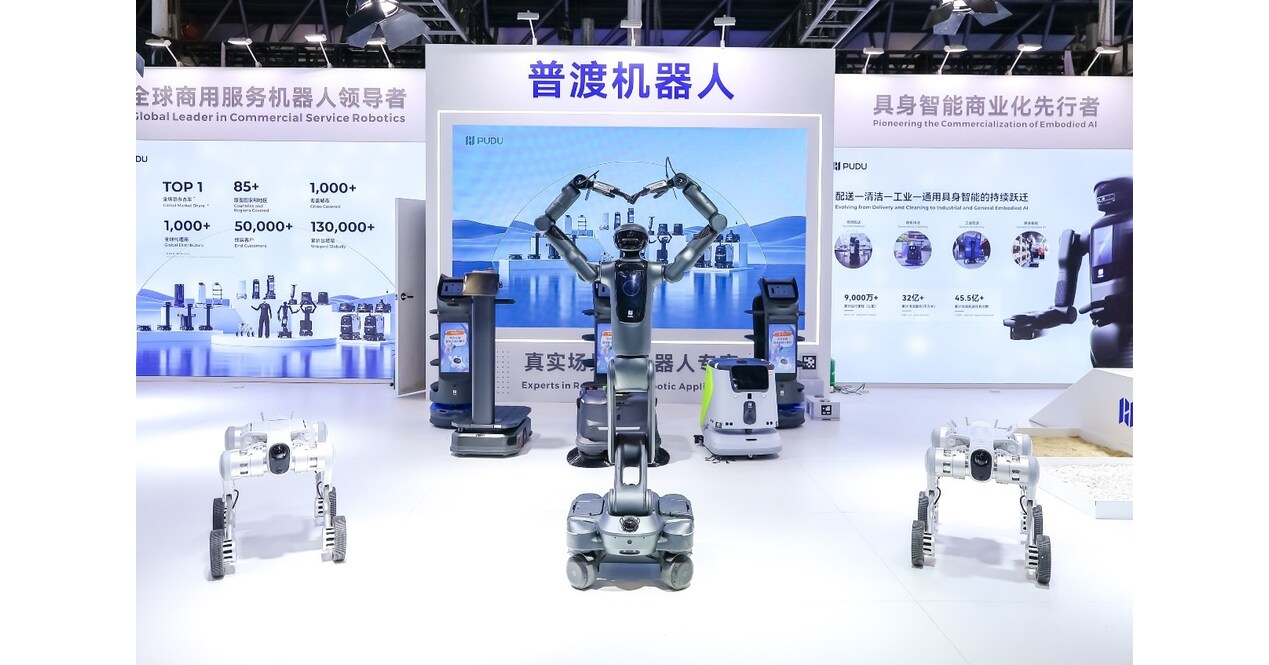
Pudu Robotics showcased its full portfolio at WAIC 2026, including the offline global debut of the semi-humanoid PUDU D7, while also demonstrating multi-robot coordination with the PUDU D5. The company received 36Kr’s “Most Investor-Attractive AI & Embodied Intelligence Enterprise” award after raising nearly $150M in April 2026 and reaching a valuation above $1.5B (cumulative funding >$300M). Frost & Sullivan data cited Pudu leading the global commercial service robotics market with 25% revenue share and 23% delivery share, plus reported YoY revenue growth of 100%+ and a positive EBITDA.
This is primarily a sentiment and signaling event, not a direct cash-flow catalyst. The meaningful market mechanism is a read-through to the listed embodied-AI complex: capital is still rewarding perceived category leaders, which can support valuation multiples even before operating leverage shows up. The bigger implication is competitive sorting—well-funded players can keep spending on field deployments and customization, while weaker rivals face either pricing pressure or slower rollout cycles.
Immediate beneficiaries are public proxies with the cleanest exposure to robotics re-rating, especially UBTECH (9880.HK) and broad baskets like ROBO/BOTZ if the market generalizes the theme. The second-order loser is any service-robotics vendor dependent on one-off hardware sales and thin service revenue, because a leader narrative tends to steepen customer concentration and force smaller peers to subsidize pilots. Component suppliers with actuators, motion control, and perception stacks could see demand pull forward, but only if demos convert into fleet orders.
Over 1-3 months, the key catalyst is contract proof: backlog, repeat purchases, and evidence that overseas demand is scaling without heavy discounting. Over 6-18 months, the risk is margin normalization as semi-humanoid systems move from novelty to procurement line items and become easier to commoditize. The contrarian view is that the market may be overestimating how quickly 'embodied AI' becomes profitable at scale; these businesses often look like software stories until support, installation, and maintenance costs reassert themselves.
What would falsify the bullish read-through is a lack of follow-through in listed peers’ bookings or guidance this earnings cycle, or evidence that orders remain demo-led rather than fleet-led. If the sector fails to see relative strength after the next reporting season, this should be treated as a tape-driven fad rather than a durable repricing.
AI-powered research, real-time alerts, and portfolio analytics for institutional investors.
Request TrialOverall Sentiment
moderately positive
Sentiment Score
0.45
