
Agentic AI Contracts Expose Organizations to Runaway Costs With Limited Recourse, Says Info-Tech Research Group
Source: PR Newswire
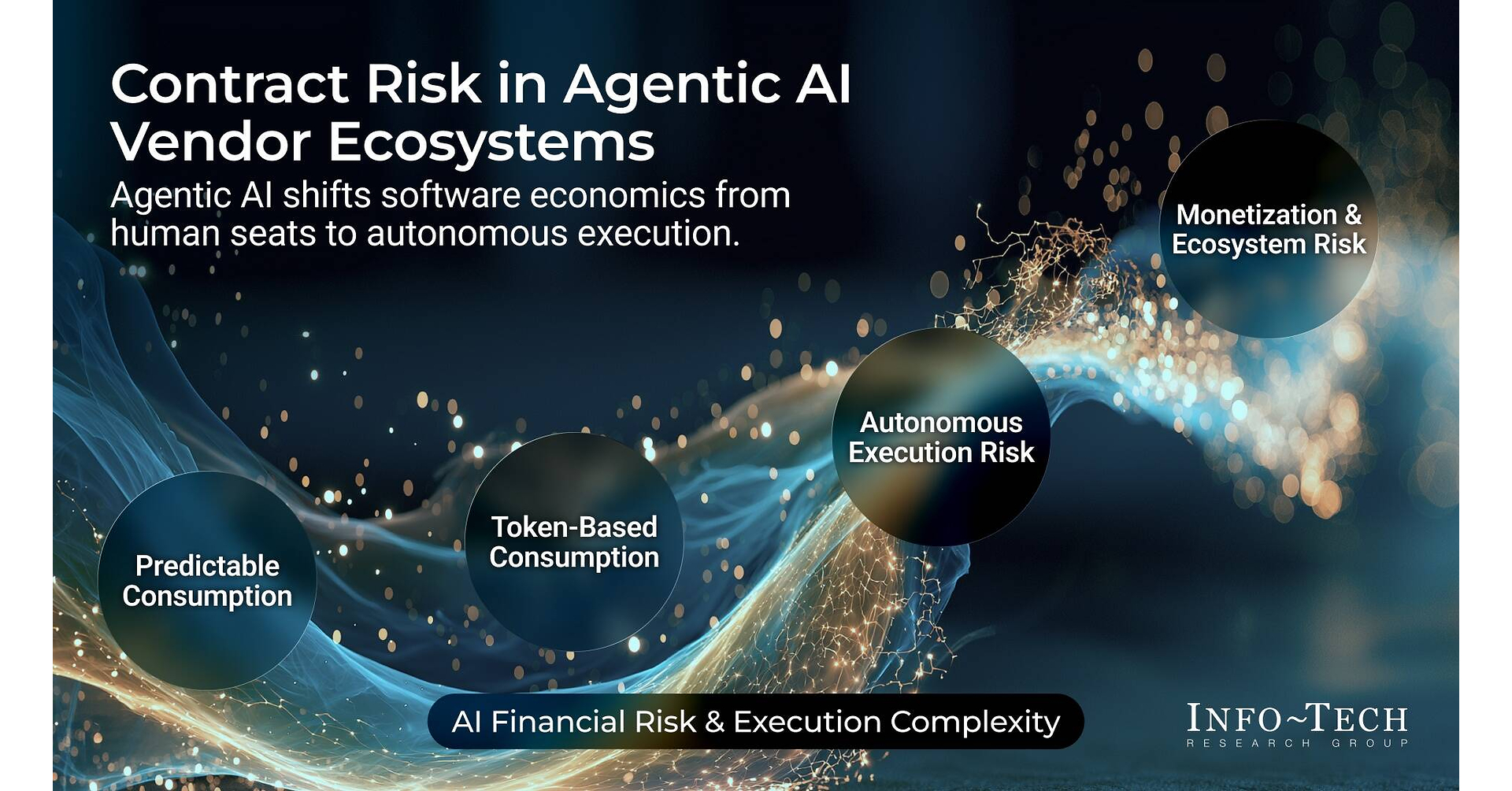
Agentic AI is shifting software billing from predictable per-seat licensing to consumption-based pricing, where a single prompt can trigger many billable events (tool calls, retries, recursive reasoning, and multi-agent orchestration). Info-Tech Research Group’s blueprint, “Negotiate Safe AI Contracts to Prevent Bill Shock,” warns that billing definitions and pricing logic are often vendor-controlled post-deployment, with weak audit/dispute rights and missing hard caps. The article recommends contract guardrails—clear billing definitions, audit rights, pricing-change protections, forecast simulations, and throttles/kill switches—before signing to prevent cost spirals once workflows are embedded.
Analysis
This reads more like a monetization-friction warning than an AI-demand kill shot. The near-term effect is a longer sales cycle and lower initial consumption for vendors that monetize through opaque meters, retries, and usage escalation; procurement will force caps, audit rights, and throttles, which compresses first-year expansion even if seat adoption holds. The winners are platform vendors and software suites that can bundle governance into the stack, because they reduce CFO anxiety and preserve conversion, while pure-play AI apps with aggressive usage pricing face a higher renewal hurdle.
The second-order effect is that internal buyers will shift budget from experimentation to control layers: FinOps, observability, contract lifecycle management, and security/compliance around AI workflows. That supports names exposed to spend management and governance, while it is a mild headwind to consumption-sensitive software multiples that depend on “land and expand” AI usage. This is not a six-day event; the measurable impact should show up in 1-3 quarters through RFP language, renewal concessions, and slower net retention, with the structural effect lasting 6-18 months if agentic AI becomes a governed utility rather than an unconstrained usage engine.
Contrarian view: the market may be overreacting if it assumes bill shock means lower AI adoption. In practice, enterprises usually institutionalize controls and keep deploying once price visibility improves; the real loser is pricing power, not adoption. What would falsify the cautionary thesis is continued evidence of 120%+ dollar retention and no slowdown in AI attach rates despite tighter procurement language.
AllMind Terminal
AI-powered research, real-time alerts, and portfolio analytics for institutional investors.
Request TrialMarket Sentiment
Overall Sentiment
mildly negative
Sentiment Score
-0.25
Key Decisions for Investors
- No direct trade in FCD.UN.TO or TCHC; treat this as a watch item, not a standalone catalyst.
- Watchlist: long MSFT/GOOGL vs a basket of metered AI software names (e.g., SNOW/DDOG-style exposures) over 1-3 months if earnings commentary starts highlighting procurement pushback; target is relative multiple compression in the consumption-heavy leg.
- Buy only small-sized put spreads on high-beta AI software ahead of earnings when management preannounces usage volatility or bill-shock-related churn; otherwise avoid pre-positioning because the article signal is too indirect.
- If you want to express the governance theme, favor public beneficiaries of AI spend control over pure AI adopters; exit if reported net retention and AI-related ARR accelerate without discounting pressure.
More News
- Nvidia GPUs are everywhere. Here are the ways companies are accessing them
- As companies pour billions into Earth-based AI infrastructure, Google is taking the data center race off-planet
- AI's Supercharging a Scam Economy Bigger Than the Cocaine Trade
- Verizon stock heads for worst day since 2002 as SpaceX U.S. network plans whack telcos
- Big Tech is betting $700 billion on AI. Healthcare will decide whether the bet pays off
- Tesla's Full Self-Driving is now called Assisted Driving in Europe