
Every Megawatt of AI Capacity Can Make Up To 200,000 Gallons of Clean Water per Day
Source: PR Newswire
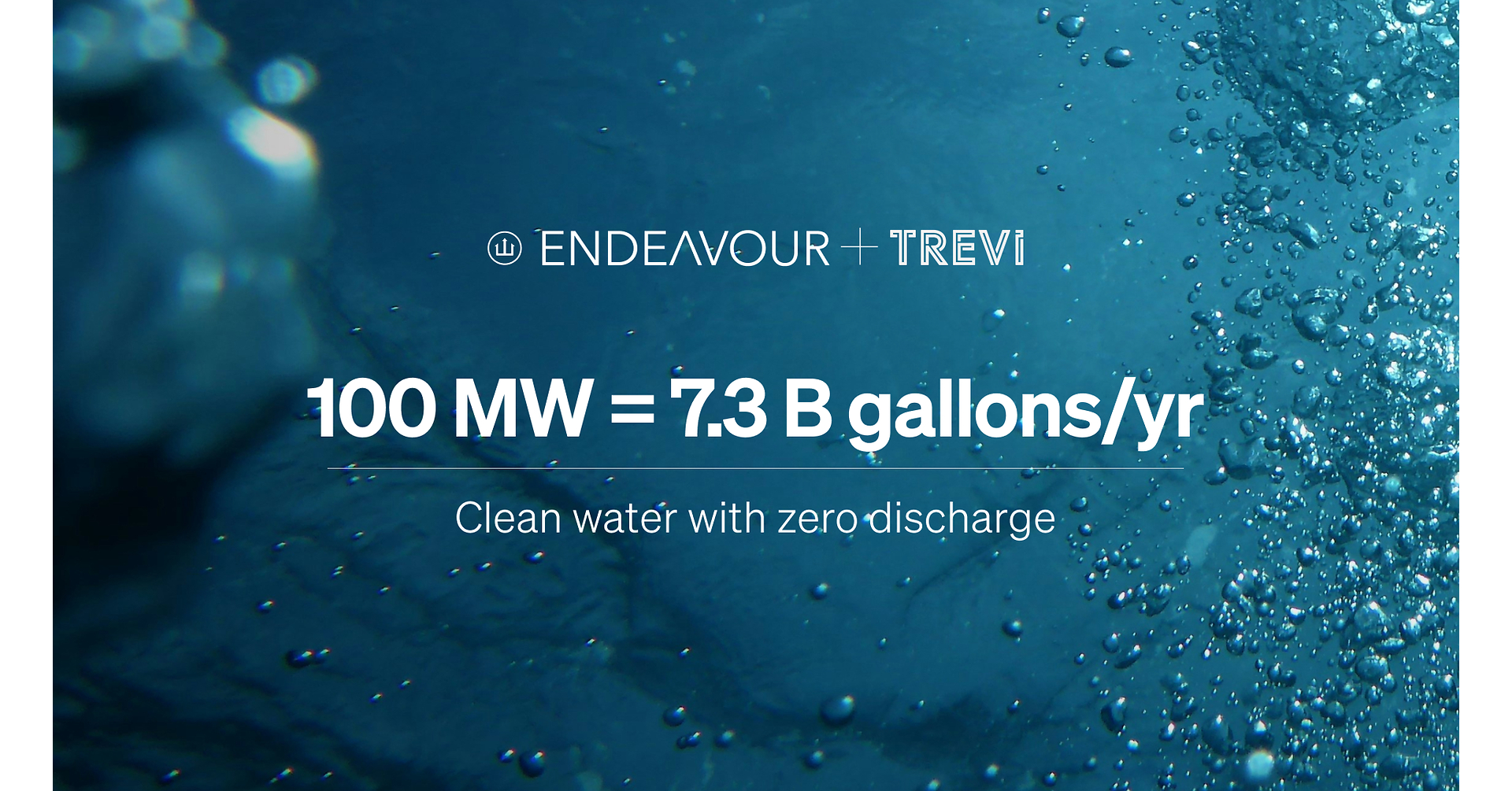
Endeavour and Trevi Systems announced a partnership to scale heat-driven desalination using data-center waste heat, with initial deployment planned at Endeavour’s U.S. data centers. The system is designed to produce up to 200,000 gallons of clean water per day per MW from brackish groundwater, while concentrating brine to solids; a 100-MW campus could produce up to 20 million gallons daily. Trevi says its process cuts purchased energy for brine treatment by roughly 85%, but the announcement provides no financial terms or deployment timetable beyond the initial rollout.
Analysis
The investable question is not the headline water yield; it is whether low-grade heat can be converted into saleable water at a lower all-in cost than conventional treatment after parasitic power, pretreatment, membrane replacement, and solids disposal. The stated output implies roughly 32 kWh of heat per cubic meter of water. That is a testable engineering claim, not yet evidence of attractive economics: verify metered heat balance, auxiliary electricity, uptime, feed-water quality, and water-quality certification at Endeavour’s first deployment. Concentrating contaminants into solids also shifts, rather than automatically removes, disposal and permitting risk.
If validated, the more durable benefit may be siting flexibility and community acceptance for data centers in water-stressed regions, not a material new revenue stream from water sales. Hyperscalers could gain an alternative to competing with households and agriculture for water; established operators such as Equinix and Digital Realty could face pressure to match the capability in permitting-sensitive markets. However, closed-loop cooling already addresses direct cooling-water consumption, so this partnership’s incremental value depends on whether local water production is cheaper and easier to permit than sourcing water elsewhere.
Near term, this is an announcement with limited public-equity exposure: neither partner has a supplied ticker identity. Over 1–3 months, look for a funded project, independent performance data, and customer offtake. Over 6–18 months, replication across sites matters more than nameplate capacity. The thesis weakens if first-site output or uptime misses claims, net purchased energy is material, or solids handling proves costly or restrictive.
AllMind Terminal
AI-powered research, real-time alerts, and portfolio analytics for institutional investors.
Request TrialMarket Sentiment
Overall Sentiment
moderately positive
Sentiment Score
0.55
Key Decisions for Investors
- No immediate public-equity trade: the companies have no supplied ticker identities, and the announcement does not establish commercial-scale economics. Avoid treating the projected global water contribution as an earnings forecast.
- Set an alert for the first U.S. deployment and require independently verifiable operating data: net thermal and electric input per cubic meter, uptime, membrane and draw-solution replacement, water-quality results, and cost and destination of residual solids.
- If those metrics validate and repeat orders follow, assess data-center operators including Equinix and Digital Realty for relative exposure to water-constrained permitting; favor operators with credible, site-specific water plans over a broad sector long.
- Falsifiers: sustained output materially below the stated design rate, significant purchased-energy requirements, failure to secure local permits or water offtake, or no evidence of repeat deployments within 6–18 months.
More News
- Asia stocks fall as AI rout batters S.Korea; Japan spooked by strong CPI
- AI debt and French bonds face a stress test — why it may not be over
- SK Hynix shares slide after chipmaker scraps Solidigm IPO plans
- Why is SK Hynix stock sliding today?
- Apple’s iPhone Duo Hits Stores in Face of Short Supply and High Demand
- OpenAI nears up to $30 billion funding round at $1.25 trillion valuation led by UAE investors
From AllMind Research
- Anthropic IPO Preview: Valuation, Timing, and What to Watch
- Shein After the IPO: Venue, Valuation, and What Must Be Proved
- What AI Research Tools Should a Small Hedge Fund Buy First?
- AI Research Tools for Pension Funds and Allocators
- AllMind's Data Standardization Methodology: Our Approach to Fundamentals