
Yealink réunit des leaders sectoriels mondiaux pour façonner l'avenir des lieux de travail basés sur l'IA
Source: PR Newswire
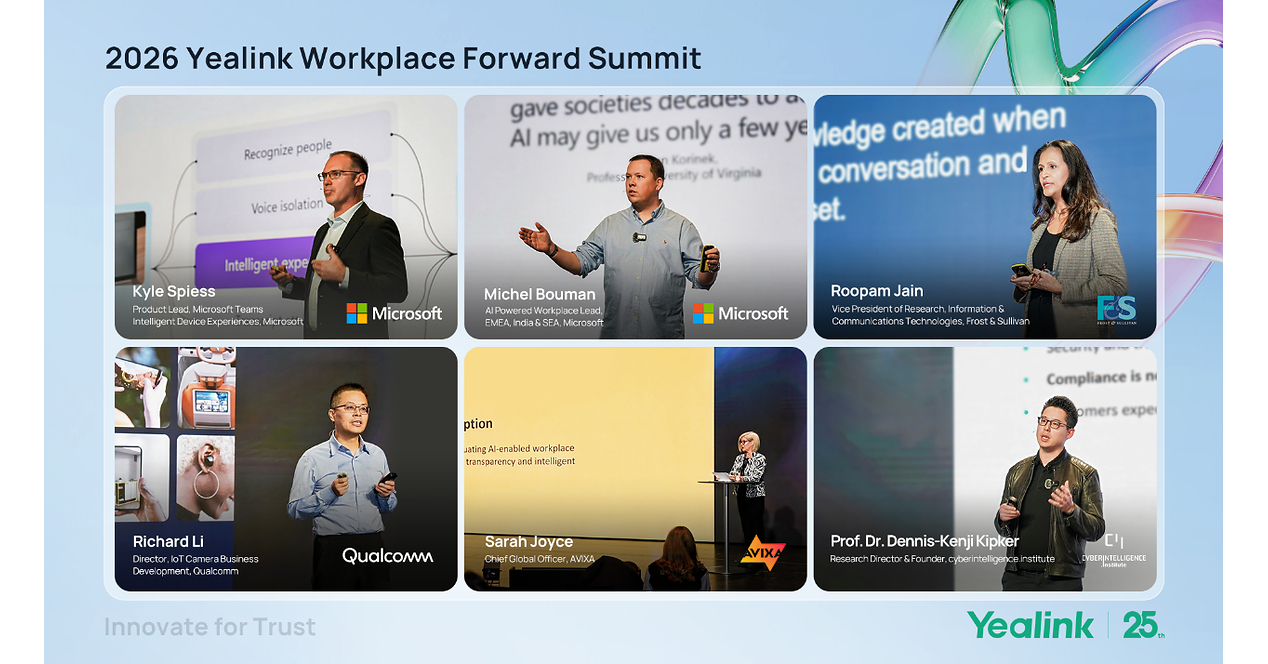
Yealink a réuni 400 participants à Munich pour présenter sa vision de lieux de travail intégrant l’IA et ses solutions unifiées de conception, gestion et service. L’analyste de Frost & Sullivan a signalé une croissance d’environ 15 % des dispositifs de visioconférence en salle au premier semestre. Yealink indique avoir enregistré un CAGR de revenus supérieur à 19 % sur cinq ans, soit quatre fois la moyenne du marché.
Analysis
Signal is strategically relevant but not yet financially actionable. A conference appearance by Microsoft and Qualcomm does not establish a commercial agreement, product integration, or incremental revenue for either; treat Yealink’s “one-stop” and AI positioning as company claims until backed by shipped products, customer adoption, or disclosed contracts. The potential value pool is split: collaboration platforms can capture recurring software and workflow economics, while room-device vendors face hardware competition and possible feature commoditization. Microsoft could benefit if AI features increase Teams engagement or paid-seat retention; Qualcomm could benefit if more inference runs on-device, but the article provides no evidence of chip selection or unit exposure. Logitech, Cisco, Zoom, and specialist AV integrators are relevant competitive checks, not demonstrated losers.
Over the next days, expect limited durable impact absent a specific deal or guidance change. Over 1–3 months, monitor product launches, named customer deployments, Teams-room attach/renewal commentary, and evidence that AI features convert to paid usage. Over 6–18 months, the key risk to the bullish narrative is that interoperability, security requirements, and uncertain ROI slow refresh cycles while AI capabilities become table stakes. The cited market-growth statistic and Yealink revenue CAGR are not independently validated here and do not establish forward growth or the economics of this offering.
Contrarian point: integrated AI room systems may simplify procurement, but complexity can shift value to software platforms and systems integrators rather than hardware vendors. No trade from this event alone; a sustained thesis requires proof of monetization and differentiation.
AllMind Terminal
AI-powered research, real-time alerts, and portfolio analytics for institutional investors.
Request TrialMarket Sentiment
Overall Sentiment
mildly positive
Sentiment Score
0.30
Key Decisions for Investors
- No event-driven position in MSFT or QCOM: their participation is not evidence of a partnership or material revenue exposure.
- Add Yealink and collaboration-hardware competitors to a watchlist; verify product availability, customer wins, pricing, and recurring-service contribution before assigning an earnings premium.
- For a 1–3 month catalyst check, monitor Microsoft Teams Rooms product disclosures and MSFT/QCOM earnings commentary for named integrations, device volumes, or paid AI adoption; absent those, treat the summit as marketing rather than a catalyst.
- Falsify the adoption thesis if subsequent launches lack named deployments, customer ROI evidence, or measurable paid usage; reassess if security or interoperability issues delay enterprise rollouts.
More News
- AI stocks hammered by midterm shock as data center buildout becomes a 'war of attrition'
- Microsoft plans to use fewer neoclouds as AI buildout shows signs of strain
- The midterms didn’t stop the AI buildout. They simply repriced it—and OpenAI is already promising to pay up
- Starlink Mobile: All the news on SpaceX’s major mobile carrier ambitions
- Google buys Wyoming data center site as hyperscalers move to own AI capacity
- Protesters break into Microsoft data centre site in Amsterdam