
RCL's $3B Sandals Bet Sparks Market Buzz: Is the Stock a Buy?
Source: zacks.com
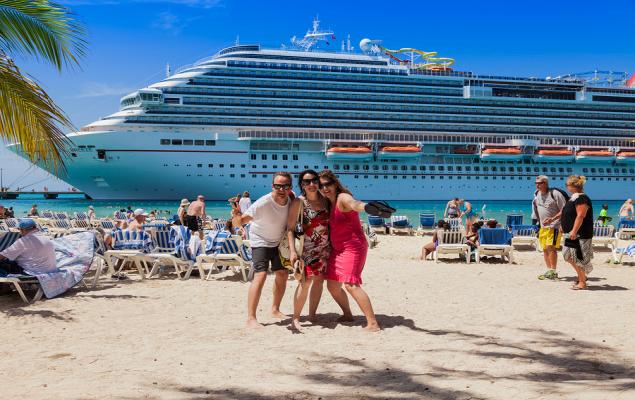
Royal Caribbean plans to acquire a 50% stake in Sandals and Beaches Resorts for approximately $3 billion, funded with committed Morgan Stanley debt financing; the deal is targeted to close in early 2027 and is expected to be earnings-accretive that year. Core operations remain strong, with Q2 2026 revenue up 6% to $4.83 billion, adjusted EBITDA of $1.8 billion (38% margin), and EPS of $4.21, $0.33 above the midpoint of guidance. Management forecasts 2026 revenue growth of roughly 9% and adjusted EPS growth of 14% to $17.73-$17.87, but the debt-funded acquisition, geopolitical pressure on Mediterranean demand, flat expected Q3 yields, and $1.3 billion of fuel expense add leverage and execution risks.
Analysis
The relevant market question is not whether the resort stake is strategically sensible, but whether RCL is converting a high-return, asset-light demand/loyalty engine into a lower-control, debt-funded capital allocation that dilutes its balance-sheet advantage. At roughly 10x forward EBITDA for a minority interest, the burden of proof is on identifiable revenue synergies and governance protections; absent these, investors should value the investment closer to a financial asset than a platform extension. Incremental interest expense and reduced buyback capacity can offset modest 2027 EPS accretion, particularly if credit spreads widen before closing.
Near term, RCL's valuation premium versus CCL and NCLH is vulnerable because it now has an additional execution variable while its core yield growth faces itinerary-related pressure. CCL is the second-order beneficiary if Caribbean demand remains robust: its larger destination pipeline can monetize the same customer preference without a new debt-funded acquisition. NCLH remains the most exposed downside vehicle in a softer leisure tape given higher leverage and weaker yield momentum, but that also makes it a poor outright short if rates fall or booking data reaccelerate.
The contrarian view is that the selloff may be underpricing the optionality of a shared customer wallet rather than an acquisition premium: resort inventory offers a release valve when cruise capacity or itinerary disruption constrains supply. That upside is not investable until management discloses pro forma leverage, cash interest cost, minority-holder rights, and a quantified cross-sell plan. Over the next 1-3 months, watch quarterly net-yield guidance and booking curves; a further guide-down or fuel-driven cost revision would likely compress RCL toward peer multiples. Over 6-18 months, deal closing terms and deleveraging cadence—not the initial accretion claim—determine whether the premium survives.
AllMind Terminal
AI-powered research, real-time alerts, and portfolio analytics for institutional investors.
Request TrialMarket Sentiment
Overall Sentiment
mixed
Sentiment Score
0.12
Ticker Sentiment
Key Decisions for Investors
- Maintain a neutral RCL exposure into the next earnings print; do not buy the headline dip. Upgrade to long only if core net-yield guidance is maintained or raised and management shows pro forma leverage returning toward the pre-deal trajectory. A cut to 2027 EPS/FCF expectations or materially higher financing cost falsifies the thesis.
- Express relative quality through long RCL / short NCLH over a 3-6 month horizon, sized modestly for sector beta. RCL's operating resilience should outperform if Caribbean pricing holds, while NCLH bears greater leverage sensitivity; exit if NCLH yield guidance materially improves or RCL's pro forma leverage exceeds disclosed expectations.
- For a less deal-specific read-through, favor CCL over RCL on new capital for the next 1-3 months: CCL participates in Caribbean destination monetization without assuming minority-investment financing risk. Reverse the preference if RCL discloses quantifiable resort cross-selling economics sufficient to cover incremental interest expense.
- Set an event alert around the financing documentation and closing approvals. Widening RCL bond spreads, reduced repurchase authorization, or a delay beyond early 2027 would signal that the transaction is becoming a balance-sheet overhang rather than an earnings catalyst.
More News
- Shares of Akamai surge after deal with Anthropic. What Wall Street is saying
- The financialisation of compute may reshape how the AI industry itself operates
- Costco just reported strong earnings. Goldman Sachs sees a sharp move higher for the stock
- Japan approval, a 27% surge: the diagnostics stock our models picked in September
- TD Synnex Analysts Boost Their Forecasts After Q3 Results
- ‘Risks Are Rising' for Nike and It's Time to Sell the Stock, Says Bank of America
From AllMind Research
- Anthropic IPO Preview: Valuation, Timing, and What to Watch
- Shein After the IPO: Venue, Valuation, and What Must Be Proved
- What AI Research Tools Should a Small Hedge Fund Buy First?
- AllMind's Data Standardization Methodology: Our Approach to Fundamentals
- What Makes Financial Data Ready for AI Research?