
Apex Intelligence Releases Apex-35B-V1.0, a General-Purpose Model Built With Automated AI Research
Source: PR Newswire
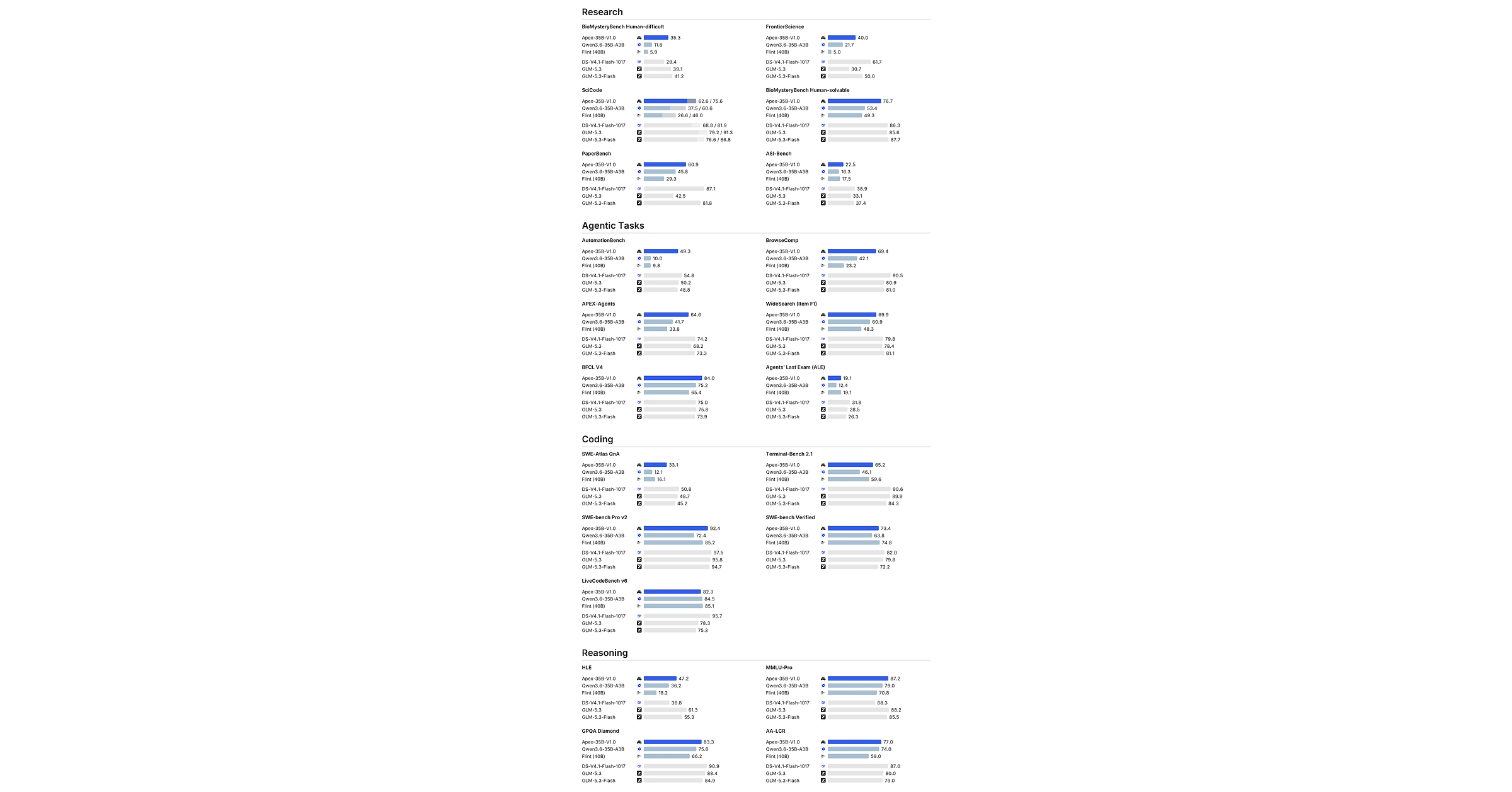
Apex Intelligence released Apex-35B-V1.0, a 35B general-purpose model developed with its automated Apex Research system; the company says it outperformed Qwen3.6-35B-A3B on 20 of 21 benchmarks and Recursive Flint (40B) on 18. Apex Intelligence reports a 32.1-point improvement on its internal CFD-Bench, 45–60% higher training throughput, 1.6–1.8x faster decoding and 30–35% lower time to first token under comparable workloads. Model weights, code and deployment materials are available on Hugging Face and GitHub; the company plans a larger model but has not provided release timing or further details.
Analysis
The investable signal is not the benchmark ranking; it is the possibility that automated data generation, experimentation and inference optimization lower the cost of producing useful open-weight models. If independently replicated, that could compress pricing power for proprietary model APIs and raise the competitive bar for labs that rely on human-led iteration. It may also expand total inference demand: lower cost per task can increase usage enough to offset reduced compute per task, so this is not straightforwardly bearish for accelerator or cloud demand.
Near term, impact is limited. Apex is private, and the reported benchmark and efficiency gains are company claims; weights being downloadable creates access, not proof of production adoption or durable advantage. The Qwen-based lineage also means the relevant competitive question is whether Apex’s additions generalize beyond its own evaluations—not whether its result displaces the broader model ecosystem.
Over 1–3 months, watch independent evaluations, licensing, reproducibility of deployment costs, and evidence of developer uptake. Over 6–18 months, a larger follow-on model and real scientific workflows could test whether automated research compounds capability or mainly improves benchmark-specific performance. A failed replication, restrictive licensing, weak adoption, or no measurable improvement in downstream research would falsify the disruption thesis. No immediate company-level trade is warranted from this release alone.
AllMind Terminal
AI-powered research, real-time alerts, and portfolio analytics for institutional investors.
Request TrialMarket Sentiment
Overall Sentiment
moderately positive
Sentiment Score
0.35
Key Decisions for Investors
- No directional position on the announcement. Apex is not identified as a listed issuer in the supplied data, and the release provides no independently verified commercial traction.
- Set an alert for third-party benchmark and inference-cost comparisons, plus licensing and hardware requirements. Treat reported efficiency gains as unverified until reproduced on comparable workloads.
- If independent testing shows materially lower-cost performance with real adoption, reassess exposure to businesses whose economics depend on premium-priced proprietary model access; do not assume this automatically weakens accelerator or cloud demand, since increased usage could offset lower compute per task.
- Use the planned larger-model release and evidence of repeatable scientific-workflow adoption as 6–18 month catalysts. A lack of independent replication or developer uptake would argue against the open-model disruption thesis.
More News
- Stocks slump, bonds leap as AI giants’ spending spooks investors
- Alphabet Erases $500 Billion as ChatGPT, Google AI Cut into Search
- Alphabet’s stock has worst day in over 20 years, dragging the S&P 500 to first loss in four days
- Taiwan Stocks Heads for Correction as Global AI Selloff Deepens
- Asia stocks tumble as AI spending concerns deepen; BOJ holds rates
- PC chip plunge wipes out a quarter of Intel’s value